
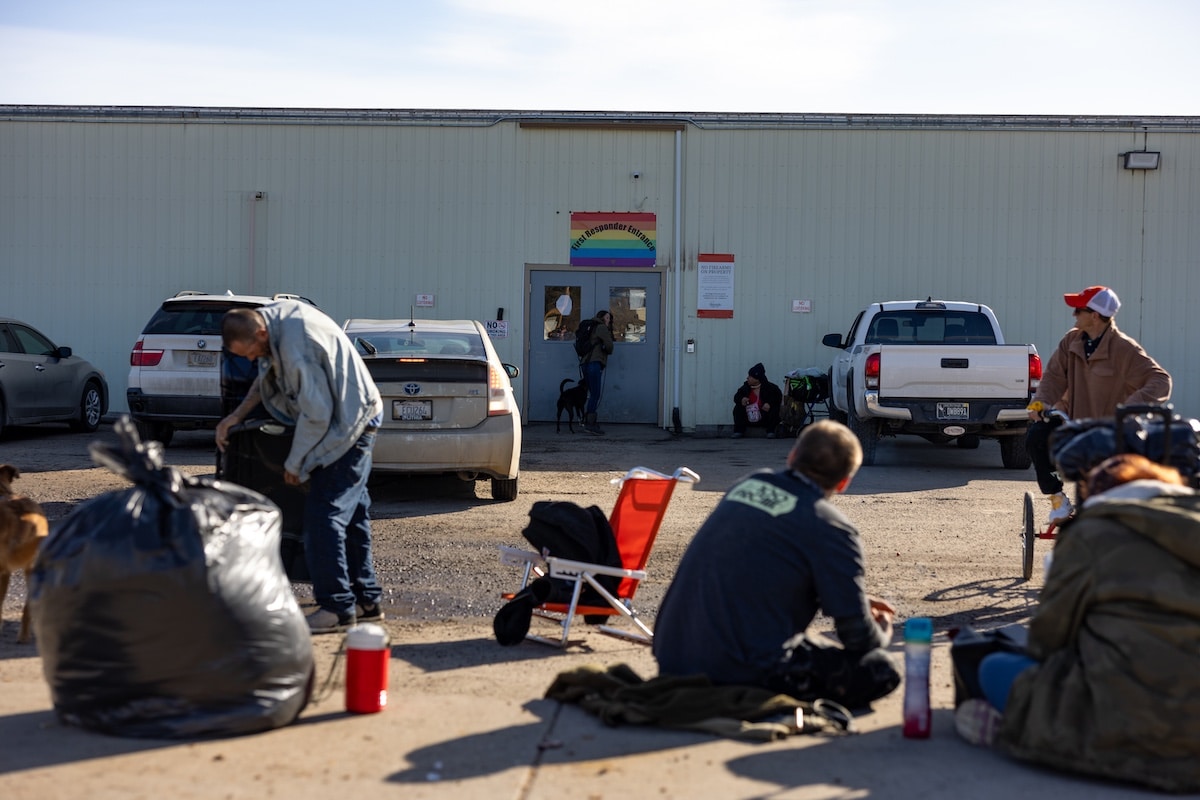
The city of Missoula and the Poverello Center will phase out use of the Johnson Street homeless shelter over the next several months, city officials said Friday.
Citing the termination of pandemic-era federal funding and related budgetary pressures, Mayor Andrea Davis said the city will begin reducing the number of people sleeping at the shelter in April, with the goal of cutting the shelter’s census by about 30 people a month until closing it in August. Johnson Street has slept between 150 and 165 people a night in recent weeks.
Davis said the city will endeavor to put as many of those people as possible in permanent housing, or at least connect them to family, transitional housing or a treatment facility. But the city seems to concede that closing Johnson Street may well result in at least some of Missoula’s most vulnerable people losing a place to sleep, if not in those exact words.
“I would say we’re realistic that 150 or 160 people are likely not going to find permanent housing by August,” Davis said at a press conference Friday.
Johnson Street, a shelter that’s owned by the city and operated by the Poverello Center, initially launched in 2020 as a temporary winter shelter and opened its doors year round in the fall of 2023 thanks to investment by both the city and county. According to the city, that expenditure was largely made possible by pandemic-era federal funds from the CARES and American Rescue Plan acts. But those dollars are no longer available, and Missoula — like many Montana cities, for reasons to be explained below — is operating in a perennial structural deficit. In other words, Davis said, the city can’t afford to fund the shelter, which costs about $1.8 million a year to operate, a bill the city splits with the county. The current batch of funding for the shelter runs out in August.
“I would say we’re realistic that 150 or 160 people are likely not going to find permanent housing by August.”
Davis said closing the shelter also aligns with the aims of the city’s new plan to address homelessness, which calls for “right-sizing” shelters while funneling people toward permanent housing and providing the resources to help make that possible.
“Right-sizing shelter does not necessarily mean we’re going to continue to build larger and larger congregate shelter,” Davis said. “It in fact means that we’re going to create the right size of shelter for our community because we’re focused on housing solutions for folks. At the end of the day, the solution to homelessness is housing. And that’s where I want to see the city put its resources.”
The announcement generated almost immediate blowback from councilmembers Daniel Carlino and Kristen Jordan, the body’s two most strident progressives and frequent critics of the city’s homelessness policy.
“We’re pulling the rug from under some of the most vulnerable people in our community,” councilmember Daniel Carlino told The Pulp. “We need more shelter space, not less. This is a lifeline for people.”
Indeed, the city is launching a “housing sprint” concurrent with the closure of the shelter designed to house as many people as possible in as short a time as possible. The sprint will include assistance with rental applications, identification, transportation, deposit payments and other hurdles to housing. Some people just might need money for a bus fare to stay with family in Great Falls. (Davis emphasized during the press conference Friday that this does not mean the city will be bussing homeless people out of town as a primary strategy).
The city launched a pilot “housing sprint” from November to January that will help inform the community’s next moves. But while deemed a success, the sprint only resulted in housing for 12 out of 15 homeless veterans that were identified as good candidates.
“We could get 80 people housed in a year if we were scrappy in our thinking,” Dylan Barbash, a staffer in the city’s community development department, said in a press release last month.
There are almost twice that many people regularly sleeping at Johnson Street. And they have less than half that time to find housing.
There are also fewer places to sleep outside than there were last year. In December, the city council voted to ban camping in city parks, effective at the beginning of 2025. Davis said Friday that the city will help those without any option but to sleep outside to do so “effectively” and in compliance with the new law, which does allow so-called urban camping on some city-owned land.

All that said, the city and service providers will also not be opening a designated camping site for those sleeping rough, something that is authorized under the recent camping ordinance but not feasible, today’s announcement stated.
The money for the housing sprint will live in the Housing Solutions Fund, a flexible repository of cash administered by the United Way of Missoula. Davis said the city wants to raise $400,000 for the sprint. (You can donate here).
But it’s not clear how much the city will be putting toward that effort. The city does not appear to be planning to spend the money it’s saving on Johnson Street directly on housing services. Davis said Friday she couldn’t quantify exactly how much the city could put in the fund.
“But we don’t have a lot of city funds, which is why we’re not keeping the shelter open,” she said. “So I’m gonna be asking other folks to help contribute to this fund.”
Missoula’s financial situation stems from a combination of inflation and state law that restricts the ability of local governments to raise and spend money.
Municipalities can only augment their budgets by increasing property taxes at a rate equivalent to a certain fraction of inflation. Beyond that, they need to ask the voters to approve levies. One problem there is that the law effectively pits those concerned about their property taxes — quite a lot of people, with Montana in the throes of a housing crisis — against those especially dependent on taxpayer-funded municipal services. And while in recent years Missoula voters tend to be more willing to approve levies than most, they notably rebuffed a 2022 crisis intervention levy that would have put $5 million a year toward addiction treatment and mental health care, services for the homeless and other related programs.
Additionally, lawmakers in Helena — especially Republicans — regularly blame city spending for rising property taxes, and have proposed legislation this session that would make it harder for levies to pass and give voters an opportunity to terminate them every decade. Those bills have been voted down, but that’s no guarantee their fundamental ideas won’t resurface later in the session.
Davis and other city officials said they regularly advocate at the state and federal level for more funding and services to help homeless people and other vulnerable populations. The state has a $1 billion budget surplus, after all. But “there seems to not be a lot of appetite to do that,” Davis said.
“It can be frustrating at the local level because the realities of situations that every other level of government are removed from, the local level just can’t ignore,” Nugent added. “It’s almost like an unfunded mandate, except they’re also putting handcuffs on the ability for us to generate revenue to fund it.”
“It can be frustrating at the local level because the realities of situations that every other level of government are removed from, the local level just can’t ignore.”
Councilmember Carlino told The Pulp that the city should be addressing its financial situation with the money it’s spending on police, private security, emergency medical care, legal services and other down-stream costs of homelessness, not cutting funding for the shelter.
Davis said Friday that this wouldn’t be possible.
“Every city I know, every mayor I talk to, and every city council I talk to, no matter how much money they put into shelter and housing, they are still managing what is happening on the street,” Davis told reporters. “So that’s a reality that we have to face as a city.”
Some business owners and other representatives of the private sector have already expressed interest in supporting the housing fund, Davis said. And she promised that the city would be able to start connecting the first batch of 30 people moved out of the shelter regardless of the philanthropic climate.
The neighborhood surrounding the shelter is a prime candidate for redevelopment. In 2023, the city council passed a resolution calling for deconstruction and development of the shelter site by the fall of 2026. The new growth plan the city adopted last year calls for dramatically increasing housing stock of all types in almost all areas of the city. In what might either be a promising evolution or cruel irony, depending on your perspective, there very well could be housing constructed on the site of the shelter.
The sunset of federal funds was no surprise to the city leaders. But Davis said the city didn’t fully understand the need to close the shelter until February, when it began developing a plan.

“It’s something we knew was going to happen,” Jill Bonny, the executive director of the Poverello, said at the press conference Friday. “Every year, we don’t know if we’re going to get another year. But we’re certainly appreciative of the past several years and the opportunity to provide shelter and we’re committed to helping and hopeful that we can help get people to better solutions. I mean, if 25 people get housed, that’s 25 people that get housed.”
The Poverello Center’s main facility on West Broadway sleeps 150 people, a limit sometimes increased during harsh weather. Bonny said she expects demand for beds at the center will increase with Johnson Street closing.
Expected or not, not all members of the council were on the same page about the move. Jordan in particular accused the city of making a “huge decision behind closed doors” in a statement to reporters. The decision to end funding for Johnson Street doesn’t require council approval, so there was no public hearing on the matter.
“A small, select representation of decision makers have quietly done this,” Jordan said. “As a result, there are city councilors whose constituents will be affected by this decision but who had no representation.”
Davis characterized that criticism as evidence of sour grapes rather than failed communication.
The council had the opportunity to weigh in on Johnson Street’s future when it adopted the redevelopment resolution, councilmember Mike Nugent, who ran against Davis for the mayorship in 2023 but has since endorsed her bid for re-election, told reporters Friday.
Carlino said the city’s planned housing sprint is a step in the right direction. But he worried that closing Johnson Street would only make homelessness in Missoula worse, not better.
“When people find themselves with nowhere to go, the J-Street is that option for them,” Carlino said. “There’s no other alternative.”


