If Bertha the moose could talk, well, the Foresters’ Ball at the University of Montana surely would have been canceled decades ago.
The mounted moose head—the antlered belle of the ball since she became the Forestry Club’s unofficial mascot nearly 100 years ago—has seen it all from her perch: the Foresters’ Ball’s make-out rooms in the 1960s, the debauchery that in the ’70s inspired Playboy magazine to rank it as one of the country’s best college parties, the binge drinking that prompted a recent UM president to threaten breathalyzer tests for all attendees.
But on the day before the 105th ball, held the first weekend of February, senior Jaiden Stansberry was busy preparing a different kind of event, one reflecting the realization that if the legendary party wasn’t contained, so to speak, the whole thing would burn down.
Wearing jeans, work boots and a well-loved red hard hat with peeling stickers that spelled out “Chief Push,” Stansberry knelt on the dusty floor of UM’s century-old Schreiber Gymnasium and explained her vision over the loud buzz of chainsaws.

Using a piece of cardboard, she sketched out how to construct one of several buildings that would transform the gym into a 1890s-era logging town, including a saloon and lookout tower.
As “Chief Push,” the student elected to coordinate the Foresters’ Ball, Stansberry joins a long line of UM Forestry standouts who have stewarded the annual party that celebrates the program.
Originally called the Lumberjack Dance, the Foresters’ Ball was first held in February 1916, and has occurred every year with the exception of two breaks: one during World War II, and the other due to the COVID-19 pandemic.
The event funds scholarships for forestry students and serves as a touch point for alumni, many of whom return to attend the ball and help to build the historic logging town each year. Students harvest almost all of the wood used for the event, trekking out to the university-owned Lubrecht Experimental Forest in fall and winter to collect lodgepole pine and douglas fir.
With over 100 years of history, the ball naturally has a long list of traditions, like a rivalry with the law school that involves stealing (and negotiating the return of) Bertha.
Other traditions, namely the ball’s reputation as a rowdy, drunken party, haven’t aged as well.
Ever since the particularly disastrous 95th Forester’s Ball in 2012, when 140 students were kicked out of the Adam’s Center, the Forestry Club (with help from university staff) has been trying to reshape the event in a way that highlights the best of the ball and leaves the party’s unseemly side behind.
Beth Dodson, a professor in the W.A. Franke College of Forestry and Conservation, took over as faculty advisor for the Forestry Club in the months leading up to the 95th ball—an event that will forever live in her memory.
“The 95th was when everything blew up,” Dodson said. Since then, she has counseled students to consider which traditions they want to carry forward. She often encourages them to watch a PBS documentary about UM’s Aber Day Kegger—a legendary off-campus party that started as a library fundraiser and eventually got out of control.
“They made the decision to end as opposed to evolve [that] event,” Dodson said. “So it’s kind of a good cautionary tale in the direction the ball could go.”

Back in the gym, Stansberry chatted with Eric Hoberg, a UM Forestry alum who graduated in 2006 and now runs a private consulting business. One benefit of working on the Foresters’ Ball is the chance to meet alumni who may be able to connect students with future jobs.
Hoberg, who also coaches the UM Woodsmen Team, a co-ed squad that competes in timber sports events, has helped to construct the Foresters’ Ball for years. “It’s the world’s largest tree fort,” Hoberg said as he tossed a measuring tape to a student across the gym.
When tasked with choosing which traditions to uphold this year, Stansberry elected to bring back those that she felt built a sense of community, like hosting a family-friendly open house at the gym and presenting goofy awards to students and faculty who helped her pull off the ball.
“I’ve always been drawn to sectors in my life that are super community oriented,” Stansberry said. “I think that’s why I like Forestry Club so much, ‘cause you get that same community feeling. People take care of you and you take care of them.”
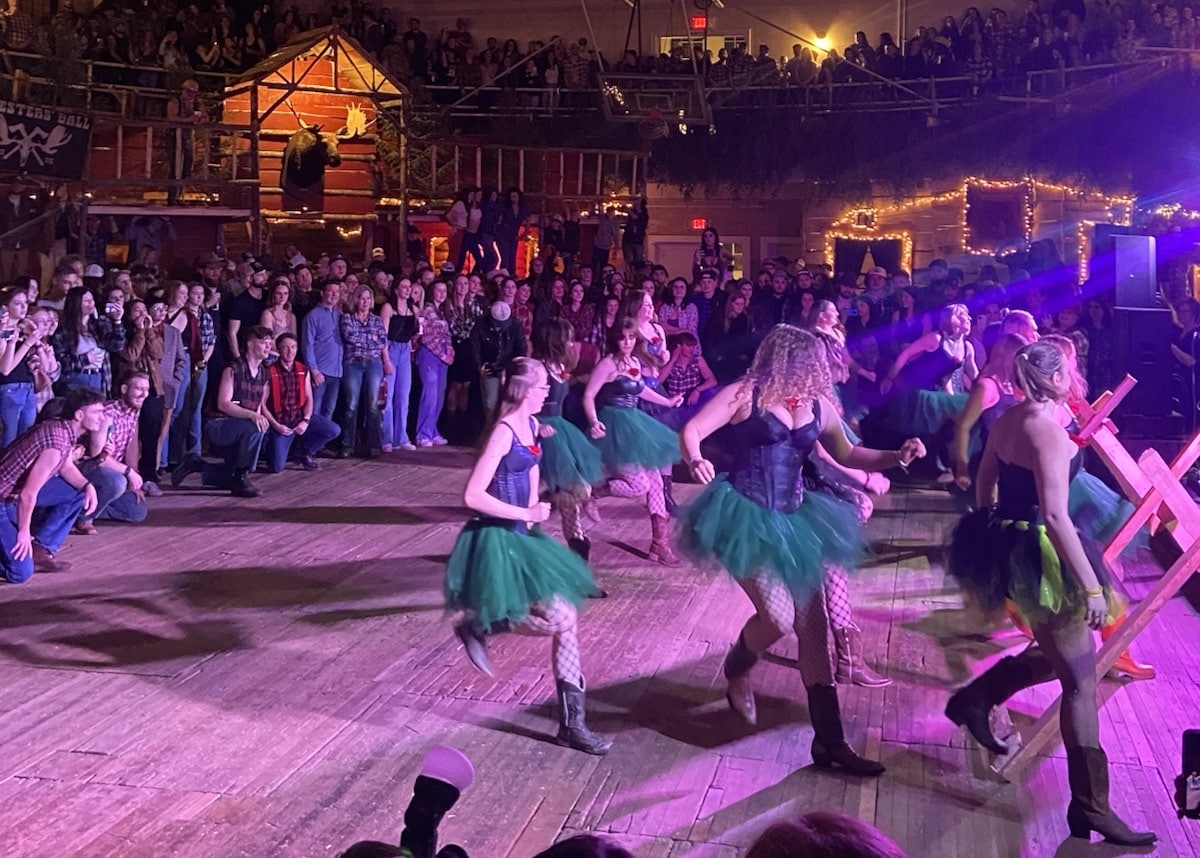
The first night of this year’s ball was a sea of flannel, jeans, and cowboy hats swinging around the dance floor, fueled by a live band playing country hits from Johnny Cash to Merle Haggard.
Patrons visited old-timey buildings like the jail, barber shop, chapel, and saloon, which offered free bottled water, peanuts and chili. A beer garden on the third floor balcony quickly filled with folks over 21, while security guards and a few police officers kept watch. Memorabilia and old photos lined the wooden walls of a makeshift museum, which included a poster of a flannel-clad man holding a small tree sapling that read, “Foresters: Our job is growing.”
An hour after Forestry Club members performed the can-can dance, a crowd favorite, Stansberry took to the stage to thank the audience and lead a rousing chorus of the foresters’ chant. Afterward, she found Hoberg, who told her that they had sold out both nights of the ball for the first time since the 95th.
By 11:30PM, Stansberry and her partner were one of few couples left on the dance floor. And just before midnight, the band eased into the soothing melody of “Goodnight Irene,” traditionally the final song of the ball. Students hiding in the balcony heard their cue and dropped handfuls of blue paper confetti, also known as “blue snow,” over the dance floor—a nod to mythical logger Paul Bunyan’s sidekick, Babe the Blue Ox.
Before retiring into the soggy February night, the remaining foresters yelled their chant one last time, then turned to face the moose head hanging over the saloon.
“All hail Bertha!”
Apart from a few boisterous whoops from the balcony, the event seemed—at least to this first-time attendee—pretty darn wholesome.