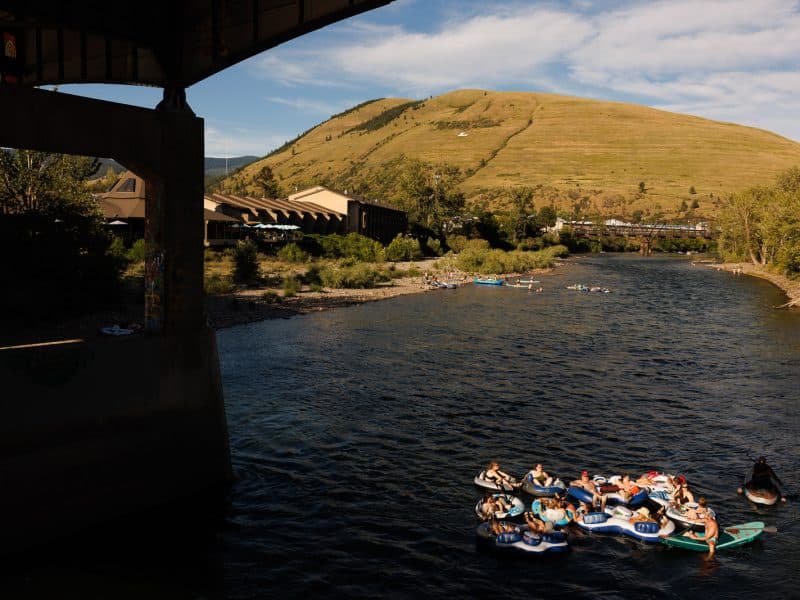
Few in Western Montana need reminding that the winters can be long, harsh, and sometimes lonely. It’s much easier to meet friends for a summer stroll along the Clark Fork. But in winter the hibernation instinct takes over. Even the idea of layering up for a walk around the block can be too much to stomach. But sometimes the cold and snow can bring out some unexpected fun. For instance: the upcoming Seeley Lake Biathlon.
Biathlons are races that combine Nordic skiing and competitive shooting. In case you’re out of touch with your inner Scandinavian, here’s how it works:
The length of the Seeley Lake Biathlon course varies by age and category, anywhere from 3K for kids to 22K for experienced adult competitors. Competitors ski a lap, then enter the range where they set aside their gloves and poles for a moment and take up a rifle. They have five shots to hit five targets. Every target missed equals one penalty lap. After shooting, each racer collects their gloves and poles and quickly skis any penalty laps they incurred on a special, short penalty loop before heading out for another big lap of the main course.
The more targets a racer misses, the more penalty laps, the longer their overall time. Over the course of the race, everyone visits the rifle range multiple times—twice, in Seeley Lake’s case (except for the 22K race where, in a new-to-Seeley twist, biathletes will visit the range four times). So the penalties can really add up. Some racers (including this first-timer last year) end up becoming very well-acquainted with the penalty loop.
The challenge, of course, is that sustained, difficult aerobic efforts (like skiing over hill and dale) and precise, fine motor skills (like shooting a 4.5” diameter target set 50 meters away) are contradictory. Competitive shooting requires calm hands and a steady heart rate, which is nearly impossible when you’ve just been skiing as fast as you can.
“It’s a sport that has two opposite things combined,” says Laurie Shammel, a longtime biathlete and one of the main organizers of the Seeley Lake event (her title is Technical Advisor and Helper). “You have to be fast to do the lap, then you have to slow down and become calm to do the range.”
It was this paradoxical aspect that got Shammel into biathlon.
“It was so cool,” she says. “It was a hoot. My favorite thing is seeing new people get to experience that.”
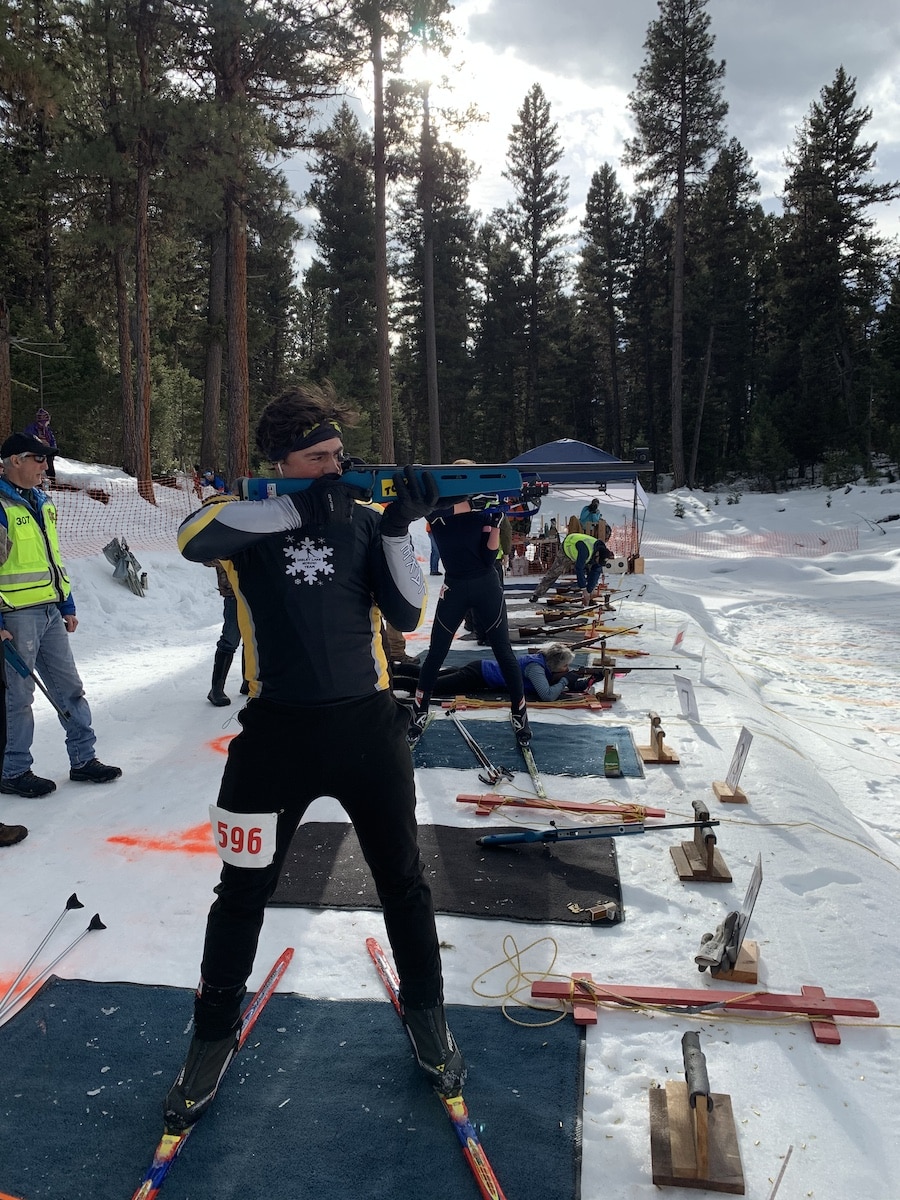
Since the biathlon is so niche, most events are principally for serious biathletes—folks on fancy skis carrying fancy rifles on their backs. The Seeley race is unusual in that the group that organizes it, the Seeley Lake Nordic Club, casts as wide a net as possible. Chris Lorentz, the race director, loves to see beginners and kids trying it out. He encourages as many kids as he can to attend, recruiting local elementary schoolers and even holding a special kids’ practice the day before the actual event.
“I really like seeing the joy on the kids’ faces,” Lorentz says. “They ski into the range, shoot, the crowd cheers, and you can see the grin on their face. It’s heartwarming.”
Shammel agrees.
“The kids’ event Friday is really, really fun and really, really worthwhile,” she says. It includes “kids who can barely ski one lap [a kilometer], but they borrow skis and complete additional laps [just] so they can shoot [again], and kids who can ski, who say, ‘OK, maybe it’ll be fun to try and shoot.’”
Lorentz was already a competitive marksman and member of the Wilderness Sportsmans Club of Seeley Lake when, in 2010, he decided to volunteer to help out on the biathlon’s gun range just to see what it was like. The next year he was promoted to director of shooting, and eventually he began running the whole shebang. The Seeley Lake Biathlon “is a labor of love,” he says. It even helped inspire his daughter to become a competitive shooter, through which she secured a college scholarship.
As you might imagine, a race involving newbies and skis and rifles requires an enormous number of safety measures, including volunteers everywhere onsite.
“The biggest chore is getting all the volunteers,” Lorentz says.
The range has 10 lanes for shooters and one safety officer per lane who handles everything rifle-related except the actual shooting. There are spotters to direct racers to the right lanes, plus scorekeepers and data entry people. There are course marshals scattered all over the woods keeping everyone on course. It’s a huge undertaking, and only possible because of a platoon of volunteers, although the Nordic Ski Club recently received a micro grant from Missoula County’s Rural Grant Program, which it used to correct the target platform height, widen the shooting lanes, and expand the safety berms around the range.
All of this community support allows Lorentz to offer an event unlike almost any other.
“Because it’s open to anybody,” he says. “People with no experience—who’ve never fired a rifle before—can come and do the basics.”
I happen to be just such a person. I grew up in a family militaristically devoted to nonviolent resistance, and I’m allergic to any kind of firearm. I’ve never hunted (which I neglected to mention when applying for Montana citizenship, so please don’t tell anyone). My first biathlon, last February, I was very nervous. Big, angry butterflies careered inside my stomach as I imagined disaster scenarios. What if I dropped the rifle? What if, on my way to a shooting lane, I accidentally skied over someone’s legs as they were trying to shoot? What if a bird swooped down in front of my target just as I took a shot and I became an involuntary hunter? (And would that get me extra points?)
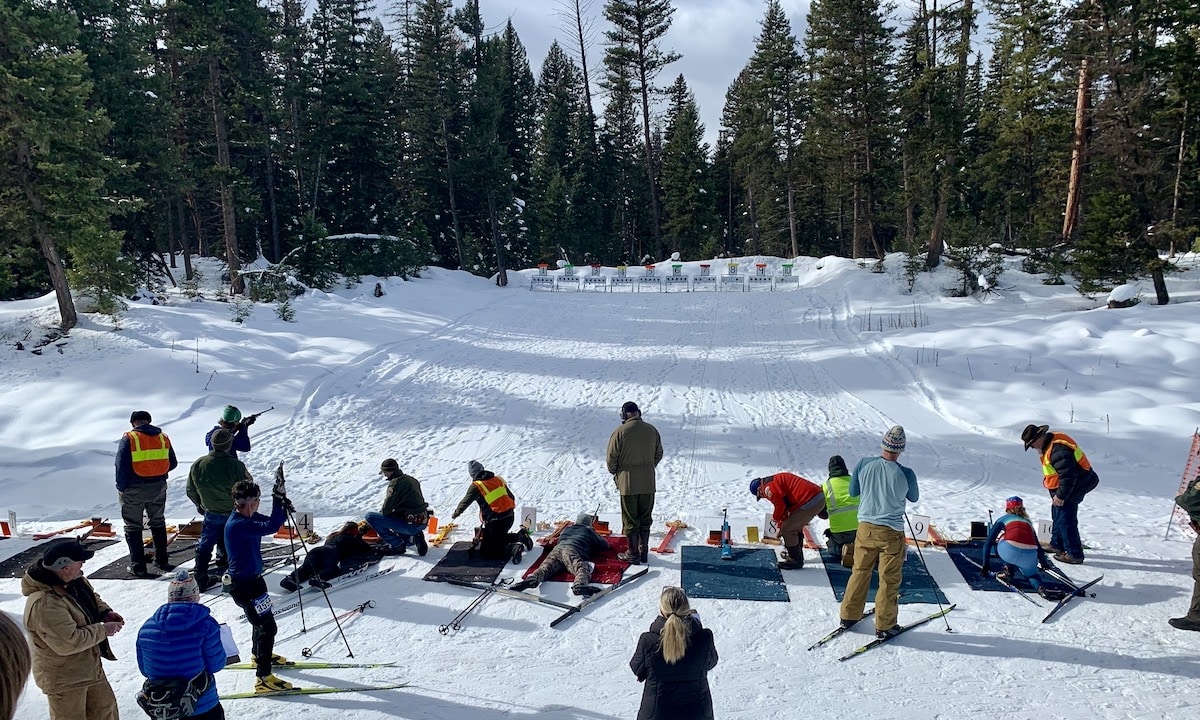
But my anxiety was unfounded. At the mandatory, pre-race safety briefing, Lorentz explained in clear, simple, friendly terms exactly how everything worked from start to finish. He introduced us to the rifle we’d be using, a .22 bolt action, and explained how the safety officers would help us into position (prone the first visit, standing the second), then hand us the rifle and five-bullet cartridge. We would shoot (extremely poorly, in my case), and hand the rifle back. After Lorentz finished his brief, we all went through the range twice to practice before the race started. Everything was so well-managed that the process unfolded seamlessly.
“The pre-race practice is imperative,” Lorentz says. “In a slow-motion setting, you do what you’ll do during the race.”
One thing I did not practice was skiing the penalty loop. During the race, I missed four of the five targets both times I was at the range, necessitating a purgatory of penalty laps before I could rejoin the race. The penalty loop itself is its own challenge: an oval with surprisingly tight corners at the top and bottom. At one point, while trying to navigate a corner I went over my own pole and face-planted, a yard sale of poles, snacks, gloves, sunglasses, and dignity. The penalty loop is right next to the food tent, a natural gathering spot, so my gaff was highly visible. To the spectators’ credit, no one pointed or laughed—that I noticed. I collected my stuff, finished my penalties, and skied back onto the main course for my next big lap.
Most importantly, I had a great time and I never felt unsafe.
For the Nordic ski club, Lorentz says, putting all the safety measures in place drastically increases the logistics, but it pays off. The crowd at the Seeley Lake Biathlon is unlike almost any other—experienced biathletes with their own special, funky rifles mix with hunters in jeans and Carhartt jackets. Hardcore Nordic skiers in snug tights chat with kids of all ages wearing a slew of new and borrowed gear.
“The Nordic ski crowd is completely different from the typical gun club crowd,” Lorentz says. “Philosophically, politically, the way they dress, the way they talk.”
But at Seeley they’re all thrown together, mingling and chatting with each other over post-race food and drinks.
“Everyone’s got a smile,” Lorentz notes. “If it’s not fun, then we’re doing something wrong.”
The Seeley Lake Biathlon takes place Feb. 3 at the Seeley Creek Nordic Ski Trails. For more race info, check out the event page. If you’re interested in volunteering, email Chris Lorentz directly at slnbiathlon@gmail.com.