Photos by John Stember
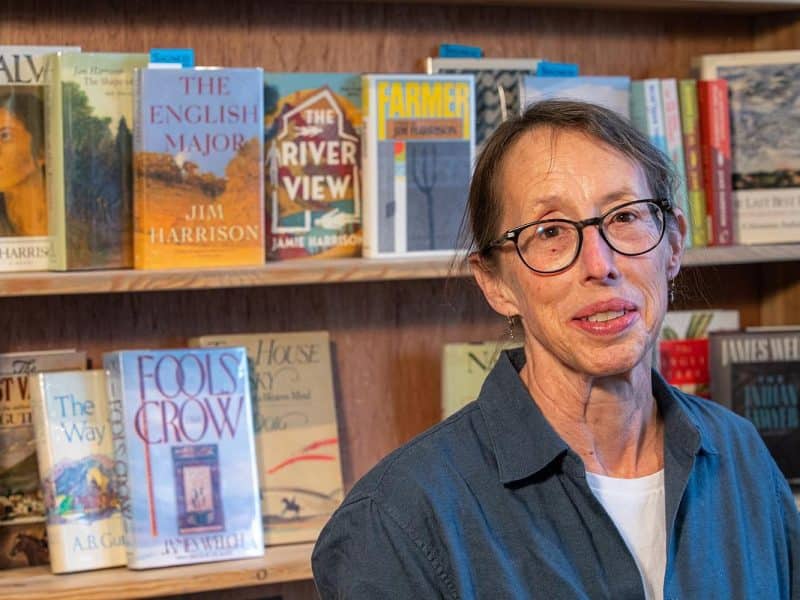
Poetry collections are called a lot of things, but rarely are they classified as “page turners.” But pick up Sheryl Noethe’s The Science of Coincidence — the fifth collection from the former Montana Poet Laureate — and you’ll find a book that demands to be read at a clip, just to see where the poet takes you next. These 87 pages move briskly from one mood, one perspective, one revelation, one scientific theory, one dark night of the soul, one joyful and intimate image to another. This push-and-pull creates an insistent momentum that carries you through the collection.
Noethe weaves a vast tapestry, taking a massive sweep of time and human experience into account and bringing it all to bear in often drastic — and expertly crafted — juxtapositions and correlations. What begins as a meditation on hotels (“What Applies to Hotel Rooms”) becomes a Trojan horse for discussing the Big Bang and the shape of the universe. In “Plague Year April 2020”, the actual Trojan horse appears as a gateway metaphor for the early days of the pandemic and the contagious suspicion of others, the pernicious “fear of invasion” —both pathogens and humans alike perceived as “barbarians at the gate”.
Noethe is not afraid to stare down the darkness of our times. She writes in “Jabber” that “Hell was prepared and waiting, even before humans existed.” Have we reached hell, then, with our creeping fascism, accelerating climate change, and consumptive capitalism (all elements at play in these poems)? Well, we are also, as Noethe writes earlier in the book, “syllables in the mouth of the Lord.” And, she declares in “Immaterial”, “There is no better life.” This is the world we have, she seems to say, the darkness and the light all at once, and we have built places in our minds to cope with this staggering simultaneity: “To make sense the brain will assemble cacophony, / Cohere from discordance, find a narrative / In the same way it interprets the universe.” In other words, it is the human imagination that may be our saving grace in the midst of a chaotic existence, and without it we may have little to hold us together.
“It’s the poets and philosophers that speak the truth and go up against the system. It’s hugely important. It comforts people, it connects people.” —Sheryl Noethe
Despite the heavy topics, The Science of Coincidence is no dour, furrow-browed slog. In Ars Poetica, Horace advised that poetry should “delight and instruct”, which Sheryl Noethe fully embodies here. For instance, take these lines from “Einstein Redux”, a charming vignette where the poem’s speaker and the famed physicist have a comic encounter: “In my astral form shivering at the pull of planets, / I am tempted by those black holes sucking daylight, / A roller coaster ride in the vacuum of a lightbulb. / Annoyed at my metaphors, he crosses his arms and glares. / He blinks. He waits. His eyebrows twitch like a pony’s.” And then there is this tender moment of magical realism from the book’s closing poem, “Rediscovery”: “A child in winter waves her hands; manipulates / Time until all the flowers blossom.” These are just two instances (out of many) of Noethe’s ability to temper the book’s darker themes with moments of levity, places for the reader to exhale before their breath catches again. It takes authority and audacity to consistently pull off such tonal leaps and manage to stick the landing every time.
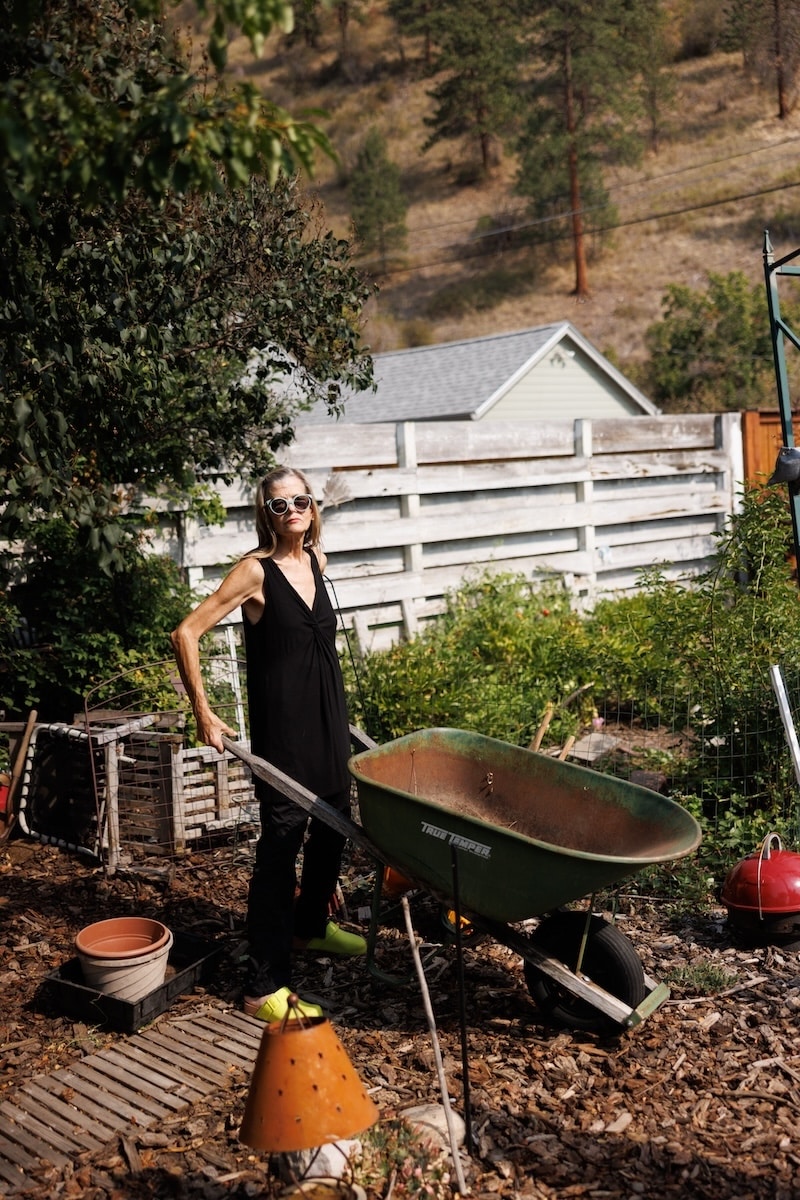
In addition to her masterful command of language and imagery, Noethe is also well known in Missoula – and across the state — as a passionate poetry educator, a role she’s been devoted to almost as long as she’s been dedicated to her own writing. In 1994, she founded the Missoula Writing Collaborative, a beloved local nonprofit that places writers in elementary school classrooms across Montana to teach kids creative writing skills and, through that, greater capacity for critical thought and language comprehension. To this day she remains one of the organization’s writers-in-residence and serves as their current artistic director. And, in 2007, she co-authored a distinguished teaching text, Poetry Everywhere: Teaching poetry writing in school and in the community, with the late poet/essayist Jack Collom.
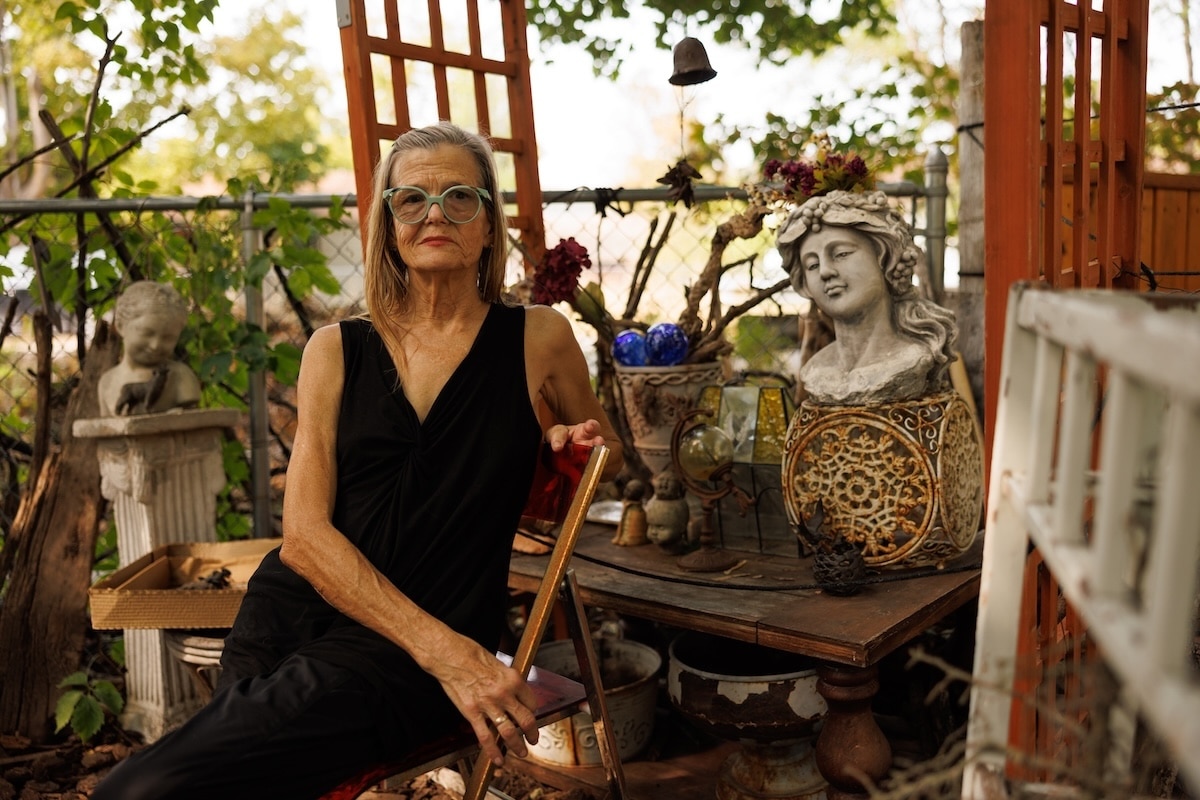
Noethe possesses a vibrating frequency that belies her 70 years, and a towering presence that contrasts with her small frame. She practically speaks in italics, exuding vitality with every sentence. We recently sat down at the Missoula Public Library — the perfect venue — to talk about her life in both writing and teaching, and how poetry can be a pathway to empowerment for people of any age and any walk of life.
This interview was edited for clarity and length.
In The Science of Coincidence, memory and the past are dealt with right alongside big concepts and myths. Do you see the cosmic or the unimaginable as ways into exploring personal depths? Or vice versa?
Time, memory, perception: it’s all in our imagination. That’s what really grabs me. We are imagining this universe in our heads. And, I recently read that the part of the brain that [houses] memory sits next to the part of the brain that [houses] imagination, but imagination is much bigger, it’s stronger. Where memory weakens, imagination steps right up.
Since you’ve devoted your life to it, what do you think poetry can do or be in the world?
It’s the poets and philosophers that speak the truth and go up against the system. It’s hugely important. It comforts people, it connects people. And then there’s that [wide-eyed gasp] at the last line of a poem or an image, where you are stunned, gob- smacked. I tell my students, “There’s poetry everywhere you go. Just look at that rock: does it have a soul? Does it move? Does it count time?” And we get to explore that kind of stuff.
You know, I’ve done writing workshops with business people, and grown-ups. They cry when they read their poem, because it’s been so long since anyone asked them, “What’s the last memory of your father?” They just don’t get asked those essential soul questions.
You’ve been at this a while.
Since fifth grade. I had a teacher who told me, “You’re gonna write books and travel the world.” That woman gave me a script that my family wasn’t capable of. I like to teach poor kids to be an artist, which is déclassé: You can travel among paupers and popes if you’re an artist.
How long have you been teaching?
I started teaching in Minnesota when I was 15 or 16, and then I moved to New York where Teachers & Writers Collaborative hired me and sent me into the South Bronx and Bed-Stuy and Harlem. And that’s where I discovered that children everywhere are the same: They’re good souls. But after five poverty-struck years in NYC, I had to get away. I got offered a job in Salmon, Idaho, teaching poetry in the schools, and I jumped on it. The first weekend in Salmon, I went out with a teacher to drink at Luke’s Club, which was a biker bar in Salmon, and I met my husband. It’s been 36 years now.
Did that earlier teaching inform how you wanted to run the Missoula Writing Collaborative?
Entirely. I based it on that model: community, compassion, connection. Freedom to say your truth — and, you know, that’s getting harder and harder to do. Like I said earlier, kids are all alike. They’re beautiful souls. Energy from the source.
Do you see your work as a poet connected with your work as a teacher?
Oh yeah. I have a lot of poems about children — about the awakening. I try to teach my students to be compassionate and kind and connect with each other, and that’s a huge part of poetry. And it turns kids around that don’t write — that are on the spectrum, kids that are bullied, kids that suffer at home — and they find a place to tell the truth. They can’t believe it when I say, “I don’t care about spelling, I don’t care about neatness, you just tell me your truth.” I had a teacher once say to me, “Why do you always have them write about death?” And I said, “No, I asked for a Christmas haiku. That’s what we got.” Because they’re waiting to tell somebody.