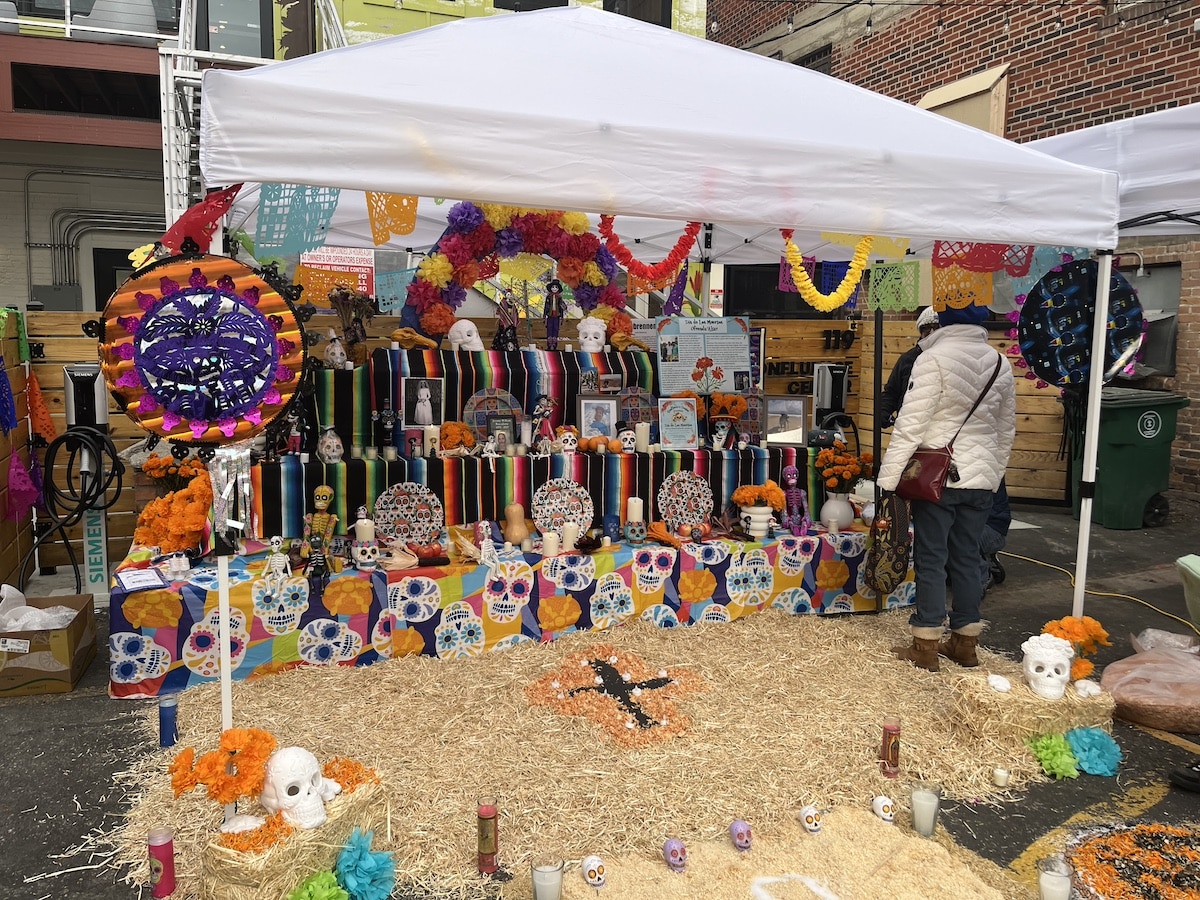
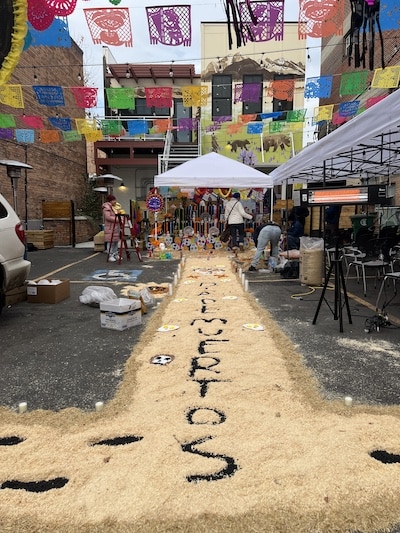
In the alleyway behind the Headwaters Foundation in downtown Missoula, a small parking lot is being transformed into a Día De Los Muertos ofrenda—or altar—meant to honor lost loved ones. The Perez family, originally from Michoacán, Mexico, direct volunteers assisting with the construction of what at first appears to be a stage with high steps. By the end of the day, the structure will become a vibrant display. Inside Headwaters, the family has gathered decorations, photographs, candles, flowers, and food they hope will make their deceased relatives feel welcome when they return from the spirit world.
For many Latinos like the Perezes, this is a time when family is at the forefront. Taking place on November 1 and 2, Día De Los Muertos commemorates the return of deceased loved ones and ancestors. The reunion is temporary, lasting only a day. At the center of the celebration is the ofrenda, meaning “offering,” on which families place photographs of their departed family members in their best years. Candles are set on the altar to light ancestors’ ways and their favorite foods are left to nourish them after their journeys. Brightly colored tissue paper cut in elaborate designs—known as papel picado—hangs above the gathering to indicate the return of the spirits of loved ones and to represent the fleeting nature of life.
Nelly Perez and her sons Ramón and Alex work excitedly, pleased, they say, to have been invited to share their knowledge and customs with a community not known for its diversity. As construction continues, brightly colored Mexican blankets are laid over the plywood structure and orange marigolds are placed amongst images of the Perez family’s departed relatives. While some of the pictures are black-and-white and show long-lost ancestors, others are more recent, like that of Jeremy William Roccaforte, who died this year. On the edge of the ofrenda, a framed photograph of a dog on a beach is propped up in front of plates decorated with Calaveras, or the ornately designed skeletons known as sugar skulls.
Although the building of ofrendas is a tradition of Latino communities, this is the first large-scale public display of the tradition Missoula has seen in recent years. Commissioned by the Headwaters Foundation, this year’s ofrenda grew out of the community conversation around Missoula’s resurrected Festival of the Dead.
Headwaters funds organizations that support health and well-being for children, family, and Native American communities. But beyond grantmaking, they also partner on projects like this one. According to Mynor Alejandro Veliz, Chief Financial Officer for the foundation, many Latino families were glad to have a place to practice their customs. That includes Veliz, himself. He says this is the first year he would get to celebrate Día De Los Muertos since he left his native Guatemala in 2001 to attend school in the U.S., and his excitement was hardly concealed.
People who are not of Latin American heritage often conflate Día De Los Muertos—whose roots predate Western colonialism—with Halloween, a tradition that hardly resembles the pagan celebration from which it started. Veliz says he’d been contacted by the committee responsible for reviving Missoula’s annual Festival of the Dead to ensure Missoula’s small, yet still present, Latino community felt respected.
“I don’t mind if you want to paint your face,” Veliz says, and the Perez family will be on-hand on Thursday for anyone interested in having their face painted with a customary Calavera. “If you want to paint it from a traditional perspective, if you learn about it and you feel really proud that you know about it and you feel proud sharing it, go for it. But if you think you’re painting it just to have a costume for Halloween, that’s when you’re crossing the line.”
This is a line that some in the Missoula community feel was crossed with the Festival of the Dead. Started 31 years ago as a way to normalize the grieving process, the celebration borrows from Día De Los Muertos traditions and iconography in a manner that some feel doesn’t respect the culture of the holiday. This includes Avianna Soto, former president of the University of Montana’s Latin Student Union and a 2020 DiverseU presenter. According to a November 2020 Montana Kaimin article, Soto was frustrated by the dearth of Latino voices on the festival’s leadership committee. Her views at the time mirrored those of Veliz, asking that anyone taking part in Día De Los Muertos festivities first educate themselves and recognize their own privilege.
This year’s return of the Festival of the Dead marks an attempt to address these concerns, with a committee led by local Mexican-Americans. The Festival of the Dead is considered a multicultural event, with an emphasis on educating the non-Hispanic community on the traditions. Some Missoulians still have reservations about the use of Latino culture in a city that is overwhelmingly white. Recalling a visitor to the Headwaters Foundation who was concerned they were taking advantage of the Perez family, Veliz was adamant. “I was like, no, they’re artists. And artists should be compensated for their time and their knowledge.”
As someone who’s experienced racism and the arduous task of attempting to assimilate into unwelcoming communities, Veliz says he welcomes discussions about how people are marking these celebrations and admits artists who have shared their culture have been treated unfairly. “I think that’s what we have experienced in the past. I was so excited that the person was asking that question.”
The ofrenda in the alley behind the foundation is a separate event from the Festival of the Dead. They wanted to create something “authentic” for those who participate in Día De Los Muertos traditions, but also help open the broader community to learning about underrepresented cultures.
Recently, Veliz invited Ramón and Alex to join him for UM’s homecoming parade and then later took them to a tailgate. Veliz described the brothers as being “blown away” by the custom, something he hopes Missoulians might experience when they visit the ofrenda the Perez family has built.
The Headwaters Foundation encourages community members to visit the ofrenda anytime between now and Saturday in the alley behind the Confluence Center at 119 West Main Street.