Two poets walk into a bar. If you know this town at all, you probably already know which bar. This is a Saturday afternoon in early fall, college football on the TV, off-duty Forest Service types yell-talking over the tops of their beers. The ghosts of bar flies past watch you from their portraits on the walls. The wood floors under your feet feel like they’ve been here a thousand years and are only getting stronger.
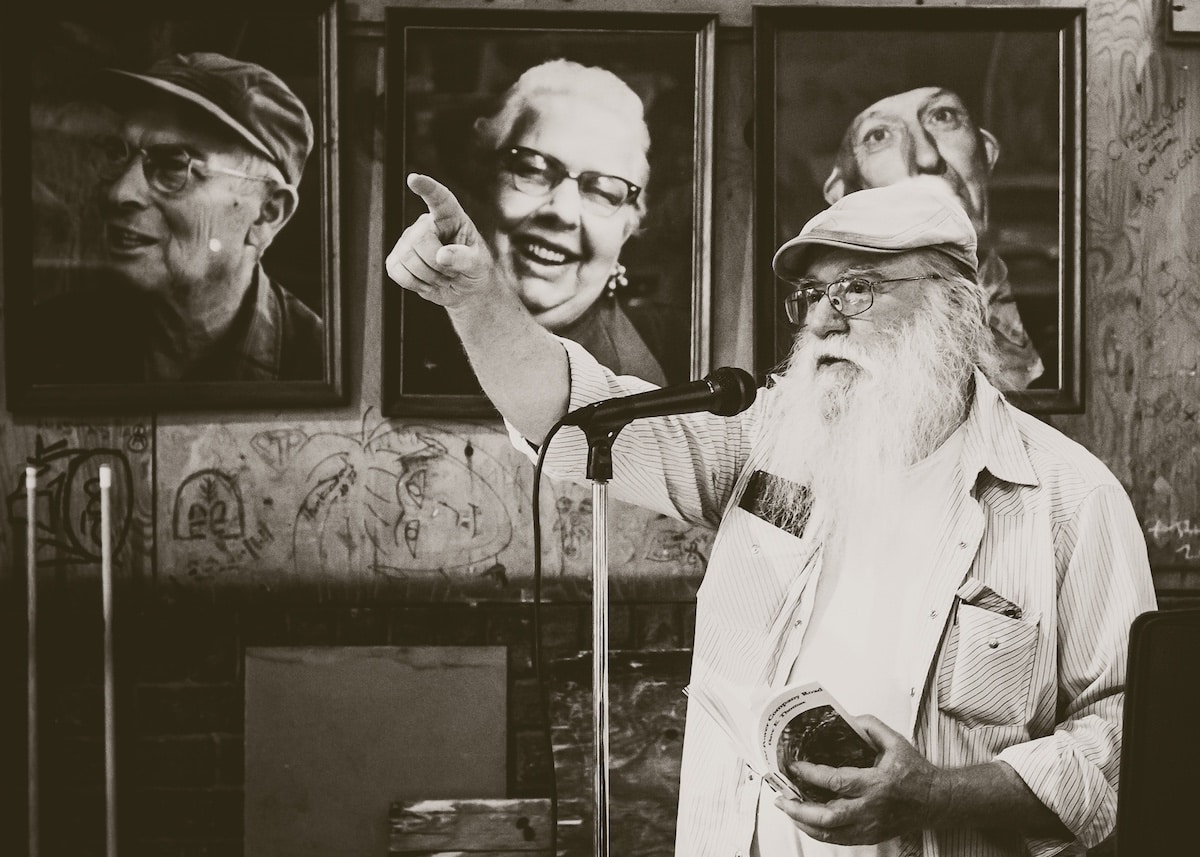
The Walking Poet moves slowly across that floor today, but he still moves. He’s been coming here longer than most of these people have been drawing breath. He was here back when it was Eddie’s Club and the people in those portraits were sitting on the next stool over, asking him when he was going to get serious and find a job.
Dave Thomas is the name his parents gave him up in Chinook in 1947. Now, at 77, his white beard dangles against his chest and he looks up at you with shy, kind eyes from beneath the brim of a flat cap.
Dave moves in short, stabbing steps, the telltale sign of a man whose back has given all it had to give. He worked on the railroads. He helped build the Libby Dam. He wouldn’t call it a career. It was just what he did for the money necessary to live and buy the occasional beer while saving the rest of his time for the important stuff like reading and writing. He isn’t sure who first started calling him The Walking Poet.
“I do like to walk,” he says. “Just my range isn’t what it used to be.”
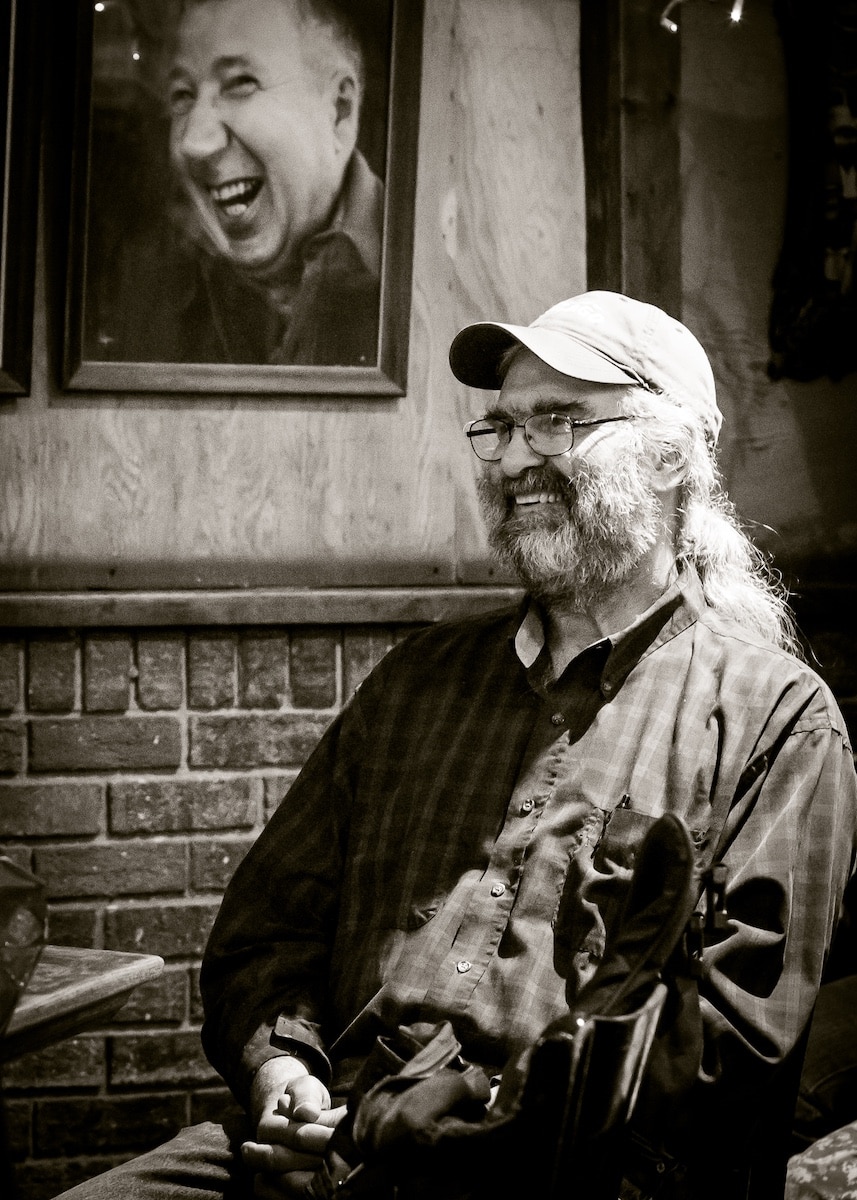
Today he’s here to meet his friend Mark Gibbons. Between the two of them you’ve got somewhere over a century’s worth of writing experience standing at the bar on these Saturday afternoons. You’ve also got well over a dozen books and more published poems than anyone cares to count — and they’re still writing. Mark was the poet laureate of Montana from 2021 to 2023. Both poets have new collections out from FootHills Publishing: Mark’s “Sister Buffalo” and Dave’s “Railroad Gravel: Selected Poems 1975-2022” — and the occasion will be marked by a reading at Montgomery Distillery.
Naturally, the people all around them shouting drink orders past their heads don’t seem to know or care that they’re sharing space with two elder statesmen of the local poetry scene, because that’s just the kind of town Missoula is. Poets populate the barstools. Painters pour the drinks. Maybe a sculptor swings by fresh from a roofing crew to buy a beer for his friend, the theater designer who’s just finished work at the coffee shop.
Mark is tall and lanky with a long gray ponytail stretching down his back. In his T-shirt and worn out jeans he doesn’t exactly look like anyone’s idea of a poet laureate, but truth be told he didn’t know what a poet laureate did until someone told him it meant he’d get to talk poetry with people from all over the state, at which point he was all for it.
“I’d been nominated for it a few times before,” he says. “I figured if I lived long enough, eventually they’d probably give it to me.”
“Sometimes I like to start with the weather,” says Dave.
You look at the day around you, its facts and impressions, then let that current carry you elsewhere. Later you can come back and tinker, revise and redraft.
“You just have to know when to leave it alone, otherwise you’ll fuck it up,” says Dave.
When Mark and Dave gather here they hoist a beer or two and talk about people they know, stories they’ve heard. Sometimes they even talk poetry — when it’s quiet enough. If you press them on the topic, you can get them to spill out a little knowledge on the two questions anyone confronts when sitting down to write a poem. The first of those questions deals with the how of it all.
And how do you know when you’ve hit that point?
“You only learn it by fucking a few of them up,” he says.
“You just have to know when to leave it alone, otherwise you’ll fuck it up.”
Mark sometimes likes to start with a memory. It doesn’t have to be a perfect or even terribly accurate one. In fact, it helps if you begin by making peace with the very real possibility that most of your memories have been filled in and reimagined into something new but no less true.
For instance, Mark has this poem called “I Believe I Remember Love.” It’s about being two years old in his family’s home in Alberton and watching his mother put some beef through a meat grinder. In his toddler’s mind it only made sense to reach up and plug the hole with his finger. That next crank was all metal on flesh and bone.
Before he knew it he was being whisked away to the hospital in Missoula, his index finger gushing blood into a dish towel, his father cursing as he took every curve at high speed. The finger was saved. He can show it to you now, slightly shorter than its counterpart on the other hand and with a gentle curve to the tip.
The poem ends with this memory from the late 1950s, being back home with a lemon sucker and a plaster cast on his finger, the center of a very specific type of attention.
I was the talk of the neighborhood,
the focus of the family. My first memory,
that trauma, was perfect drama. An audience brings
us joy. Our greatest happiness is

the belief we are loved. It’s what we live for,
what we desire most. We learn to tolerate
any pain, risk blood or breath, anything, if
we believe we are loved, right now, forever.
Now he’ll tell you that he’s not sure the lemon sucker was really lemon, or even if it existed at all. The dish towel he remembers bleeding into, he later learned it was a Kotex pad his mother grabbed on the way to the car. And that feeling after — sitting on the floor while wrapped in a certain species of care and attention — he wasn’t exactly aware of it at the time. That’s part of why he wrote the poem later. It’s a way of remembering and documenting, but also of explaining your own life to yourself.
That’s the other question you get into when you sit down to write a poem, is the why. That part can change depending on where you are in life, Dave says. When he started, it was just something he’d been doing in secret without knowing the how or the why.
“I didn’t think there was anything you could really do with poetry,” he says. “People didn’t have much use for it up on the Hi-Line.”

Then he came to Missoula and enrolled at the University of Montana. He’d wander away for chunks of time. He hopped a train to Seattle. He hitchhiked to San Francisco and spent a while sleeping on someone’s floor in the Haight-Ashbury neighborhood. But he always found his way back to Missoula. Eventually he decided to stay, if only to figure out what it was about this town that had such a hold on him.
Dave’s poem “The Ten Thousand Things” was chosen for inclusion in the classic 1990 book “The Last Best Place: A Montana Anthology.” It came from his time working on the Libby Dam, and begins with a list of the tools and fasteners and everything else — “shebolts, hebolts and stress rods” — found on the job. The poem diverges from this exhaustive list only briefly, yet powerfully:
There’s times when I wander
     about picking up
     and sorting bolts
there’s times when a chance glance
     at a star
     trying to outshine
     the lamps
is all the rest I get. It happens every night
     from 4:30 pm
     to 12:30 am
     at Libby Dam.
To have his work included in that anthology brought a little recognition.
“I won’t say it was a big break, but it was a break,” he says. “Some years [writing] works well and other years it doesn’t. It’s been hit or miss for, oh, the last 50 years or so.”
Much of Dave’s later work deals with the theme of loss. As he’s grown older, he says, it’s a fact of life he’s had to come to grips with more and more. Poetry is one way of doing that, a little bit at a time.
“It’s like Kerouac said, ‘I am made of loss. I accept loss forever.’ That’s just the way things are,” he says. “You witness things, life moving through you, meeting people and getting to know them, then they drift away and die. I think Alan Watts defined Buddhism as simply getting to know as many people as you can. It’s a process. I don’t worry about trying to explain it too much, because we can’t. But we are all in it together.”
That part — the being in it together — is a big part of the why for Mark, too. Unless you’re an idiot, you don’t start writing poetry because you think it’ll make you rich and famous. Even the few poets who do get a little bit famous never get rich. Just telling someone you’re a poet is a good way to make them wish that you would shut the fuck up in advance.
“I don’t have any agenda,” Mark says. “I don’t expect anything to last. But if something’s in print, it’s there. Someone can find it and maybe it speaks to them and lets them know they’re not entirely alone in the world. That’s the reason to publish, I think. Try to be fucking honest with yourself and write shit down and hopefully it’s true. Maybe somebody finds it, whether it’s five or 10 or 20 years later, and it’s true for them too.”
“I don’t expect anything to last. But if something’s in print, it’s there. Someone can find it and maybe it speaks to them and lets them know they’re not entirely alone in the world.”
What both men have always liked about Missoula is that it’s a place where a person can carve out a life around other people who care about the art of living and not just the grim necessities of it. A community of artists and arts can offer that. It also creates a place where it’s fairly unremarkable to find oneself sitting next to a poet laureate, but that’s part of the deal. These are some of the reasons Dave and Mark have always returned to this town, even though it hasn’t always been an easy place to make a living.
“I know people think that now,” Dave says, “but we thought it in the ’70s and ’80s too. And still it was a lively place to be and we loved it.”
Like the toddler on the floor with his finger in a cast, wrapped in a type of care that masquerades as worry, we go looking for something like community wherever we can find it. If a couple of poets can find it over a cold beer on a Saturday afternoon, why wouldn’t they keep coming back?
“Really, it’s all just forms of love,” Mark says. “That’s what you figure out eventually. What people run on, it’s either fear or love and you take your fucking pick. I’ll take love.”
David E. Thomas and Mark Gibbons read from their poetry collections, along with poets Sheryl Noethe and Marc Beaudin, at a FootHills Publishing event at the Montgomery Distillery on Sun., Oct. 13, from 3 to 5 p.m.