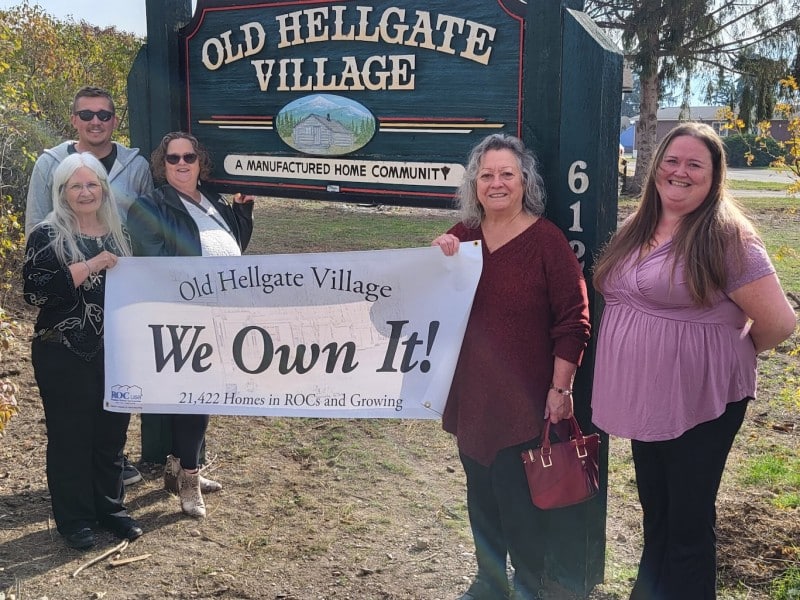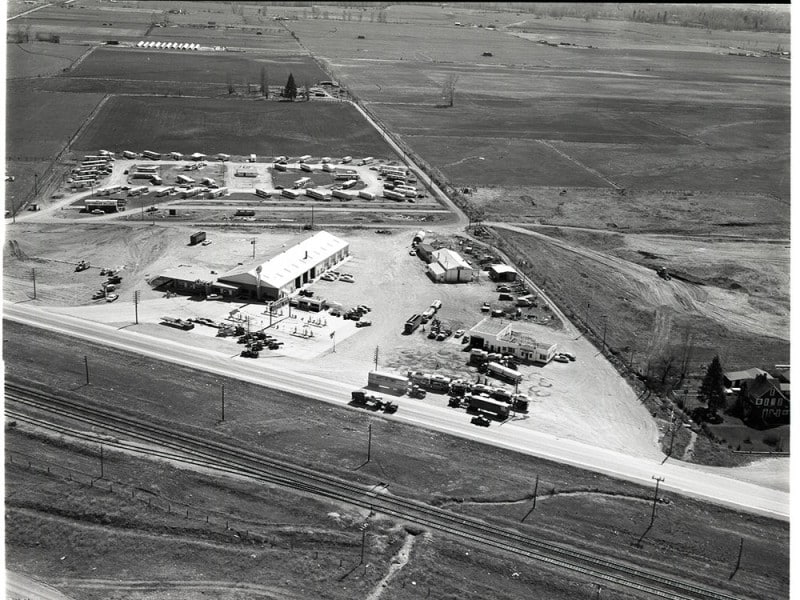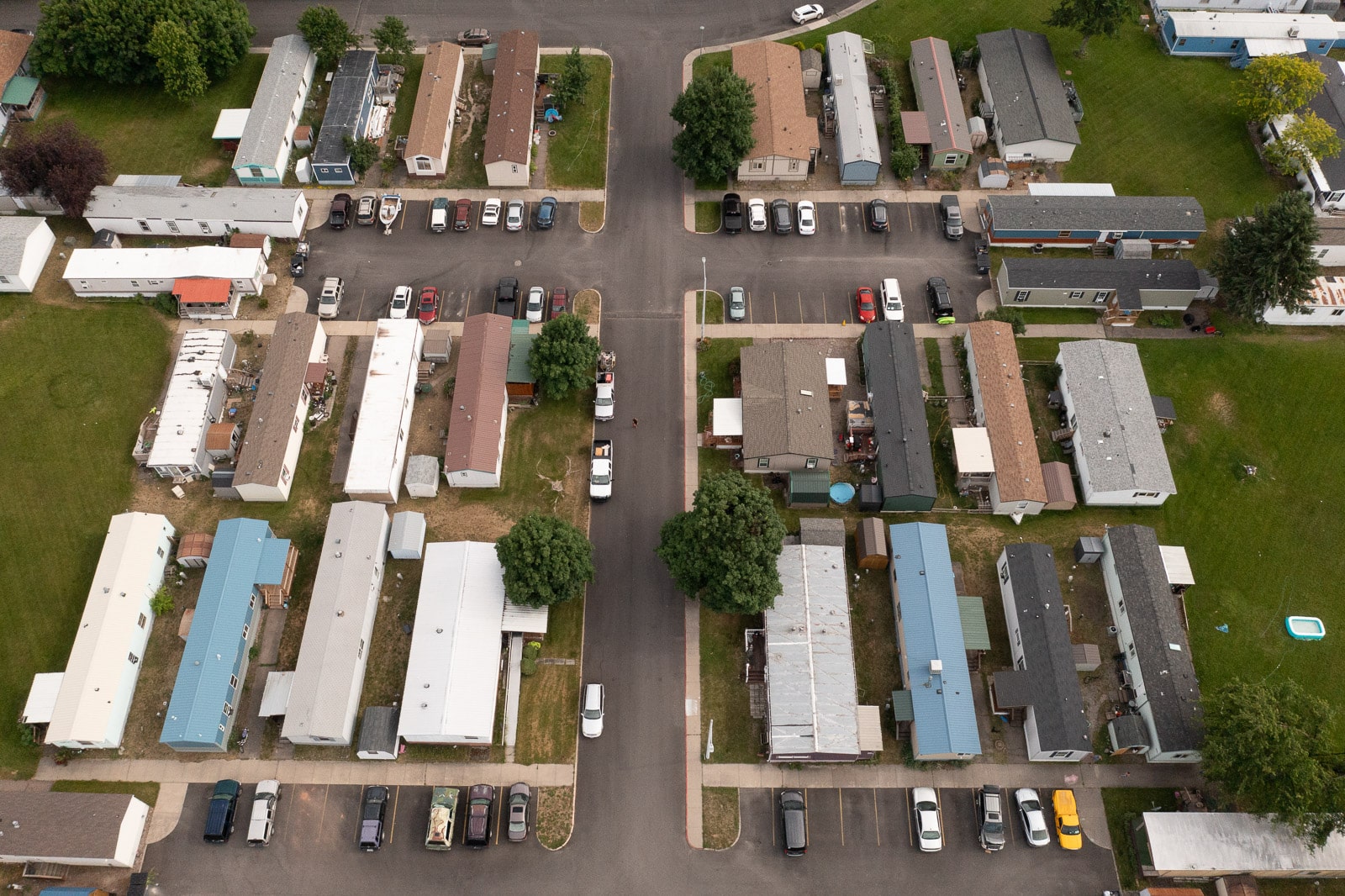
The reporting in this story is part of “Unsettled Ground,” a collaboration between The Pulp and a University of Montana history class taught by Leif Fredrickson, director of the Public History Program. Students’ research and oral history interviews informed Robert Chaney’s reporting and form the backbone of a digital history exhibit that is now live.
There is a class of things not built to last. Some are purely disposable, like paper plates. Others have a defined but limited purpose. A wedding dress rarely becomes a party frock.
Some things start out temporary yet wind up permanent. The school annex that never goes away. The shortcut across the park that gets so packed, grass will never grow again. The mobile home on a (hopefully) permanent foundation.
In Missoula, the mobile home stitches curious threads in the community fabric. They appear throughout the city’s history like reconnaissance scouts exploring the fringes of popularity. A century ago, before the Rattlesnake Valley became a popular (and expensive) neighborhood, it fostered the city’s first “auto-park” for traveling — and sometimes settling — campers. As today’s affordable housing crunch grinds on, out-of-state investors have been buying up Missoula’s mobile home parks and squeezing them for rent, while the redevelopment market considers the land itself for “higher and better use.” And when longtime Missoulians rally to fight out-of-state financiers, the tenants unions have consistently sprung up around the barbecue pits of mobile home parks.
“Montana has long had an exceptionally high percentage of mobile homes compared to the rest of the country, and Missoula County has had a high number of homes and parks compared with the rest of the state,“ said Leif Fredrickson, director of the Public History program at the University of Montana and leader of a student project examining the city’s trailer parks. “It’s a pretty big silence in the public history space. There are plaques for various historic homes around Missoula. There are no plaques for mobile homes.”
Such black holes in the archives tend to hide some of the thorniest bits of a community’s timeline. City governments, including Missoula, spent much of the 20th century stigmatizing mobile homes through zoning laws, financing patterns and public scorn. Multi-lot mobile home parks not only had to locate on the fringe of city limits, they usually had to be screened from view by fences and hedges. Individuals who chose a mobile home as their starter residence typically clustered around the former lumber mill sites now covered by Southgate Mall, Polley Square and the Milltown-Bonner area.
Mobile homes were seen as a temporary stepping stone to a more permanent American dream, inhabited by up-and-coming new families. Nevertheless, the old reputation of disreputable trailer trash never washed away.
For example, East Missoula’s Montana Avenue is made up of dozens of individual mobile homes mixed with occasional stick-built houses. It differs from places like Travois Village, a nearly 300-residence community with a traffic gate at the main entrance, walls around the perimeter and little connection to the surrounding industrial zone of West Broadway.
But there can be intense identity within those distinctive clusters. Consider Richard Fifield, the self-proclaimed mayor of “Least Missoula.”
“I’m the most house-proud bitch in East Missoula,” Fifield declared as he showed off the floor-to-ceiling art project that is his 2005 Mountain View mobile home. “This house and property has been the love of my life, and has also changed me. I ain’t fucking leaving.”
But Fifield often feels both his house and his community have other plans. Five years ago, a crack appeared in the middle of his living room. Despite numerous repair attempts, it has exposed Fifield’s interior to black mold, stopped his doors and windows from sealing properly, and so weakened the structure of the home, it would probably break in two if he tried to move it.
“I bought this mobile home brand-new, and now it’s worth less than a meth lab,” Fifield said.


Mobile home owners face a property conundrum stick-house owners would never accept. Their trailers are taxed both as a motor vehicle and as residential property, in addition to taxes on the lot. He said Montana state tax appraisers consider his damaged mobile home to be a house worth $100,000 and the lot it sits on is worth $200,000. He figures the building he lives in is worth $8,000. He’s been fighting with the state Property Tax Board of Appeals and losing.
Fifield served on the East Missoula Community Council for three years, and also as a Democratic Party precinct chairman. He also tries to “do the rogue things,” like organize a community vaccination clinic disguised as an art fair. In the process, he’s been consistently frustrated by how trailer home communities remain invisible in the public conversation.
That invisibility reaches into the most basic statistics of community life. The U.S. Census American Community Survey estimates East Missoula has 2,094 people in 2026.
“Census-wise, they’re fucking with us,” Fifield says. He estimates 3,200 people actually live in the neighborhood, when all the couch-surfers, street-campers, and other homeless people are added in.
“The problem isn’t mobile homes. It’s poverty. It’s lack of representation.”
Fifield grew up in Troy, Montana, living in a 1967 Fleetwood trailer. The town at the time had about 900 people, which supported a local police station, several churches, bars, a post office and a grocery store. East Missoula has lost its post office and grocery store, has no community center, closed its public Jumbo Elementary School and relies on the main city for public safety protection.
“With all of our tax base, how come we don’t have any of that?” he asked. “The county uses open space bond money to buy Marshall Mountain, to make Sha-Ron improvements, and then everybody drives through East Missoula and hammers the roads,” he said. Missoula County received and used federal grants to upgrade the airport and rebuild Russell Street, but lost a $24 million grant to fix a dangerous railroad overpass leading into East Missoula.
“The problem isn’t mobile homes,” Fifield said. “It’s poverty. It’s lack of representation. How are they supposed to go to our food bank to see how people are struggling when we don’t have a fucking food bank? How are they supposed to meet other young mothers at church? Good luck with that. You cannot build a community without some sort of common place.”
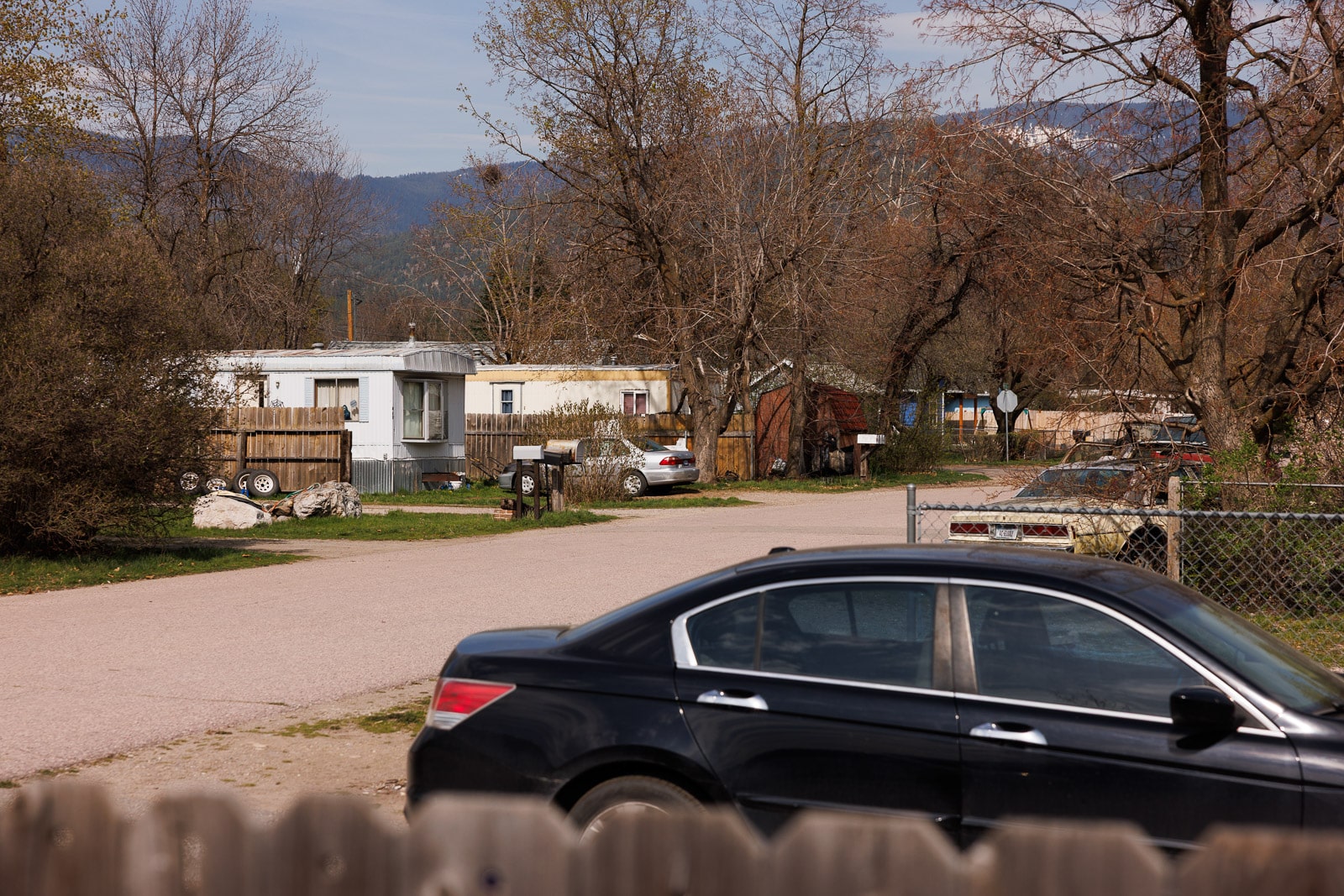
Mobile homes and poverty have been linked since 20th-century trailer living entered the historical record. Despite an economy and society that prized movement and new beginnings, American property rights culture has had a persistent problem with wheels.
University of Colorado-Boulder history professor Phoebe Young traces that long dual history in her book “Camping Grounds: Public Nature in American Life from the Civil War to the Occupy Movement.” Whether you left the city pursuing a sense of adventure or pursued by rent collectors, a trailer was home away from home.
“Auto-camps could both exemplify a vision of democracy and a deep gulf between experiences,” Young wrote. “For leisure campers with an increasing focus on ‘how to motor camp without hoboism,’ owning equipment designed only for use in occasional recreation made a notable impression.”
That included marketing campaigns that both advised “don’t make the mistake of cutting down on too much equipment,” and offered “cost-conscious models promoted as paying for themselves in savings made from rent.”
“Auto-camps and trailer parks also had to combat negative images of harboring not just itinerants and migrants, but radicals and criminals,” Young wrote. Hotel owners would disparage the competition, even as city fringes with available space became popular roadside markets drawing business away from downtown. FBI Director J. Edgar Hoover fulminated against them in magazine essays with titles like “Camps of Crime – Behind many alluring road signs are dens of vice and corruption.”
Ironically, Hoover suggested that “honest” camp operators change their brand from “camp” to “court,” “as the better type of proprietors often prefer that their places be called.” As the 1930s wore on, Young noted that public records showed many auto-camps actually had few tent or temporary sites compared to the much larger proportion of “small wayside bungalows.”
Zoning rules in place in the 1970s required individual mobile homes to have at least five-acre lots and 50-foot setbacks from any other residence. At the same time, stick-built single-family homes could be packed 16 to the acre.
Fredrickson’s oral history students also plowed into the text archives to trace beginnings of Missoula’s mobile home concentrations. Missoula Auto Park on Wylie Avenue in the Rattlesnake Valley appears in the city’s Polk Directory — the historical registries of residents and businesses — in 1925, although other references mention a business in that location serving as many as 100 car campers a night in 1920. At the time, the mix of vacation travelers and semi-permanent campers was rather fluid.
The Garden City Auto Camp is recorded in 1929 on 1001 East Broadway, where East Gate Shopping Center now stands. By then at least five additional “auto camps” had also opened, offering electricity and laundry facilities to tourists. That number jumps to 14 by 1945.
The Great Depression of the 1930s shoved millions of Americans into mobile living, as the Dust Bowl climate disruption ruined farm towns and bankruptcies sent laborers on a hunt for new opportunities. The end of World War II flushed a different kind of surge into the housing market: millions of military veterans with new families and big ambitions. In Missoula, that translated into enrollment boosts at then-Montana State University, along with a housing crunch.
Part of the solution rolled out of Hanford, Washington, which was briefly the fourth-largest city in the state when the Manhattan Project turned it into a nuclear bomb production center. For a few years, it had a population of 52,000 people. By 1948, practically the entire community was erased. One load of trailer homes from Hanford was sent to Missoula, where they became student housing on the university campus.
At the same time, a post-war industrial boom turned work camps into semi-permanent towns with projects like Hungry Horse Dam and Colstrip. Those places needed housing fast, and caravans of mobile homes answered the demand.
Changes in the “mobile” part of mobile homes played a big role in their acceptance. Although trailer homes were gaining increased popularity through the 1950s, federal highway regulations limited them to widths of eight feet. A law change in 1963 allowed loads of 12 or 14 feet wide.


Between the years 1962 and 1972, mobile home production rose 500 percent. Production hit almost 650,000 trailers in the peak year of 1972 – almost 30 percent of all new residential construction that year.
Time magazine predicted “by 1980 … 10 percent or more of all Americans will be living in mobile homes.” That was an overshoot. In 2026, about 22 million Americans live in mobile homes, or 6.4 percent. Even so, a UM study by Zoe Ann Stoltz found that 79 percent of Missoula County’s new housing in the decade 1982-1992 was manufactured housing.
Those boom towns grew on the basis of good wages and steady work (until the dam was finished, anyway). Mobile homes were seen as a temporary stepping stone to a more permanent American dream, inhabited by up-and-coming new families. Nevertheless, the old reputation of disreputable trailer trash never washed away.
University of Montana student James Edgecomb worked at the Missoula Planning Office on county zoning for three years before seeking a master’s degree in urban planning. In his thesis paper, he reported that San Francisco has the United States’ earliest version of land use zoning, starting in the late 1800s.
“Zoning was not motivated by the need to protect property rights but rather by the desire to exclude ethnic minorities,” Edgecomb wrote. It’s not until 1913 that New York City starts developing zoning codes based on property rights. And although those codes generally separated single-family homes from industrial zones and apartment complexes, mobile homes apparently were as welcome as Asians under the 1882 Chinese Exclusion Act.
“With the initial use of house trailers and the later forms of mobile homes, regulatory agencies either prohibited their use or forced them into areas where no one else wanted to live,” Edgecomb continued. “In comparison to conventional housing, this type of housing was viewed as unattractive and unsafe, and property owners feared depreciation of their land values. Further, the exile of mobile homes to industrial or commercial areas continued to foster their negative image.”
But Missoula planners kept with the national trend of discouraging mobile homes. Zoning rules in place in the 1970s required individual mobile homes to have at least five-acre lots and 50-foot setbacks from any other residence. At the same time, stick-built single-family homes could be packed 16 to the acre.
The rules [at Travois Village] included a ban on vegetable gardens, no commercial baby-sitting (therefore no daycare), and “a requirement that children pick up their toys immediately after use.”
Mobile home parks had their own special zone, but they had a maximum density of seven dwellings per acre. The discrepancy can be seen today as you fly into Missoula and notice the roomy lot sizes of Westview Park trailer park on the east end of Wheeler Drive with the compressed standalone homes of Potter Park Loop.
In 1982, the Montana Supreme Court held in Martz v. Butte-Silver Bow Government that zoning less than one percent of municipal land for mobile home parks was an unconstitutional ban on that kind of housing. Edgecomb went to work at the planning office shortly after, and for those years “was able to experience first hand the problems of people who wanted to live in manufactured housing. These people were often frustrated by the regulations which tended to exclude them from the majority of the urban single-family neighborhoods.”
While driving around Missoula researching this story, the gremlin algorithms of an online music service served up Ashley McBryde’s “Brenda Put Your Bra On.”
“It’s just getting’ good/Shit’s goin’ down in the trailer-hood”
Sensing an interest, the speakers pumped out another 20 minutes of mayhem in the mobile home court. Cowboy Junkies sang “Murder in the trailer park/Pack your things Anne Marie, we’re heading west/We’re going to make a fresh start.” Jackson Dean praised a home “Like a castle up on 12-inch block/And pride underneath the paint.” Jimmy Buffett, (who also gave us “Livingston Saturday Night”) proclaimed “The sea’s in my veins, my tradition remains/I’m just glad I don’t live in a trailer.”
That image collapses in a visit to Travois Village off Palmer Street in the West Broadway industrial park. Surrounded by warehouses, railroad yards, car dealerships and other worksites needing lots of elbowroom, Travois Village sits almost invisible behind fences and hedges. Its entrance is guarded by a keypad-locked gate. Inside, almost 300 trailer homes in concentric rings surround a park with picnic tables, barbecue grills and playground equipment.
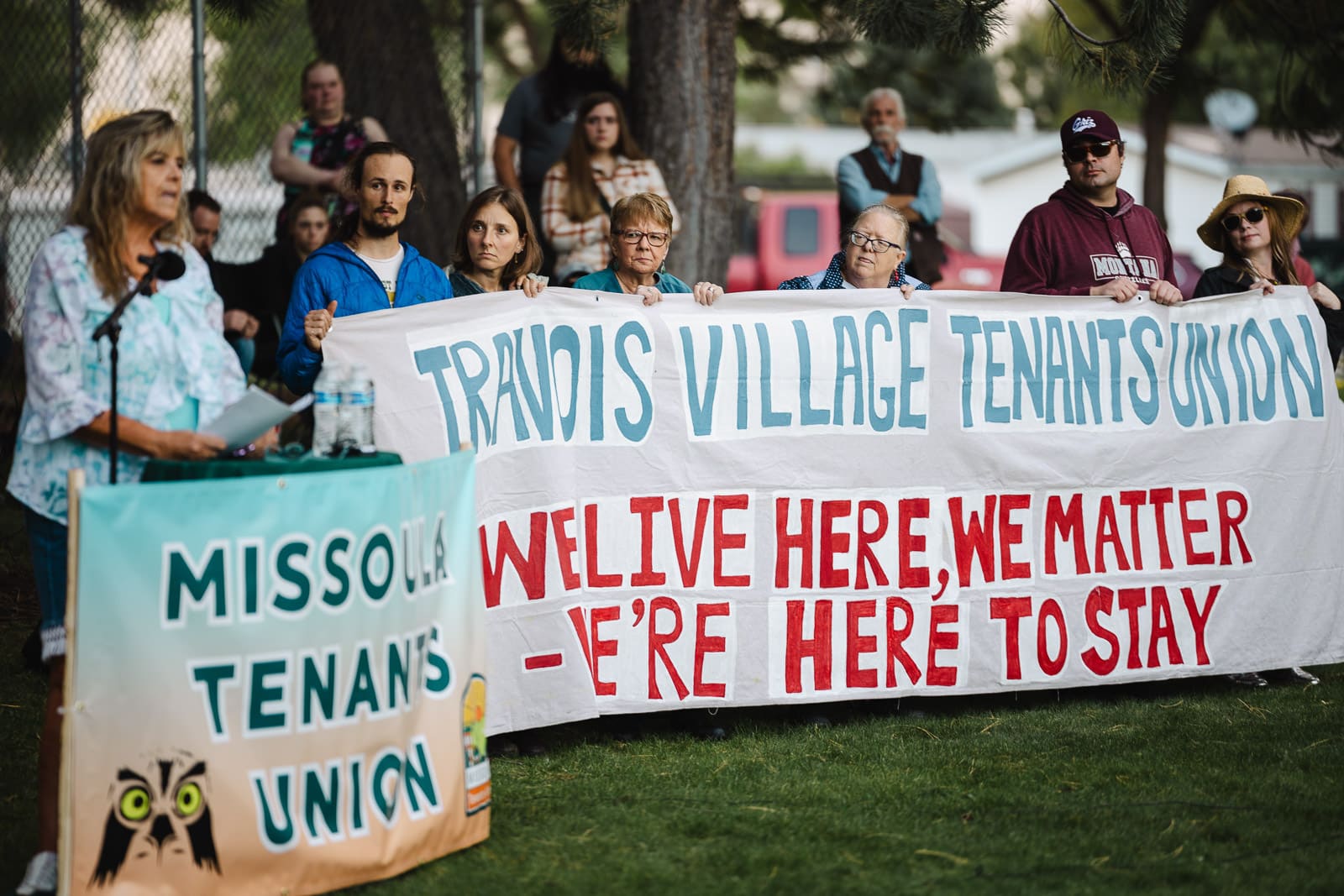
Another irony of that stigma has been the recent interest in mobile home properties as a financial gold mine. Many of Missoula’s trailer parks were locally owned for generations until the 1990s. That’s when the property investment firm Moore Enterprises of Mission Viejo, California, bought three mobile home parks in 1991, including Travois Village. Residents received an 11-page list of rules for allowable activities in the park, according to Fredrickson’s student Iliana Capozzoli, who was a Travois Village resident. The rules included a ban on vegetable gardens, no commercial babysitting (therefore no daycare), and “a requirement that children pick up their toys immediately after use.” The no-garden rule particularly hit six Hmong families, who were prolific gardeners.
After initial protests, a new rule came down stating “No person, whether a resident, invitee or other outsider shall … engage in hand billing, pamphleting, leafleting, picketing, political activity, or fundraising without management approval.”
Residents responded this was a direct violation of First Amendment rights.
Title transfers kept coming. Between 2017 and 2026, Missoula’s Juniper Court, Target Range, Hollywood Court, El-Mar Park, Harvey’s Park and Travois Village all changed ownership among out-of-state investors. A Missoulian investigation by reporter David Erickson found out-of-state private equity companies owned at least 30 manufactured home communities containing more than 3,900 residences in 2026. Almost 1,000 of those are in Missoula.
The ownership changes typically presage big rent increases. Katoonah Lodge residents paid $500 a month for their lots in 2024. After a new owner bought the land, rent rose to $750 a month, with notices it was soon to hit $1,000 or $1,100 as reported in the Missoulian. Residents there formed a tenants union in March. They were the sixth such chapter to organize with assistance from the Missoula Tenants Union.
Travois Village residents have also faced rising costs. Last April, the park was filled with residents waiting to hear how the latest struggle with their out-of-state landlord had resolved.
“We’ve accomplished our goal – we’ve got a face-to-face meeting,” Kathy Kelly, a Travois Village resident for 23 years, yelled into a megaphone to about 100 of her fellow tenants union members. The tenants union negotiators had secured seven commitments from OakWood (the company that acquired it in 2023), including an acknowledgment of the union’s right to be at the table and residents’ freedom from retaliation if they joined it. But most of the rest of the planks had less-certain wording: “commitments to seeking” a capped 3 percent rent increase and “consideration of a two-year lease option.” The final language wouldn’t be known until the new leases were released in September.
The rent fights feel existential for many mobile home residents. Assuming their home is in good structural shape, estimates range between $3,500 and $15,000 to move one to a new lot. That assumes a new lot is findable, and doesn’t face the same economic squeeze as the previous one.
“The prevalence of mobile homes in the housing stock peaked around 1990 in Missoula and has declined in the area and the nation since, but Missoula remains a place with a lot of mobile homes and mobile home parks,” Fredrickson said. “Missoula County currently has 161 licensed mobile home parks, an incredibly high number that is only partly the result of categorizing two or more mobile homes together as a park. MHVillage.com, the major commercial directory for mobile home parks, lists 50 in and around Missoula, which is significantly higher than most other cities its size.”
Back in East Missoula, Richard Fifield recalled how growing up in Troy’s tight-knit community of mobile homes was a comfortable time, but one made fragile by the constant churn surrounding temporary housing.
“Knowing who you are and where you’re from is so important for a kid,” Fifield said, adding that one of his childhood homes where his pet dog was buried has been scraped and replaced with a church.
“What do roots mean?” he asked. “What does foundation mean? My whole life would be different if I had a foundation – my trailer wouldn’t have sunk into a pit.”