Every chair in the Missoula County Public Schools board meeting room was filled Tuesday evening with dozens of community members showing up to support Pride flags in classrooms.
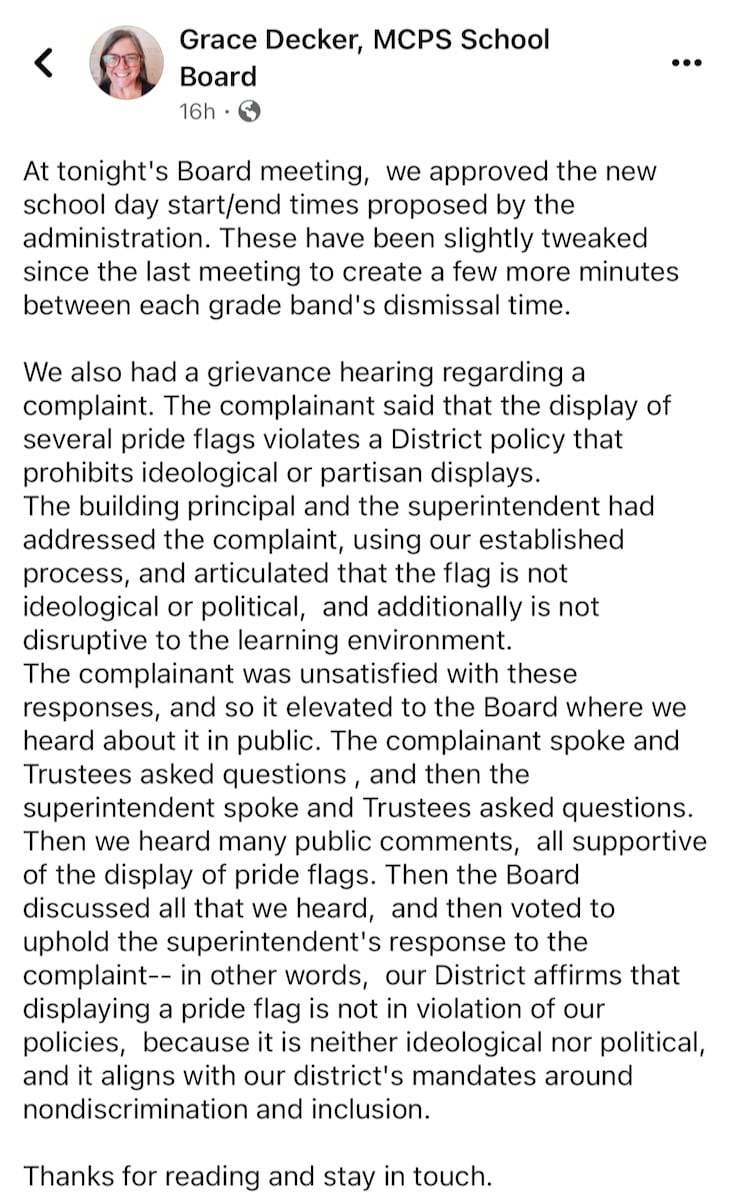
After about two hours of discussion and often emotional public comment, the Board of Trustees upheld the administration’s decision to deny a grievance arguing that Pride flags in two Sentinel High School classrooms violated policy.
Most of the board members, as well as nearly two dozen public commenters, stated the Pride flag is not ideological nor partisan, but rather a symbol of inclusivity.
“There are differences of opinion in our community around this,” said Trustee Grace Decker. “What is clear is what our policies say already about nondiscrimination, what our mandate is around inclusion and what a Pride flag represents, which is not an organization, a political viewpoint, and not really an opinion, but a welcome to all.”
In response to Nate Kalkofen’s initial complaint, Sentinel High School Principal Stephanie Thennis wrote in a December email that the flags were permitted as symbols of inclusivity and diversity and are not political statements, according to meeting agenda documents.
Following district procedure, Kalkofen, a Lolo resident and a former member of the Lolo School District Board of Trustees, brought his complaint to Superintendent Micah Hill, stating Thennis’ decision was flawed because “social liberalism is a political philosophy, therefore flying a flag that promotes a tenet of said political philosophy is inherently a political statement.”
Unless or until the policy is changed, Kalkofen asked the district to remove all ideological or partisan flags, messages or posters from school buildings regardless of their meaning.
During Hill’s investigation of the complaint, he met with administrative staff and teachers, toured Sentinel and consulted legal counsel, he told Kalkofen in a December email. On Feb. 11, Hill denied Kalkofen’s grievance, stating he determined displaying the Pride flag in a classroom or elsewhere on the school district’s campus doesn’t violate policy.
“Displaying the Pride flag in a classroom isn’t a teacher teaching about Pride flags. It is merely meant to be a representative symbol in buildings and the community that you are safe here.”
The policy aims to protect academic freedom by giving teachers the ability “to teach and conduct inquiry without fear of sanction or reprisals should they present an unpopular or controversial idea.”
“Displaying a Pride flag hardly qualifies as ‘teaching,’” Hill wrote to Kalkofen, “but to your point that staff must ‘refrain from using one’s classroom position to promote one’s own ideology or any partisan point of view,’ I contend (having talked with the staff member) that the display of the flag is neither political nor ideological.”
Since the board doesn’t have any policy regarding display of flags, banning only the Pride flag would be considered viewpoint discrimination, Hill said. It may also violate the First Amendment, as schools can only restrict speech that causes a substantial disruption, he wrote.
In Kalkofen’s reply sent Feb. 12, he agreed that banning any particular flag would likely violate the First Amendment and clarified he is not requesting a specific ban on Pride flags.
Kalkofen appealed Hill’s decision, bringing it to Tuesday’s board meeting, where he presented his complaint to the trustees. Kalkofen asked for either a change in policy or a “policing action” to remove any flags or messaging promoting an ideology or partisan view, regardless of meaning or affiliation.
“It doesn’t matter what the ideology is—these are examples in classrooms,” Kalkofen said. “I’m bringing this to you, saying your policy is being violated. It’s up to you to change the language.”
Board members questioned Kalkofen’s categorization of the Pride flag as presenting an ideological or partisan viewpoint. Trustees and Kalkofen went back and forth about what counts as an ideology.
Hill told the board he didn’t find any examples of Sentinel classrooms showing a partisan point of view. Kalkofen’s effort to find a violation based on one sentence from the larger policy seems “obscure,” Hill said.
“Displaying the Pride flag in a classroom isn’t a teacher teaching about Pride flags,” he said. “It is merely meant to be a representative symbol in buildings and the community that you are safe here. … What I want is students to be able to come into a place free from those kinds of biases, challenges.”
Elizabeth Kaleva, legal counsel for the district, said policy—as well as state and federal law—prohibits discrimination based on sexual orientation. Inclusion is not an ideology, but a mandate from state and federal government, she said.
Kalkofen agreed that inclusion is “absolutely critical” for everyone, but he maintained that trustees are missing the point.
“In regards to having what is a sign of ideology or partisan point of view hanging on a classroom wall, it’s irrelevant what that is, period,” he said. “Again, should the board choose to do nothing, that’s fine, but that allows everything.”
Kaleva clarified that the board has discretion to interpret its policies, including whether the Pride flag is an ideology and violates policy.
Nearly two dozen commenters—a handful sporting Pride flags or other clothing with messages of LGBTQ+ support—spoke in favor of Hill’s decision to deny the grievance.
Hellgate High School student Solen Duwell-Le Bihan said she has friends who don’t feel safe at home and look for support elsewhere.
“Teachers displaying Pride flags is one of the simplest ways to demonstrate they are an accepting, safe individual to be around,” she said.
Duwell-Le Bihan asked the board to “think twice before taking away our source of acceptance.”
Parent Jesse Jaeger said while people’s sexual orientation and gender identity are not a political stance, we live in a state where those identities are being constantly politicized. In that context, pride flags are “like islands of care and support for our LGBTQ kiddos,” he said.
Missoula student Max Berndt, who is non-binary, said seeing Pride flags in classrooms affirms they belong in the academic world despite many saying otherwise.
“Pride in and of itself is not political. Pride is a celebration of safety,” Berndt said. “Teachers have been fundamental in my success and the rapport I have with them has stemmed from … the safety I feel seeing supportive actions like Pride flags in classrooms.”
Resident Carolyne Whelan said growing up queer, she was depressed and confused, something no child would choose, especially because of a flag.
“Queerness is not an ideology, it’s just who people are,” she said. “It’s a fact of being, a part of humanity and showing pride literally can save lives. It didn’t even dawn on me until one of the earlier speakers brought up the idea of what impact it would have on those students to take that away.”
Following public comment, most board members said they didn’t find Kalkofen’s points “compelling” and don’t believe he proved it violated policy.
“Teachers displaying Pride flags is one of the simplest ways to demonstrate they are an accepting, safe individual to be around.”
Board Chair Wilena Old Person said flags show representation but are not an ideology, giving the example of the Blackfeet Nation flag hanging in the meeting room.
“I’m not forcing Blackfeet culture onto you but that’s my flag,” she said. “That symbolism is not an ideology at all.”
Trustee Jennifer Vogel said she agreed with Kalkofen that the Pride flag is an ideological symbol.
“I do not feel that a teacher needs to display a flag to communicate their love for a student,” she said. “Walking into a classroom that has a Pride flag doesn’t automatically mean when they cross that threshold now they’re safe.”
Trustee Grace Decker said the testimony from students and former students of what the flag communicates to them weigh more strongly than the perspective of a teacher in that scenario.
In regards to Kalkofen’s earlier comments that the decision to allow Pride flags allows “everything,” Decker said the policy by design allows the board to handle expression on a case-by-case basis, “because ideology is not always clear or viewed the same way.”
“Moving through a lens of thoughtful reflection and engagement with the folks in the buildings, it becomes much more clear whether something is ideologically motivated or not,” Decker said.
Trustee Rob Woelich suggested the policy language may need clarification, as this grievance shows definitions of ideology vary.
The board voted 7-1 to uphold Hill’s denial of the grievance, with Vogel opposed.