Editor’s note: This story first appeared in The Pulp’s fall print edition. It was reported at the start of the season. Hellgate went on to reach the state championship game for the second straight year, losing to crosstown rival Big Sky, 21-7, on Oct. 8.
It’s a little before 8 a.m., the tail end of summer, that first bite of fall sneaking into the morning air as the girls from the Hellgate High School flag football team start warming up by tossing the old pigskin around.
The mood is light. The muscles are sore. They’ve got a Bluetooth speaker sitting in the grass playing Chappell Roan and Kendrick Lamar and you can hear it all the way down the river trail.
They’re nearing the end of two-a-days, that grueling summer ritual all football players know and dread. Every day the same thing: Wake up, head to the practice field, go home long enough to rest and rehydrate, then right back at it in the evening. For bodies unaccustomed to using those stop-and-start football muscles, it’s a shock and a grind, which is kind of the point.
The boys’ team won’t make it out to their practice field on the other half of Toole Park for another hour yet. But the Hellgate girls’ squad, now in its second year of existence, is already getting to work. The fact that most of them never played any form of football before joining this team barely seems to matter.
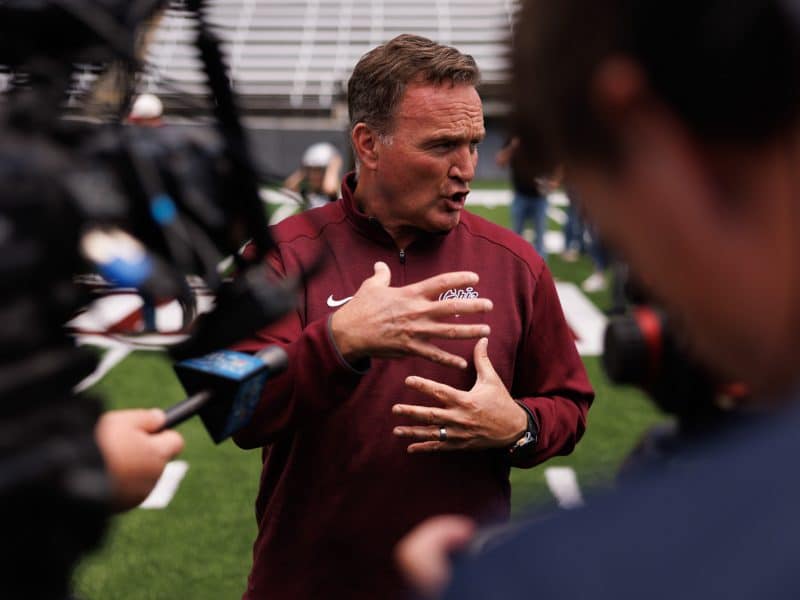
“When we were first starting practices I remember stopping at one point and asking, ‘Who here knows what a down is?’” says Tyler Gilman, the Knights’ second-year head coach. “Only a few hands went up. That’s when I realized, OK, we need to sort of begin at the beginning here.”
You don’t have to reach back very far to find the beginning of girls’ flag football in Montana. The first season was barely one, with only three schools fielding teams in 2022. By the 2025 season, that number had grown to 27. This year, 39 high schools across Montana offer girls’ flag football, with the Montana High School Association (MHSA) designating it an “emerging sport.”
“We’ve really worked hard to create an atmosphere where everyone’s lifting each other up all the time. We know that the only way we can succeed as a team is if everyone acts like a team.”
This growth isn’t limited to the Treasure State. The Arthur M. Blank Family Foundation, in partnership with the NFL’s Atlanta Falcons (which Blank is the majority owner of), has worked to aggressively grow this seven-on-seven, non-contact version of the sport, hosting camps in Montana and elsewhere to promote the game. Some of that is likely a financial calculation. A 2023 Siena poll found that 72 percent of Americans consider themselves football fans, with men accounting for the bulk of the fanbase. If leagues like the NFL want to add fans — and they do, as evidenced by their increasing international outreach, even when it means putting up with the grumbling of teams forced to make long flights to play in Australia or Brazil — it makes sense to focus on adding more women to the viewing audience.
But there’s also a cultural element at work. While America may be football crazy, it’s also waking up to some of the physical risks associated with the game. The sport has grown more sensitive to brain health concerns at all levels in recent years. Even the NFL has managed to cut down on some of the head-knocking, while also adding mandatory concussion protocols that weren’t even on the radar a couple decades ago.
Still, some parents remain wary about putting their kids on the gridiron. Over the last 18 years, 37 states have seen a dip in the number of kids playing high school football. Montana is one of those states, with a 37 percent decline in high school football participation between 2008 and 2024, according to the National Federation of State High School Associations.
It’s possible that girls’ flag football could be a safer alternative to help counter that drop. The sport would seem to be well-positioned for a breakout moment with its inclusion in the upcoming 2028 Olympic Games in Los Angeles. For some universities, it’s also a relatively inexpensive way to add a new sport without running afoul of Title IX requirements.
High schools are already doing their part to supply the talent and the interest. A recent survey by the National Federation of State High School Associations found that nearly 4,000 high schools nationwide now offer girls flag football, with 102,000 students participating in 2025. Four years earlier, that number was fewer than 16,000 across the nation.
In Missoula, the sport arrived in 2025, when Big Sky, Hellgate and Sentinel all fielded teams for the first time. Here at Hellgate High, the growth was explosive. Texas Gilman was an incoming freshman when she heard that the high school she was planning to attend would field a flag football team. She’d been a standout in club soccer through eighth grade, but was ready to drop it as soon as she heard there was a chance to play high school football.

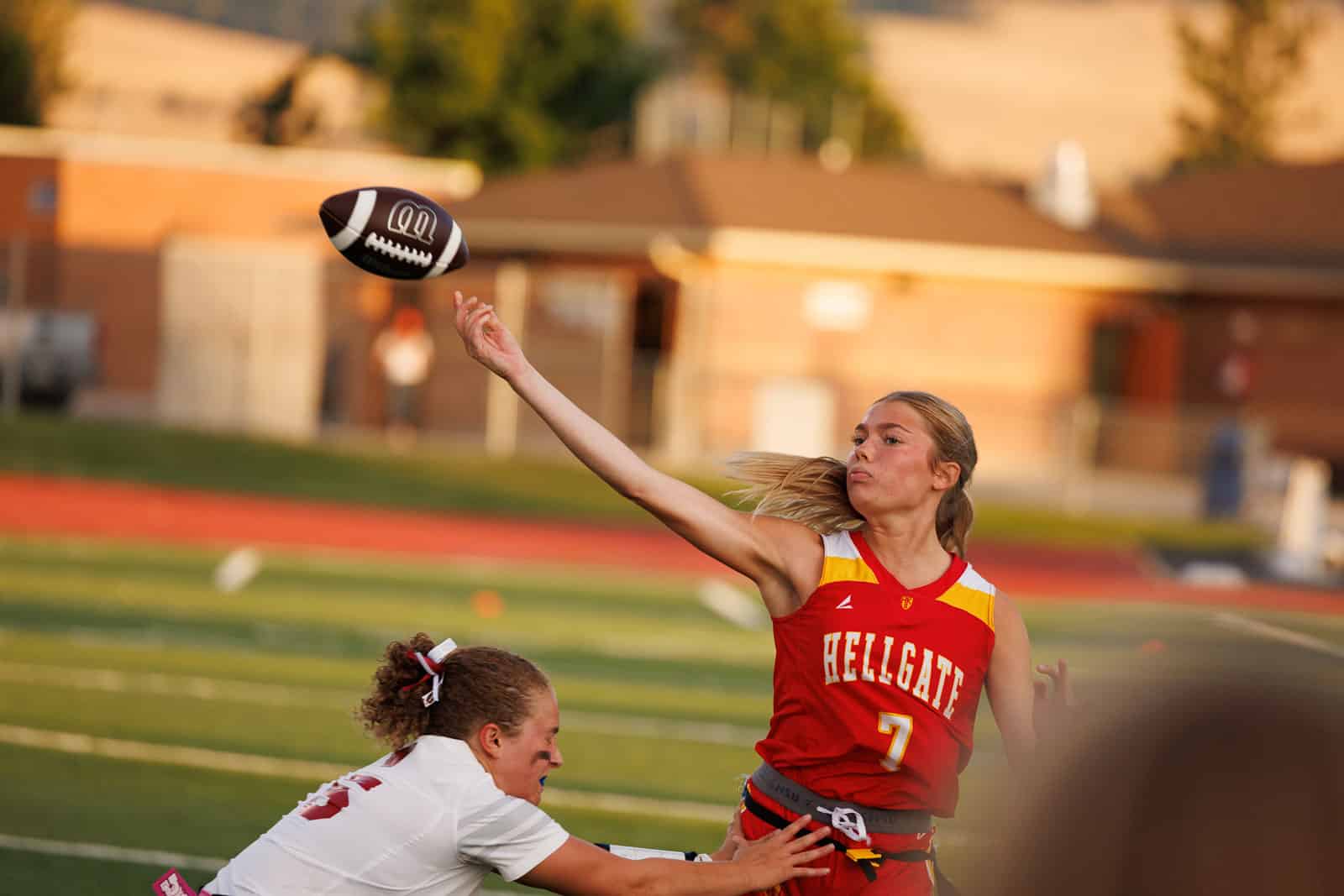
She came to her dad with a plan fully formed: She’d play and he’d coach. He wasn’t sure it was really as simple as all that, but he agreed to put in an application and see where it led. He had plenty of youth coaching experience by that point. He had also been a standout three-sport athlete (football, basketball, track) at Hellgate High back in the mid-’90s. So sure, they gave him the job. Then it was up to him to figure out how to form and coach a team where one had never existed before.
They had 15 healthy players that first season. One of the smallest rosters in the state. They held their practices at a dog park. They also made it all the way to the state championship, losing in the finals to the defending champs from Glacier High School in Kalispell.
After that, interest among students exploded. A total of 44 girls came out to join the team this summer — a nearly 200 percent increase from the first season to the second. Of those, only eight are returning players from last year. The rest are brand new, with football experience ranging from touch games during elementary school recess to throwing around the ball with their family or friends to nothing much beyond seeing the pads-and-helmets version of the game played on TV here and there.
“I just really wanted to try something new … I heard they had summer practices, so I came out to see if I liked it, and the energy was just really awesome.”
Asmaa Khalil, a freshman, had never played organized football before coming out for the team this summer. The closest she came was watching her brother, Youssef, play for the Knights until he graduated in 2025.
“I just really wanted to try something new,” Khalil says. “My brother kind of inspired me to try some different things. I heard they had summer practices, so I came out to see if I liked it, and the energy was just really awesome.”
The energy gets a lot of praise, from students and parents alike. At the Knights’ first game, one mother tells me that her daughter made the school’s soccer team but prefers flag football now because “the vibe here is just so much better.”
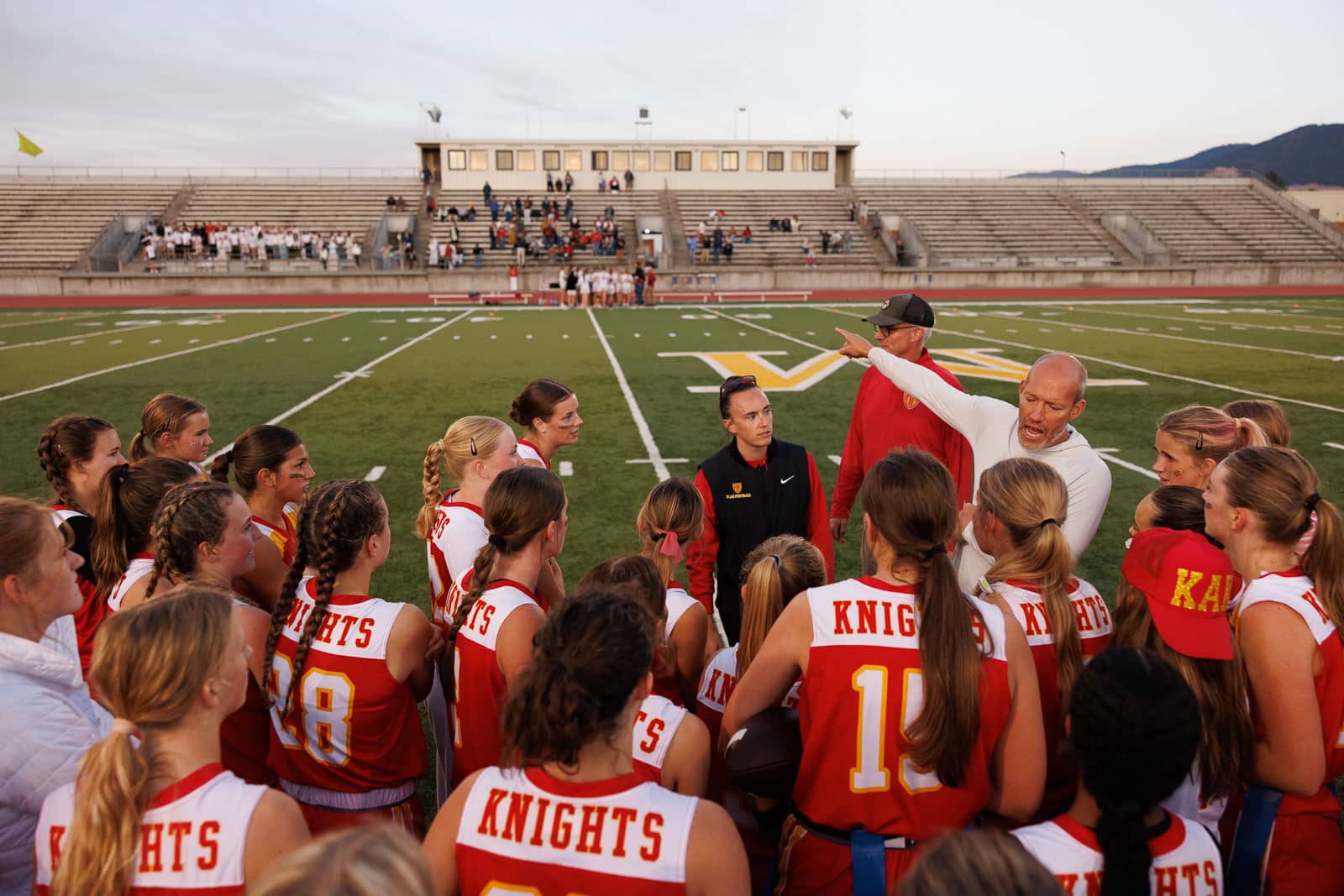
The head-knocking, swearing and screaming version of high school football you’ve seen in TV and movies — or that you might remember yourself, especially if your graduation year starts with a 19 — is entirely absent here. Gilman has two assistant coaches: Sami Riggs, a recent graduate of Willamette University, where she played basketball and track, and Stewart Hansen, a former college quarterback whose daughter Kate, a senior, plays safety on the team.
Riggs is the one closest to the girls’ age, Gilman points out, and therefore comes across less like all the other authority figures in their lives and more akin to the big sister they don’t want to disappoint.
“If there are any ass-chewings that need to take place,” Gilman says, “it’s Sami who handles it.”
Even then, the things the girls are most likely to be criticized for are deficiencies in effort or enthusiasm toward one another. Positivity is required and relentless. Drills at practice end with high fives and words of affirmation. The final summer practice closes with Riggs telling the girls that the reward for all this work is the following day’s game.
“And we’re going to support and uplift each other every play,” she says in a drill sergeant tone of voice. “No matter what happens, we are there for each other.”
Gilman is of the generation that experienced the other way of doing high school sports. He’s willing to admit that there might be some minor “extra extractive value” to yelling at teenagers until they empty their tanks due to fear of being yelled at some more.
“But you’re not going to get invited to many weddings that way,” he adds.

There are other reasons for a different approach. One has to do with what he’s learned coaching both girls and boys over the years.
“With girls, I’ve discovered that you need to block off twice as much time as you think you need for every activity just for answering their questions,” Gilman says. “So many questions. But they’re good, thoughtful questions. Boys, they think they invented the game. They don’t want to hear about it from anyone.”
The other reason is that, with something that’s this new and still taking shape, there’s an opportunity that may no longer exist with the other, more established high school sports.
According to Gilman, many of the girls on Hellgate’s flag football squad are refugees from various youth club sports scenes known for their relentless, commodified pace. Others may have just been frozen out by a youth sports infrastructure that assesses and categorizes kids early on, especially in sports like volleyball and soccer — two of the dominant fall sports offerings for high school girls in Montana. By the time kids get to high school, Gilman says, there’s a sense that the pecking order is already established. If you’re not in by then, you’re out. That leaves the other kids looking for some alternative.
“Not everybody wants to do cross-country,” Gilman says. “Having this as an option gives them the chance to try something new.”
Want to read this story in print? Pick up The Pulp’s fall print edition, available now at local businesses all around Missoula.

It was a very welcome option for Ava Harrington, a senior who joined the team in its first year, earning a starting job on both defense and offense. Her participation in sports had been limited due to a congenital heart condition called long QT, which can cause potentially life-threatening irregular heartbeats. She wasn’t cleared for this level of activity until her second year of high school, when many of the other sports rosters already seemed filled and established.
“That kind of prevented me from playing most sports through the winter of my sophomore year,” Harrington says. “So I was super excited to get the opportunity to play flag football, just for the opportunity to play sports again.”
Harrington wasn’t sure what to expect that first season. A new sport, new team, new coaches. She got a crash course in the rules and strategies and techniques of the game during summer practices, then the season started and soon it was off to the state championship final.
“I was curious to see how it would go, how many players we would get, it being the first season,” Harrington says. “But it really exceeded my expectations. I think we’ve really worked hard to create an atmosphere where everyone’s lifting each other up all the time. We know that the only way we can succeed as a team is if everyone acts like a team.”
It’s a perfect early September evening when the Knights pull on their red jerseys to host Hamilton in the first game of the season. The afternoon temperature is dipping with the sun and the girls get out their trusty Bluetooth speaker to fuel them through warm-ups. It doesn’t take long for quarterback Texas Gilman, still just a sophomore, to lead them down the field for a touchdown, and then another.
“The straw that stirs the drink,” is the way Coach Gilman describes his daughter’s role on the team. She led the Knights in passing and rushing as a freshman, and if you didn’t know she was the coach’s kid you can tell just by the way the two of them talk to each other. Every other player gets the kindest, gentlest version of the coach’s critiques. Texas gets a more direct variety, but also responds in kind. (“I know,” she’ll reply at one point after her dad offers corrections on her punting form. He’ll just roll his eyes. “Yeah, that’s what it’s like coaching your teenage daughter,” he says almost under his breath.)


Late in the first half, her value to the team becomes impossible to ignore. After a turnover on downs by Hamilton, prompting something of a sideline meltdown by some very vocal Broncs’ coaches, Gilman sticks the dagger in their hearts by airing out a long bomb that lands gently in the hands of senior Lucia Savoia, who is all alone behind the last Hamilton defender. She could walk into the end zone from there. But Savoia, like the rest of the team, has been reminded by the coaches many, many times to play through the whistle, so she sprints the rest of the way for the score.
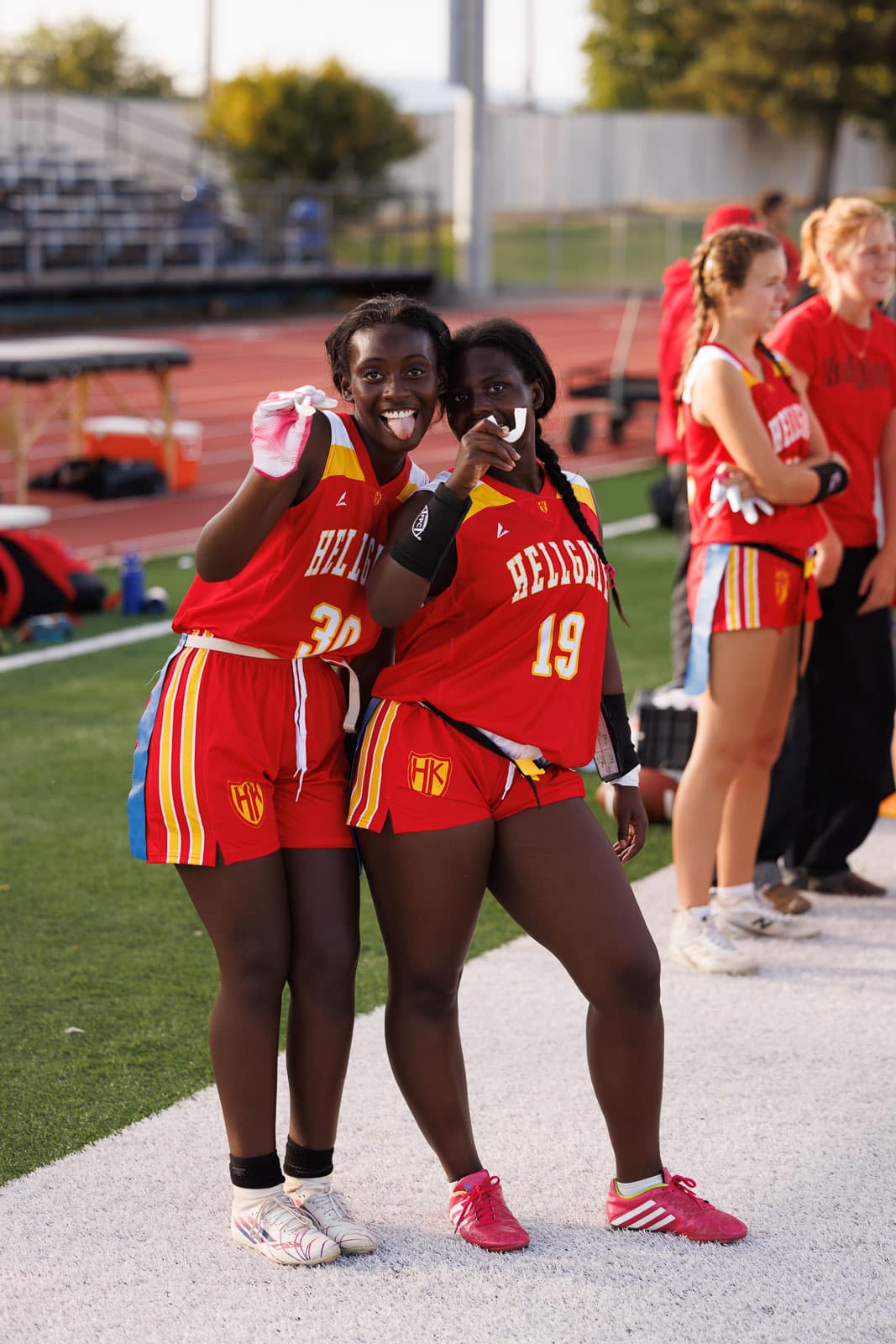
The home team’s sideline is a red blur of leaping bodies. In the stands, a tight phalanx of supportive students performs an impressively contained wave. Coach Gilman dishes out the high fives and then goes rifling through his playbook, looking for the best call on the point-after attempt. Even the backups who have been entertaining themselves by rehearsing TikTok dances on the sidelines are in on the celebrations now.
When the final whistle blows, the scoreboard confirms that this one has been all Hellgate. A 24-0 victory over Hamilton opens the team’s second season, and the girls celebrate like they’ve won the Super Bowl. There is much jumping and hugging and yelping in joy. No one has to tell even the most inexperienced of them to be enthusiastic and positive now. This season — and this sport — may be just beginning, but the thrill of victory is one thing everyone can understand.