Bonner Park is a pleasant neighborhood park during the summer. Friends picnic, dogs catch frisbees, children gallop around the playground and splash pad. But for one Sunday in June, a sweaty, addle-brained mob of distance runners curses the very dirt the green space is built upon. Numb-legged and mildly hypoxic, they refer to Bonner Park — or, more accurately, the roads paving its perimeter — as the Loop of Sadness.
The Loop of Sadness constitutes mile 24 of the Missoula Marathon. The course follows Burlington Avenue east to the intersection at Higgins Avenue. A left onto Higgins would deliver runners swiftly to the north end of Beartracks Bridge where the finish line awaits. But first, runners must go straight through the intersection. Two blocks past it is the loop at Bonner Park, which marks the start of the final two miles of the race. Then comes the finish-line celebration everyone’s been chasing for months of training: the music, the cheering, the medal, the free beer.
Running a marathon once is challenging enough. Fewer than 1 percent of Americans will ever compete at the 26.2-mile distance. But it takes a special kind of person to tackle the same course, to run toward the same Loop of Sadness, year after year.
Danelle Gjetmundsen, Tom Halverson, and Tammy Mocabee are that kind of person. Of the 617 runners who completed the first Missoula Marathon in 2007, and the handful who kept coming back, they are the last three to keep a streak alive, almost two decades later. They are known as “Legacy Runners,” an accolade that local running organization Run Wild Missoula has awarded to a roster of diehards.
They’ll each run the Missoula Marathon every year, no matter what, until someone’s wheels fall off.
Legacy runners are those who have completed the event every year since its 2007 inception. Because legacy runners had to get in on the ground floor, they are a finite resource that has only shrunk with time. RWM also tracks legacy half-marathon runners and legacy mixed-distance runners, who have run either the half or full every year. But for Gjetmundsen, Halverson, and Mocabee, three longtime Missoulians in their late 50s and early 60s, 26.2 miles is the only distance for them.
Now, they’ve developed something of a “pact,” even though it sounds more like good-hearted stubbornness: They’ll each run the Missoula Marathon every year, no matter what, until someone’s wheels fall off. They didn’t set out to be the last ones standing. But here they are, bound together by something that started as habit and has since become a promise — one that none of them wants to be the first to break.
I met with each of them to figure out why, joining two on runs around town and sitting down with the third for coffee.
Danelle Gjetmundsen can’t run without a fresh stash of chewing gum at her disposal. Any flavor will do in a pinch — before one race, she snagged a forgotten piece from the bottom of a shuttle driver’s bag — but she prefers Icebreakers Arctic Grape. It matches her shoes, the bulk of her running clothes, her nails, her sunglasses, and her purse, all of which are varying shades of purple. “Purplerunner” is even part of her email address.
Gjetmundsen, 57, met fellow Missoula Marathon legacy runner Mocabee, 63, in a training class for the first marathon. They’ve been friends ever since, spending their race mornings together before stepping off and going their separate ways on the course. They’re also part of a larger group of women who run together and support each other through whatever life throws their way — birthdays, kids leaving for college, even one friend’s hysterectomy. (The group threw her a recovery party.)
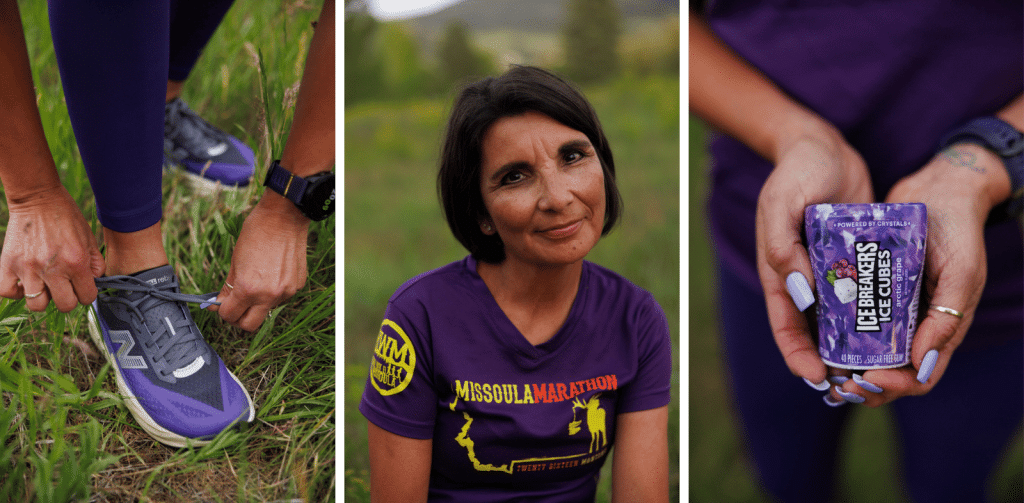
“I’m a social runner,” Gjetmundsen says as we trot around the bucolic University District. “By the time I started running, my kids were 10 and 11. I had done the PTA, volunteered at their schools … I decided I needed a thing.”
A Riverton, Wyoming native, Gjetmundsen was 37 years old when she joined that first marathon training class. Now, two decades later, she has developed a comprehensive understanding of the joys and challenges of what running does to the human body.
“People outside of the running community will ask silly things like, ‘Do you run in the winter? Isn’t that bad for your lungs?’ or ‘You only have so many heartbeats, why would you waste them running?’”
“I’m lucky to be doing this. I’m lucky my body is letting me do this.”
Gjetmundsen is talking with ease while I start to gasp for air.
“But I know what running does for me. I’m not as fast as I was in my late 30s. Sometimes I’ll be running and thinking to myself, ‘Why am I doing this?’ But then the next thought is, ‘I’m lucky to be doing this. I’m lucky my body is letting me do this.’”
Tom Halverson, 65, knows a thing or two about feeling gratitude for what his body is capable of. As a Type 1 diabetic, he has to monitor his sugars extra closely, producing a sandwich baggie of Hi-Chews from his pocket to prove his point as we run along the Milwaukee Trail.
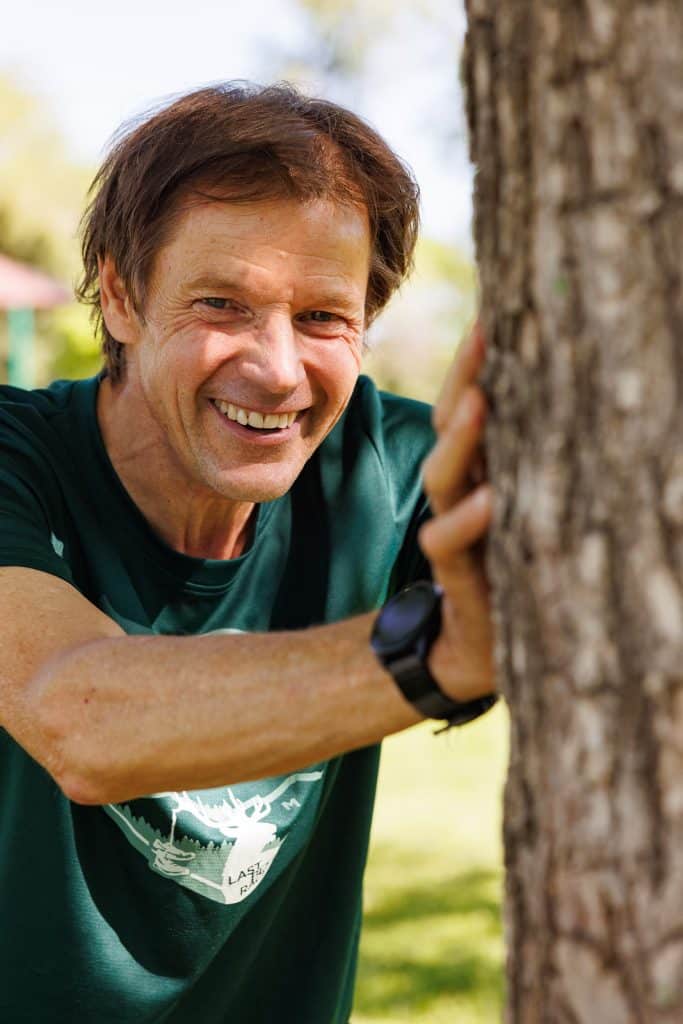
Halverson is as committed to minimalism as he is to the marathon itself. As the running world evolves further toward hydration vests and phone belts and other accoutrements, Halverson resists bulk in his approach to gear. In fact, if Hi-Chews are the only thing he can’t run without, vests are the only thing he can’t run with.
His approach to mantras, on the other hand, is a bit more maximalist.
“I just say ‘You can do it’ probably several thousand times throughout a race,” Halverson says. “It’s gotten so bad that I’ve now learned the phrase in French and Spanish, too.”
Halverson picked up running in the early 1980s as a way to keep in shape for winters of downhill skiing at Snowbowl. He ran his first marathon, the Governor’s Cup in Helena, in 1992.
“That’s where the addiction began,” he says.
For the next 14 years, Halverson ran a marathon almost annually, sometimes two or three in a single year. Then, while retrieving a race packet for the Portland Marathon in 2006, he found a promotional flyer for a new marathon in his own hometown.
“I can’t believe the lengths people have gone to keep this legacy thing going.”
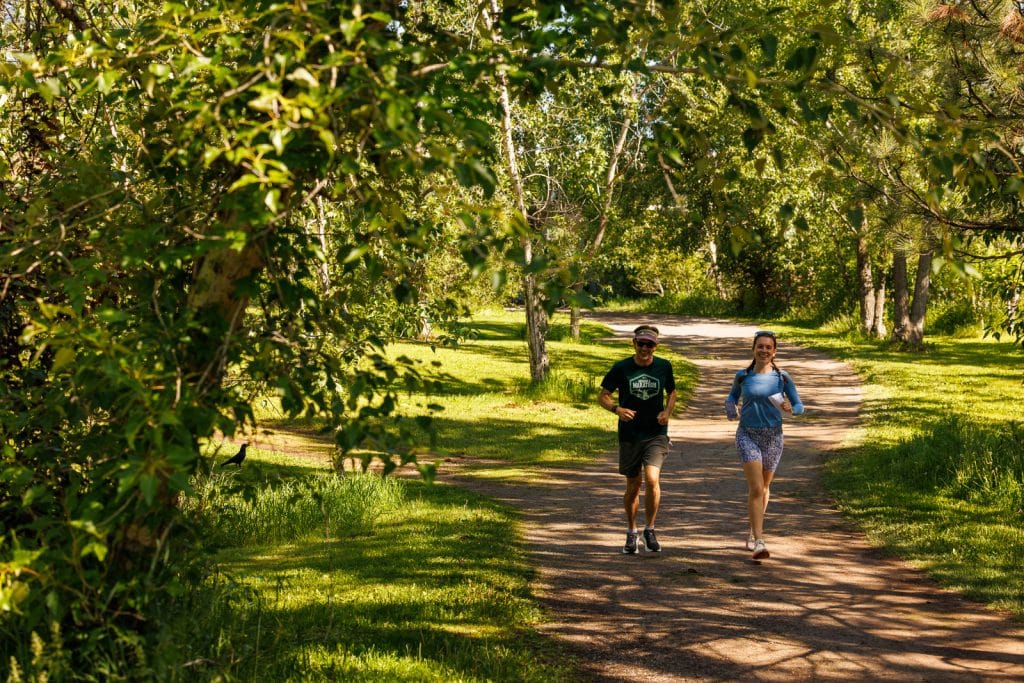
Now, as we work our way along the Milwaukee Trail, which the lifelong Missoulian runs with all the familiarity of a homeowner jogging down their driveway to retrieve the mail, a handful of his other interests float into our conversation. Juggling. Climate change activism. International travel with his girlfriend and dedicated half-marathoner, Shelley. He’d really like to get better at guitar, but swears he’s allergic to sticking to it. Maybe he’ll have the time once he retires from a career as a real estate appraiser, or maybe he’ll do more mountain biking instead.
I start to wonder if Halverson might just be allergic to sitting still.
Being a legacy runner brings with it some local fame that, Tammy Mocabee admits, has drawn her out of her tendency toward shyness. When Mocabee crosses the finish line, people know her name. They cheer for her. She waves, enjoying the celebration of her extraordinary athletic feat.
But she also takes her rest days seriously, which means we meet for coffee at Break Espresso rather than tackling a running interview. When she mentions she has a 20-mile training run the next day, my legs cramp a little bit.
Mocabee, 63, grew up in Hardin but has called Missoula home for almost 34 years after relocating here for jobs she and her husband took with the BNSF railroad. They both retired three years ago and have since started volunteering, traveling, and camping more. But Mocabee’s ultimate kryptonite? The 1,000-piece jigsaw puzzle; her family bought her nine of them for Christmas this year. She approaches a long run the same way: one piece at a time.

Running has also filled up lots of Mocabee’s newfound time. In the beginning, it was an easy way to exercise after having her first child. She joined a running class at a gym in town and tackled her first race, the Bloomsday 12K in Spokane. Then, some people she knew in the Missoula Road and Track Club started a short weekend run. Mocabee slowly stretched her distances with the group, which had also started discussing organizing a marathon.
“By this point I was running five or six miles, and I figured I could probably run a marathon if I could stop and walk some,” Mocabee says. “I signed up for the first marathon training class and stuck with it.”
“I couldn’t believe I was doing it. Each training run was the farthest I’d ever gone. But it was such a feeling of accomplishment.”
Transitioning from running a few miles to training for a marathon was a surreal experience.
“I couldn’t believe I was doing it,” Mocabee says. “Each training run was the farthest I’d ever gone. But it was such a feeling of accomplishment.”
On race day, the trio usually takes the 4:15 a.m. shuttle bus to the starting line. Gjetmundsen and Mocabee eat their peanut butter bagels in the parking lot and visit with Halverson, who already ate oatmeal at home, before lining up. While many of their fellow competitors recognize the trio, many more don’t, making them sneaky celebrities among the 1,700 sleepy-eyed participants.
Once the race begins, the three go their separate ways, locking into their respective paces and rituals. Eventually, they all plod their way down Burlington Avenue toward the Higgins intersection. They know better than anyone else what’s coming, what it will take to endure yet another trip around the Loop of Sadness.
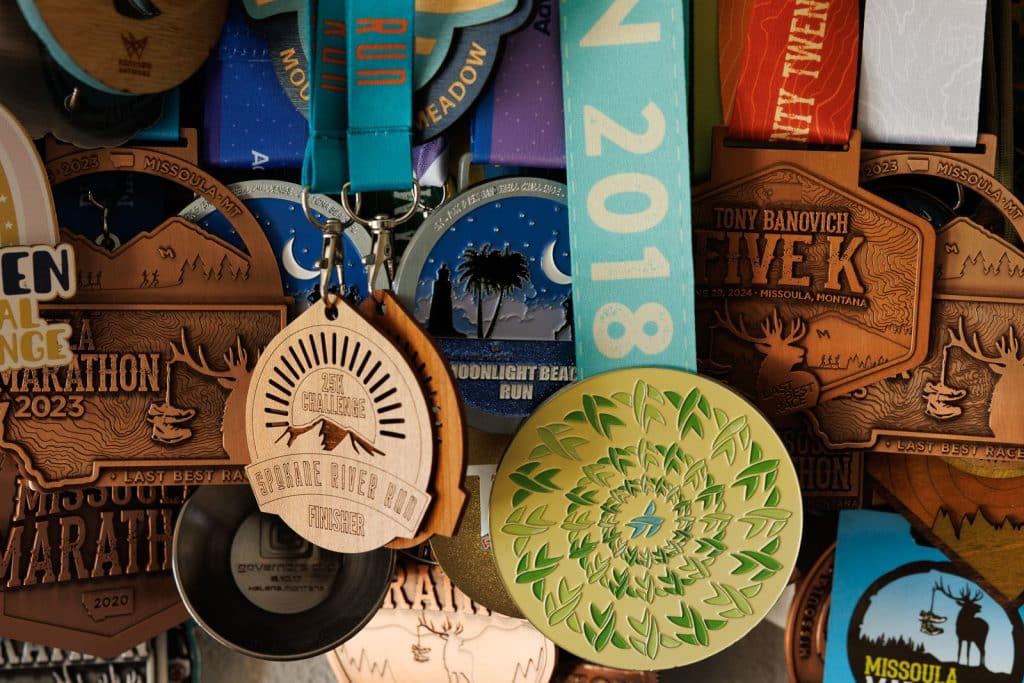
On the other side of the finish line, they find each other once again, sharing congratulations and posing for photos together — another snapshot of the Missoula Marathon legacy living on in real time. The warmth between the trio is palpable. So is the friendly competition, the secret sauce of their agreement-in-perpetuity, which they each chuckle about in their own way.
“Oh, we’re locked in,” Gjetmundsen says. “We were all like, ‘Well, there’s no way I’m not doing it…’”
“I can’t believe the lengths people have gone to keep this legacy thing going,” Halverson says.
“We all want to be the last man standing,” Mocabee says.
She laughs, then stops.
“…but seriously.”