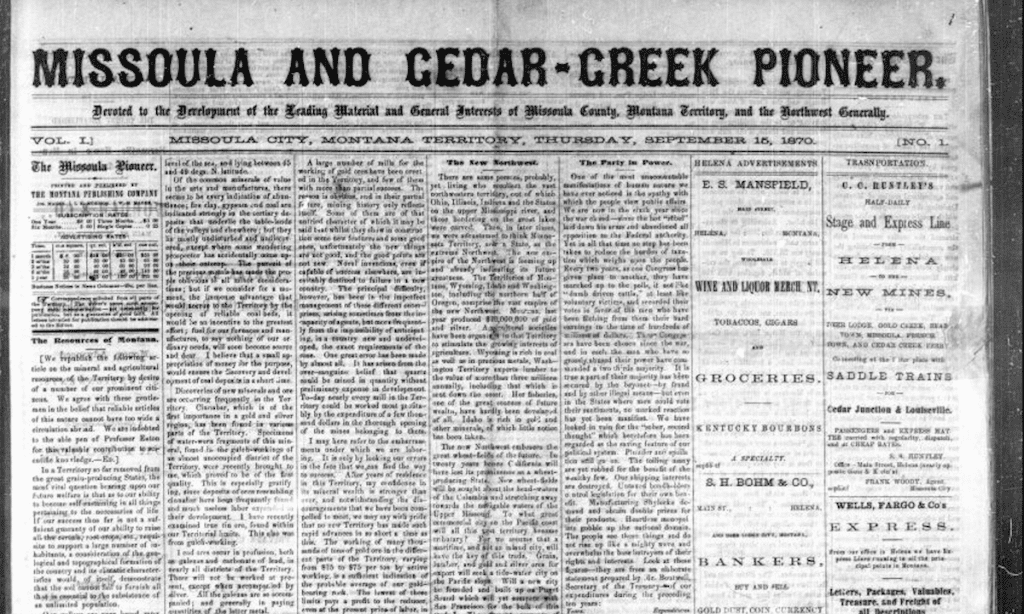
It’s no cinch to launch a newspaper. Legend says it took three men and a four-horse team most of a week to drag a cast-iron press from Helena to unpaved Missoula in 1870. As they approached, the men tied red ribbons to the horses’ ears to celebrate their audacity.
They unhitched the team at a shack on Front Street and started work on the weekly Missoula and Cedar Creek Pioneer, the first paper to serve Missoula’s 300 locals and 1,500 others scratching for gold 50 miles downstream on the Clark Fork River. (Also “legend” is really the late John H. Toole’s 1989 book “Red Ribbons: A Story of Missoula and its Newspaper.” I wasn’t there as a witness, though some of my students at the University of Montana School of Journalism question this.)
It seems a fitting story to mark the birth of The Pulp, Missoula’s new nonprofit and online news organization. Though it won’t require horses or even a press (yet), the venture is still an act of faith worthy of raising a pint. But then, beginnings are the easy part.
Remember the Pioneer? Of course not. Missoula’s history includes a boneyard of short-lived newspapers. Within a year, one of the Pioneer’s three owners quit to buy a bar, that other essential territorial enterprise. Two years later, the other two sold out after struggling with 19th-century supply chain issues: Newsprint, made from pulp, was expensive and hard to get. (The weekly’s shifting colors, size and texture were hot topics of conversation.) Literate editors and dependable printers were tough to come by, too.
But at least the need for news from beyond the valley’s view was constant. The Pioneer changed owners, names and locations before joining the town’s long list of journalistic has-beens. Remember the Mountaineer, Messenger, Fruit Grower, Silverite, Populist, Socialist or The New Northwest? Probably not. Who today could possibly distinguish among the various Gazettes, Heralds, Times, Democrats and Republicans? The Sentinel and The Borrowed Times barely echo today.
A 1986 database of Montana newspapers listed no fewer than 51 Missoula titles, including their weekly, semiweekly and daily editions. Only the Missoulian, a descendant of Pioneer, survives, though it’s been whittled down a bit.
For the rest, causes of death varied. Subscribers and advertisers were fickle in unsettled times. Not that early editors didn’t try. Most boosted their towns’ promise with their last drop of ink, but bolted as soon as the ore ran out. The Pioneer’s fate was common.
And in times when newspapers were the only means of politicking, those tied to factions might last only until Election Night. Strapped publishers who took on investors often found themselves pushed to the curb. Others simply grew tired of the endless search for support or dependably sober printers.
The arrival of big industry and investment offered more stability, especially for the expensive daily papers, some of which attracted professional talent with glittering resumes. Missoula briefly sported three dailies in 1926. But they came with strings imposed by politicians, timber and mining barons, bankers and, eventually, corporations whose business models sometimes strained to meet the demands of local readers and distant shareholders. Alongside them, Montana still boasts some long-lived weeklies, but survival is never a gimme.
But hope, they say, is a thing with feathers. So here’s to The Pulp and its effort to find a niche among Missoula’s news media. May it meet the city’s endless need for independent community journalism whose chief loyalty is to its readers.
Recently, supporters of the online non-profit and independent Montana Free Press gathered in Missoula to celebrate its successful publication for more than eight years. Its founder and editor-in-chief, longtime Montana journalist John Adams, shook his head as he recalled his nervousness in pitching his idea to a statewide gathering of the Butte Press Club.
Also in that buzzing room of well-wishers were Erika and Matt, The Pulp’s talented co-founders, who, like Adams, are both alums of the quirky and much-lamented Missoula Independent. As I recall, the Indy’s remarkable 27-year run was similarly hard to predict at its birth in the early 1990s.
The lively Free Press gathering also reminded me of a rough continuity in Montana’s journalism history: the ongoing reconstitution of people and hope to serve the community’s bottomless need for awareness.
So, power to The Pulp and its aim to catch the spirit of art, culture, politics, innovation and weirdness that makes Missoula unlike any city in the state. May it provoke, delight, inspire and outrage Missoulians in the finest traditions of our state and its press.