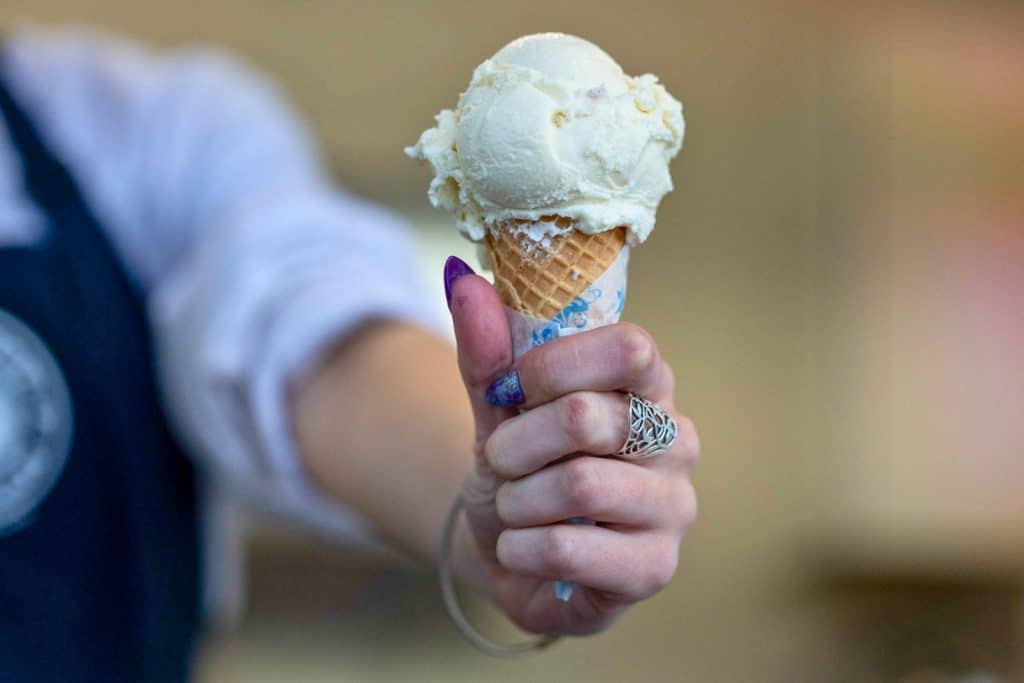
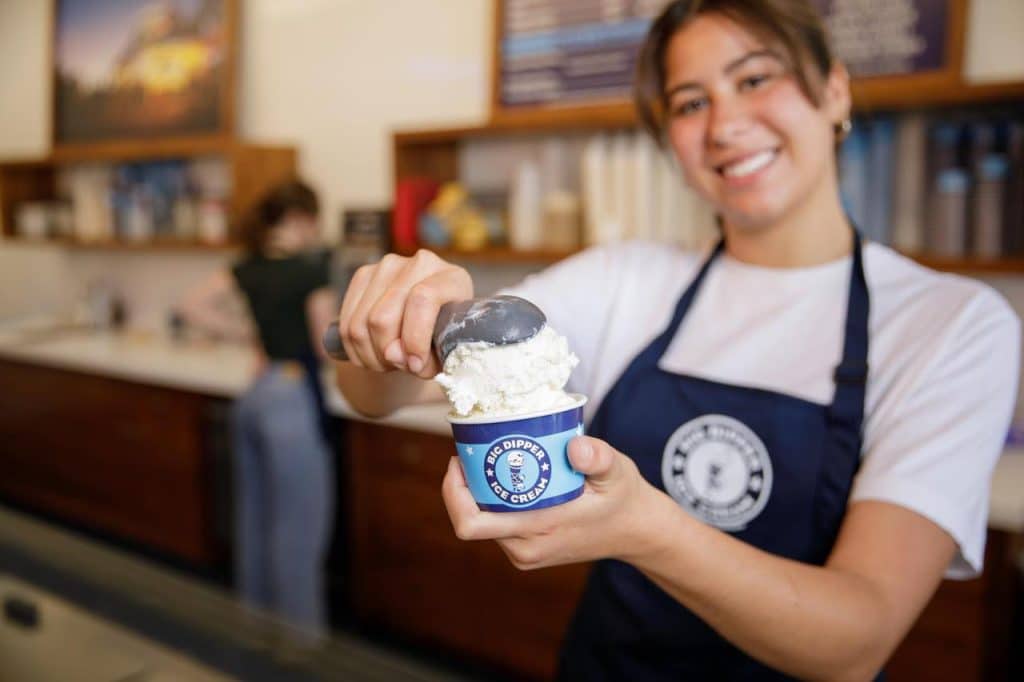
Recently, my friends and I stopped at the Big Dipper walk-up window in downtown Missoula where they ordered Mexican chocolate, espresso heath and cardamom. When it was my turn, I asked for a scoop of vanilla on a cone. One of my friends raised an eyebrow. Another said, “Seriously? Vanilla?”
I shrugged. But as we walked down the street, cones in hand, their reactions nagged at me. I love vanilla ice cream — I had been craving it — but even I’d felt conflicted about ordering it when there were so many other flavors to choose from. It was like there had been a little voice in my head reminding me that vanilla is plain. Boring. Bland. Safe. Not words I necessarily wanted associated with my life choices, even when it comes to something as low-stakes as ice cream.
I took a bite. It was creamy, sweet, the tiniest bit chewy, and so rich in vanilla flavor. I suddenly felt a little indignant. Vanilla wasn’t just a defensible choice, it was a great choice — just as exciting as any other flavor on the menu.
So how did vanilla end up as the universal shorthand for boring?
Later that evening, I looked up Webster’s definitions for “vanilla.” The first definition was: “a commercially important extract of the vanilla bean that is used especially as a flavoring.” But in the second definition, there it was: “lacking distinction: plain, ordinary, conventional.”
In non-ice-cream-shop conversations, I’ve mostly heard it used to describe dull sex. But my search for definitions found it commonly woven into terms across industries. For instance, developers use “vanilla install” to refer to the default, out-of-the-box versions of software with no customizations. In finance, “plain vanilla” stocks and bonds are basic, while advanced types are “exotic.” And somewhat ironically, chefs sometimes use the term “vanilla” to mean an ordinary, unadorned dish.
The more I thought about it, the less this popular conception of vanilla made any sense. For one, it’s delicious, and sings the bass note for many more highly lauded ice cream flavors. But also, we add a dash of vanilla extract to practically every baked good. It’s incredibly expensive, even in its extract form. It comes from tropical, faraway countries like Madagascar or Tahiti, where it grows in the same regions as other decidedly un-plain ingredients like chocolate and coffee.
So how did vanilla, of all things, end up as the universal shorthand for boring in the U.S.? I started digging.
Vanilla, I was starting to suspect, had been demoted from gift to commodity. But when, and how?
Turns out, vanilla isn’t plain at all. It’s one of the most complex — and complicated — flavors on Earth. The botanist and author Robin Wall Kimmerer writes that the difference between experiencing something as a gift and experiencing it as a commodity isn’t just philosophical, it changes your relationship with the world. Vanilla, I was starting to suspect, had been demoted from gift to commodity. But when, and how?
Originally, vanilla grew wild as a flowering vine in the tropical forests of Mesoamerica, where the Olmec peoples may have used it as early as 1500 BCE. Centuries later, the Totonac cultivated it — to scent temples, flavor food, and mark important ceremonies.
After the bloody conquest of the Aztecs (who had themselves long subjugated the Totonac people), Hernán Cortés returned to Europe with tlilxochitl in the 1520s, where it languished in a culinary supporting role until the early 1600s when it rose in popularity as a title character. The Spanish renamed it vainilla from the Latin “vagina,” and tinctured it as an aphrodisiac — making its later association with boring sex all the more confusing. The French put it in ice cream. Colonists planted it across Africa and Southeast Asia. And it was in one of those colonies — on the tiny island of Réunion off the coast of Madagascar — that in 1841 a 12-year-old enslaved boy named Edmond Albius discovered the hand-pollination method still used today, nearly two centuries later.
Currently, Madagascar produces about 80 percent of the world’s vanilla, and the work remains almost entirely manual — the hand-pollination Albius discovered, months of curing, nearly a year from flower to finished bean. For rural farming families there, it’s one of their most important sources of income. But their dependency is a product of a global economic structure that forces them into cheap labor, including the children between 12 and 17 who make up roughly 30 percent of the workforce.
I want to pause here, because I notice what I’m doing. I’m telling you this history the way vanilla’s history usually gets told — as a series of events that lead, eventually, to my ice cream cone. The Totonac, Edmond Albius, the farmers in Madagascar — they appear in the story, do their part, and the narrative moves on. That’s precisely the kind of extraction this essay is supposed to be critiquing. So let me go back.
The boy who discovered hand-pollination, Edmond Albius, was eventually granted his freedom, but received no recognition and no compensation during his lifetime. He died in poverty in 1880. Without his discovery, large-scale vanilla cultivation wouldn’t exist. His name appears in the history of vanilla the same way his contribution appears in the price of a vanilla bean: technically present, practically invisible.
Also, the Totonac’s relationship to vanilla didn’t end with colonization. They still grow vanilla today, in the same region of Veracruz where they always have. For them, vanilla has never been plain. Their relationship continues, on their terms, independent of what vanilla means to anyone else. And the farming families in Madagascar aren’t a footnote in a story about my enlightenment. They are the people on whose labor the entire industry rests, including the cone I was eating when this essay started.
Most people don’t encounter real vanilla often. They get a replica. A shadow of the real thing.
For a long time after its introduction to Europe, vanilla was neither cheap nor overlooked. Thomas Jefferson helped popularize it in American ice cream after encountering it in France in the late 18th century — you can find his recipe in the Library of Congress, calling simply for “a stick of Vanilla.” It was in-demand and expensive. And it had entered a world that didn’t ask where it came from.
Then, in the late 1800s, scientists synthesized vanillin — the most prominent of vanilla’s 500 flavor compounds — making synthesized “vanilla” 20 times cheaper and available everywhere. Vanillin now flavors more than 90 percent of all “vanilla-flavored” products, including cookies, protein powder, vodka, shampoo, air fresheners, and candles. Most people don’t encounter real vanilla often. They get a replica. A shadow of the real thing.
The difference between that subtle substitute and real vanilla is miles apart. Recently, I decided to stage a blind taste test for my partner and our friends. I made two puddings: one from a box mix, one made from real vanilla beans I bought — two for $16. I steeped the beans in milk, added eggs and sugar for a custard, chilled both the real and boxed versions, and sat everyone down blindfolded.
The boxed version, which tasted one-note and familiar, got polite praise: “good,” “nice,” “I just love pudding.”
The real vanilla was floral and rich — more like dried fruit than sugar.
And the response to it was clear: “This is fucking phenomenal.” “Wow.” “It’s so much deeper.” “There’s, like, four-dimensionality,” said one friend, who’d been watching a lot of Top Chef.
Side by side, the decision was unanimous. Which made the whole thing feel a little obvious. It was like looking at a postcard of a mountain instead of climbing one and seeing it for yourself. Like, duh. Of course the real thing is awesome — and better.
When I called Charlie Beaton, the owner of Big Dipper, and asked why he still uses pure Madagascar vanilla when synthetic would cost a fraction of the price, he didn’t talk about history or supply chains. He just said: “A lot of people might not even notice the difference. But what I was not willing to do was cut any corners.” He said that vanilla has always been his favorite flavor — this from a man with access to every flavor he makes.
The word came to mean boring because the thing became boring because the thing was made boring by design — because boring is cheap and profitable and requires nothing of us.
Coffee, chocolate, cotton, sugar — so much of what we consume casually and cheaply has a version of this same history and violent supply chain. They also have synthetic substitutes. Synthetic vanillin didn’t improve conditions for the farmers producing the real thing — it just reduced demand for their product, contributing in some periods to price crashes that made their situations worse, not better.
Here is where the word “vanilla” as another word for “plain” finally makes some kind of sense. The plant was taken and renamed over and over. Then the single most commercially useful compound was isolated and replicated, and everything else — the other 499 flavor compounds, the orchid, the labor, the history — was discarded as unnecessary. So, the synthesis of vanillin didn’t start the erasure of vanilla’s history, but it helped complete it. The word came to mean boring because the thing became boring because the thing was made boring by design — because boring is cheap and profitable and requires nothing of us. When we use it that way, we are enacting our collective amnesia without even knowing it — reaching for a word whose emptiness is the record of everything that was removed.
My ability to stand at that window and order vanilla, and then spend months rediscovering its complexity and feeling pleased about it, is itself a product of that same history. The distance that made vanilla seem plain to me is the same distance that made its true costs invisible. Closing that distance isn’t really a matter of choosing the better tasting, more expensive vanilla, or feeling enlightened about what I learned. It’s understanding that using “vanilla” to mean “plain” is one of the best examples of how far we have been willing to stand apart from the full weight of what we were tasting.
A few nights ago, I opened my freezer, found a half-gallon of Big Dipper vanilla, and scooped some into a mug. I took a bite and the cold, delicious cream melted immediately on my tongue. What a miracle, to have a freezer! The ice cream was made only a five minute walk from where I stood, but spanned centuries of complicated histories, and miles of landscape and socioeconomic systems that are happening now, and that are still mysterious to me. I’m not sure what to do with that, exactly. Maybe you let the flavor become a way of unforgetting. At least it’s a start.