The feel of any bike race is determined by a broad mix of obvious factors—the course, the weather, a racer’s preparation and mindset—and one subtler ingredient: the organizer’s personality. The current manager of the Pattee Canyon Hill Climb is the local cycling club Rattlesnake 1000 (R1K), who are a touch more metal than your average race organizer.
Their slogan is “Shut up and get rad.” If you wish to join R1K, you must first, over the course of about six months, ride 1,000 miles in the Rattlesnake in addition to completing other various challenges around Missoula. There’s the Town Pump 200k Challenge, where, in a single ride, you have to stop at all the Town Pumps (East Missoula, Frenchtown, and the Bitterroot) and the only sustenance you’re allowed is what you can source from the Pumps’ hot boxes. If the hot box is empty, you can grab a microwavable burrito. You cannot carry water with you, only Cherry Coke or a Rainier beer (I’ll remind you that this is a 125-mile journey, usually done in the summer).
There’s the Total 50 Challenge, where the miles you ride, the beers you drink, and the croissants you eat all have to add up to 50. Or the challenge where you go out for the sushi, then ride up the MoZ Trail (that extremely steep trail that switchbacks across the southwestern flank of Mt. Sentinel), and “review the sushi,” which may or may not be code for “expel the sushi.”
You get the idea.
“We do these monthly challenges to keep people motivated to get outside and ride,” says R1K frontman Jason McMackin. “We start with an idea and then it explodes into something horrible.”
Their fall fling of sorts, which took place in early October, is the Pattee Canyon Hill Climb, and it is a strange and perfect event. It’s ostensibly a normal bike race: the fastest wins, everyone rides solo, and there are separate divisions for men and women. And many people do ride it as such—seriously. Setting the fastest time each year is an honor. But the PCHC’s full scope is broader and weirder. This year saw ascents on all manner of bikes, a buffet of bratwursts and whiskey, melon pregnancies, and the Fastest Known Cactus. Conclusion? Typical.
The PCHC began life as the Western Montana Hill Climb Championships in 1977 under the stewardship of Greg and June Siple (who founded the organization that would become the Adventure Cycling Association) and the Missoula Bicycle Club. Greg conceived the idea after learning about short hill climb races in Britain. These were largely grassroots events where racers would find an isolated road climb, get out the stopwatches, and ride up it as fast as possible. At a given race you might see professionals, youngsters, and “why-not” amateurs all competing.
The Hill Climb Championships followed that same format.
“At the time there was very little adult cycling in the U.S., and we looked to Europe to understand the sport,” Greg says.

Back then, the event had a bit less silliness. There was a more official start line than the current setup (more on that later), with an on-the-ground timing system. In some respects it was a standard bike race, but nonetheless it established a reputation as a beloved community event open to more than just the serious racers.
“The event was unique in that top-level racers could be mixing it up with 9-year-olds and hand cyclists. And because of the staggered start, when you crossed the finish line no one had any idea of how slow you might be. No chance for embarrassment,” Greg says.
And it wasn’t limited to plain old two-wheelers. Recumbents, tandems, tricycles, hand cycles, high wheels, and unicycles all got raced, with appropriate record times laid down (the women’s unicycle record is still unclaimed, hint hint).
There was also the tradition of exchanging prizes. Every entrant was required to bring a prize. Examples include (from a Hill Climb flier that Greg and June used to promote the event): “homemade bread or cookies, dental floss, used golf balls, carpentry work, books, bicycle parts, frozen dog meat, fishing flies, and sparkles.”
The prizes were randomly doled out at the end.
“And so a rider with scores of victories to their credit might win a secondhand T-shirt and the 9-year-old would ride off with a $20 gift certificate to the Good Food Store,” Greg says.
But this didn’t detract from the competition, which was fierce enough to draw plenty of big names. Local legend and national champion Tamara Bassett won the Women’s Overall multiple years. In 1988, a teenager from Butte named Levi Leipheimer won his age group and went on to ride in the Tour de France and take a bronze medal in the Beijing Olympics. Same story in 2003, when a young Tejay van Garderen won the Hill Climb and later took fifth place in the Tour de France.
And so we come to the current iteration of the Pattee Canyon Hill Climb.
The course is the length of Pattee Canyon Road starting from Takima Drive, a few blocks up Pattee from South Higgins Avenue. The event is unlike other bike races in that there’s no official start time. Simply ride the course at any time between 8 a.m. and 5 p.m, and record your ride on the cycling app Strava. No registration or fees needed. The times are collated by McMackin, who sends out a post at the end of the day announcing the winners. You can ride incognito or with friends, on whatever wheel-and-pedals contraption you desire. For part of the day, R1K is stationed at the top with food and drinks. You bring the bike, R1K brings the party.
This year, on a Sunday so gorgeous and autumnal it just about broke your heart, my bike and I made our way to meet a small group of other racers at Takima. Any Pattee residents peering out their kitchen windows would’ve seen a curious sight not unlike a flock of birds on a telephone line. Riders arrived solo or in pairs, congregating in a loose clump, chattering and squawking to each other, displaying a wide variety of plumage. I opted for a plain dark gray kit (northern mockingbird) while a few other guys chose the lighter gray of the MTCX bike shop’s team kit (closer to mourning dove). In a reversal of regular avian sexual dimorphism, the women were decked out in bright colors. A few members of the women’s team, MT Alpha, wore black zebra stripes over habanero orange, and one woman sported such an array of clashing colors and patterns that I had to keep my sunglasses on.
You could loosely discern someone’s goals by their clothing choice. Tight, aerodynamic bike jerseys and bibs (“kit”) for those trying to go as fast as possible, regular clothes and goofy costumes for those who came for the fun of it. This year seemed to be roughly split 50-50, but as long as you’re riding when R1K is at the top, you can hop into the party no matter your outfit.
This year the Pattee residents were treated to some particularly elaborate fauna—two women, in solidarity with their pregnant friend, carried under their jerseys a cantaloupe and a pumpkin, respectively. The cantaloupe seemed manageable if highly unaerodynamic, but the pumpkin was a real county fair contestant—huge, bulbous, and hanging from a complex sling of plastic wrap. Everyone laughed and made melon-related birthing jokes.
Eventually, the migratory urge overcame us and we began our ascent one by one. The event’s loose nature means there’s no start order. You just go when the mood strikes. The race’s instructions tell you to mark the start line by placing your front wheel next to the sewer grate at the corner of Takima Drive and Pattee Canyon Road. Already full of nerves, I found the sewer grate, tightened my shoes, and, in the words of the event’s description, “Gave ‘er heck.”
Even though the instructions say you must ride alone—no drafting allowed—it’s understood that rule is really only for those trying to set a competitive time. Some people ride it together, keeping each other company. But if you do ride it solo and, like me, are not in contention, you might find it takes a lot of discipline not to slack off. Most people do the thing in about 15-25 minutes, every second of which passes slowly.
I once heard the correct way to gauge a time trial effort is when you ask yourself, “Can I keep this up all the way to the finish?” the answer should be, “I don’t know.” So I set my legs to I Don’t Know and climbed up the canyon, past the crowded Barmeyer Trailhead parking lot, past the horse paddock where I once made eye contact with a lone coyote, past the boggy part of the creek where the heron lives in the summer, cruising over the new smooth asphalt and jolting over the pebbled rough stuff, and finally, reaching the top, rode past the big ponderosa that marks the finish line. Mission complete.
Like most people, it took me a few minutes of hacking and coughing and swearing and dying before I was ready to join the parking lot revels. Big sunglasses perched on his trucker cap, McMackin presided over the food and beverages table, handing grilled bratwursts over glass bottles filled with every imaginable liquor. The R1K guys are all big and bearded and kind of intimidating because they always look like they’re having more fun than you. In my silly bike shoes, feeling a bit like the high school nerd in a crowd of popular jocks, I stepped carefully through their midst to secure a donut and a grapefruit sparkling water that was hiding under a pile of Miller Lite.
The Takima flock gradually reassembled, everyone comparing notes. Portaging melon or human fetuses, it transpires, is not conducive to setting a Personal Best. Although I followed instructions and recorded the ride, I had no immediate indications on how I’d done. It would have to wait until I actually uploaded the ride to Strava later, at home. The same is true for most people. And so, at the finish, there’s a sense of judgment deferred—a lot of shrugging and, “It felt good/bad.” I care more than I should about my time, but even I can recognize that it’s not really the point.
Given that it’s a free event, it feels decadent to relax at the top with food and beverages and fun provided by R1K. When asked what he likes about managing the event, McMackin says, “Almost nothing. I hate organizing. It’s like mountain biking. I fucking hate mountain biking in Missoula. I hate riding up those hills and then, when it’s over I look back and I’m like, ‘That was dope.’”
He started managing the Hill Climb during the pandemic when all other bike events had been axed. Missoula has an especially tightly knit bike scene, and the lack of group rides and races added to the general malaise and isolation. McMackin created the current format of the Hill Climb largely to bring back a little community spirit even with the pandemic restrictions on socializing. Looking back on the Western Montana Hill Climb Championship, McMackin was hooked not necessarily by the racing, but the sense of community and fun.
“I saw a newscaster riding a unicycle up Pattee Canyon,” he explains.
For him, the gift exchange was the highlight. It kept people hanging around after their rides, mingling. Old folks with young folks, slow with fast, burly mountain bikers in flannel with wiry roadies in Lycra.
“Just getting out riding bikes is a success,” McMackin says. “Success isn’t in setting a PR.”

The way he sees it, you can kill yourself riding it as fast as possible, but that’s not the be-all, end-all. “No one cares, dude, do whatever you want.” (In this year’s post-race roundup he wrote, “It’s nice to see a seriously stupid event taken both so seriously and so stupidly.”)
An eruption of cheers made me look to the finish line where someone in a full cactus costume was rounding the corner. If you’ve never seen a six foot saguaro sprinting for the line then you’re missing out. One guy stood near a beefy gravel bike wearing tall black socks with “Fuck Nazis written on them,” chatting with someone in plain socks. Across the parking lot, a kid who looked to be maybe 13, jokingly offered to pour my friend Brian a shot of whiskey. Brian laughed, asking, “Are you old enough to serve that?” and someone nearby shouted, “It’s county land!” as if we were in international waters and all the bartenders were teenagers.
Biting into my donut, I wondered what the prizes for this year would be. There’s always different weird prizes, depending on McMackin’s mood and inclinations. As long as you publicly set a time in the proper 8 a.m. to 5 p.m. window, you’re eligible to win something. In 2021, racer Tom Facey won a Burns St. Bistro gift card for, “liking all [McMackin’s] posts on the Missoula Cycling FB page AND for doing the damned thing.”
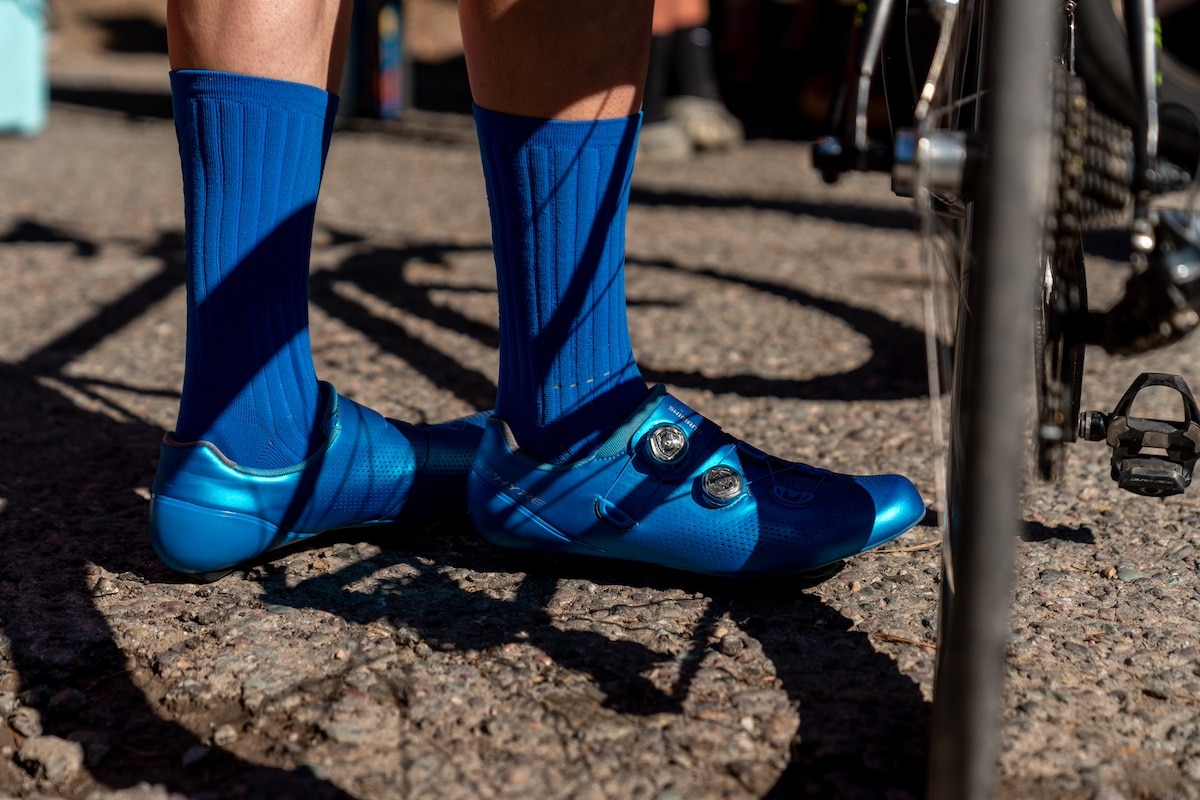
This year we saw the Watts Going On Award (highest watts recorded), the Panache Award (best socks-and-shoes combo), Parent of the Year (towing two children up), and of course the coveted Lanterne Rouge, a traditional cycling prize given to the last place finisher (the name comes from the red lantern that historically marked the caboose on French trains). And, finally, this year’s winner was told they would receive “a skull from Burns St. Bistro,” which—your guess is as good as mine.
In the parking lot, the party had swelled considerably and there were bikes everywhere, some propped against trees and cars, some splayed out on the ground. My pumpkin-laden friend fully unzipped her jersey and the pumpkin swung wildly, threatening to escape its sling as she laughed and hoisted her beer.
Sensing it was time to hit the ol’ dusty trail, I retrieved my bike and said my goodbyes. The last thing I saw before descending the hill was a knot of people on the pine needle-strewn grass, their race times of little concern, drinking from aluminum cans and water bottles, laughing. It’s the end of this race, but there’s still more ground to cover. Everyone will keep riding, alone and in groups, until the snow piles up.
For more bike news, check out the gallery from the recent Pan American Cyclocross Championships, which took place at the Missoula Mavericks Stadium on Nov 4-5.