In 1987, entomologist E.O. Wilson gave a speech at the National Zoo in Washington, D.C., which was celebrating the opening of its new invertebrate exhibit. Wilson took the opportunity to campaign for insects everywhere. “Let me say a word on behalf of these little things that run the world,” he said, and then went on to share some wild examples of the crucial roles insects play. His favorite example — and now mine — is the mites that live on the bodies of army ants, specifically one kind of mite that only lives on the hind foot of the soldier caste of army ants.
But very quickly, Wilson jumps to the hard truth: these insect ecosystems don’t need humans, but humans absolutely need these insect ecosystems to survive. They are the showrunners who lay the groundwork for our sustenance, even if it’s not visible to us.
“If human beings were to disappear tomorrow,” Wilson says in his speech, “Gaia, the totality of life on Earth, would set about healing itself and return to the rich environmental states of a few thousand years ago.”
But Wilson doesn’t dwell on the extinction of humankind. He’s not a doom-and-gloom type. Sure, humans could disappear, but it’s almost just as bad to survive and not care — to miss out on such a wild wonder.
The 2024 film The Little Things That Run the World, which references Wilson’s phrase, embodies this same idea. If you missed the secret screening of it at the Big Sky Documentary Film Festival a couple years ago — or any of the Roxy’s previous showings — you can catch it at the Roxy on Tuesday, June 23 in honor of World Pollinator Month. If you’re feeling allergic to bad news, you should still go see it. Yes, it is about the dire situation humans are in because of the decline in insect populations. But like the Wilson speech, the film doesn’t leave us stranded in hopelessness — though it kicks things off in a pretty spicy way.
All these little creatures we swat away and blast with pesticides? They run this joint.
The doc opens with a clip from The Hellstrom Chronicle, a 1971 satirical documentary horror film, in which a dramatic narrator — like a madman from the future — intones that if any living species is to inherit the Earth, it will not be man. It will be insects. I love a film about nature that doesn’t start out in the field with quiet narration. It’s a great trick — this classic framing of humans versus the monster. It says everything about the faulty logic around conquering nature that colonizers have long held.
The Little Things That Run the World is by Doug Hawes-Davis and Drury Gunn Carr, Missoula-based filmmakers who co-founded High Plains Films in 1992 and are, at this point, genuine OGs of independent documentary filmmaking. The documentary reveals the essential existence of flying insects — considered the most numerous and most overlooked class of animals on Earth — whose decline has been accelerating at a pace scientists find startling and have compared to previous mass extinction events.
The story of the decline is carefully folded into the fascinating stories of how these insects run the world. We learn that many don’t live long, but in that time they navigate a world of astonishing complexity. They are part of a well-oiled machine — the way they interact with other animals and plants, the very characteristics their particular type of species has evolved, is what makes the whole ecosystem function. Three quarters of all animal species are insects. They were the first animals to evolve flight, more than 400 million years ago, and they survived every mass extinction since. Their ecosystems are miraculous and precarious.
Films like this — that suggest humans are on the brink of destroying life on earth — aren’t easy to stomach. The Little Things That Run the World takes Wilson’s approach by leading with wonder rather than lecture. The film is visually stunning, with macro photography that makes flowers — in all their pinks, greens, and oranges — pop. And the insects! They are so in focus you can see their little hairs and the textured details of their sheer wings and alien eyes. It’s exquisite. The story is colorful, too, told through multiple voices — gardeners, farmers, nature enthusiasts and scientists who are real characters. And in total, they create a holistic view of the insect world — one that’s both scientifically rigorous and genuinely moving.
Hawes-Davis and Carr have award-winning docs under their belts, including Libby, Montana, which landed on PBS’s POV series and earned a National Emmy nomination. Hawes-Davis co-founded the Big Sky Documentary Film Festival in 2004 and it has since become a prolific, Academy Award-qualifying event. What they do so well is find just the right balance when tension between humans and the rest of the natural world is coming to a head.
Some nature films soft-lens everything — you’re an observer who gets to see nature apart from us. The Little Things That Run the World shows how complicit we are in insect population decline, partly in the way insects have been framed as both too little to matter and too pesky to care about, and also in a broader human tendency to make big decisions about things we don’t quite understand. The film and Wilson’s speech are both after something bigger: asking us to take a peek under the hood of the machine. All these little creatures we swat away and blast with pesticides? They run this joint. And that’s interesting, right?
I like that the message isn’t delivered gently, but also with hopeful passion. Most of us already know that the way we large-scale farm, consume and extract isn’t sustainable. We know what we’re doing to solve the issue isn’t enough. We’re right. And it’s actually worse than we think. But this gigantic, overwhelming problem is also solvable, with lots of small actions — and the film makes that case through examples of humans already working on it.
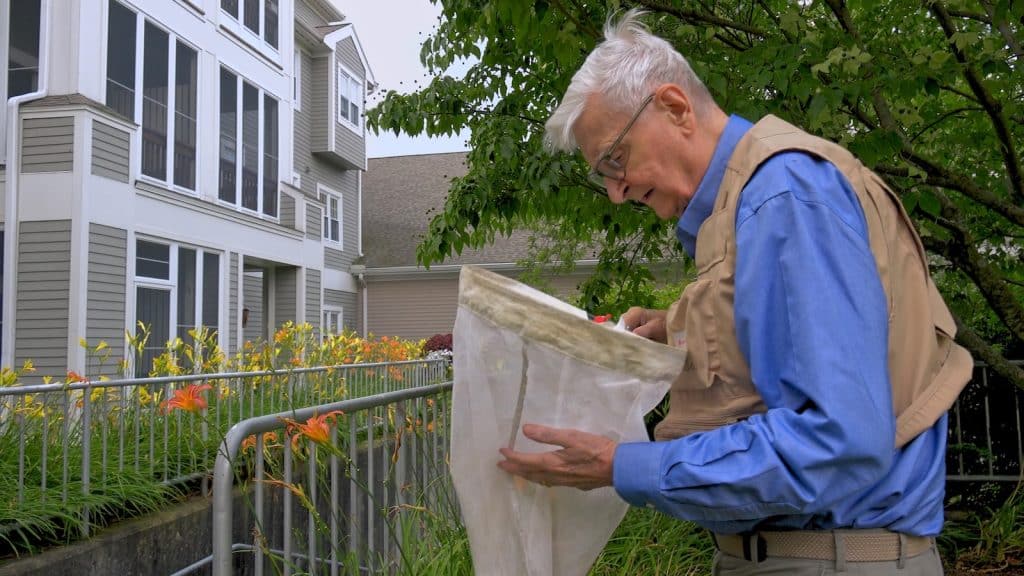
Wilson himself appears in the film, older now, squinty-eyed, dragging an insect net across some plants and coming up empty. It’s a kind of devastating image — the world’s foremost champion of these creatures, confronting their absence firsthand. But the film doesn’t leave us there. It leaves us with what Wilson left his audience with in 1987: not just the fear of losing something essential, but the choice to be aware and curious. And maybe, in the process, save ourselves, too.
“If humanity depends so completely on these little creatures that run the earth,” he said in his speech, “they also provide an endless source of scientific exploration and naturalistic wonder.”