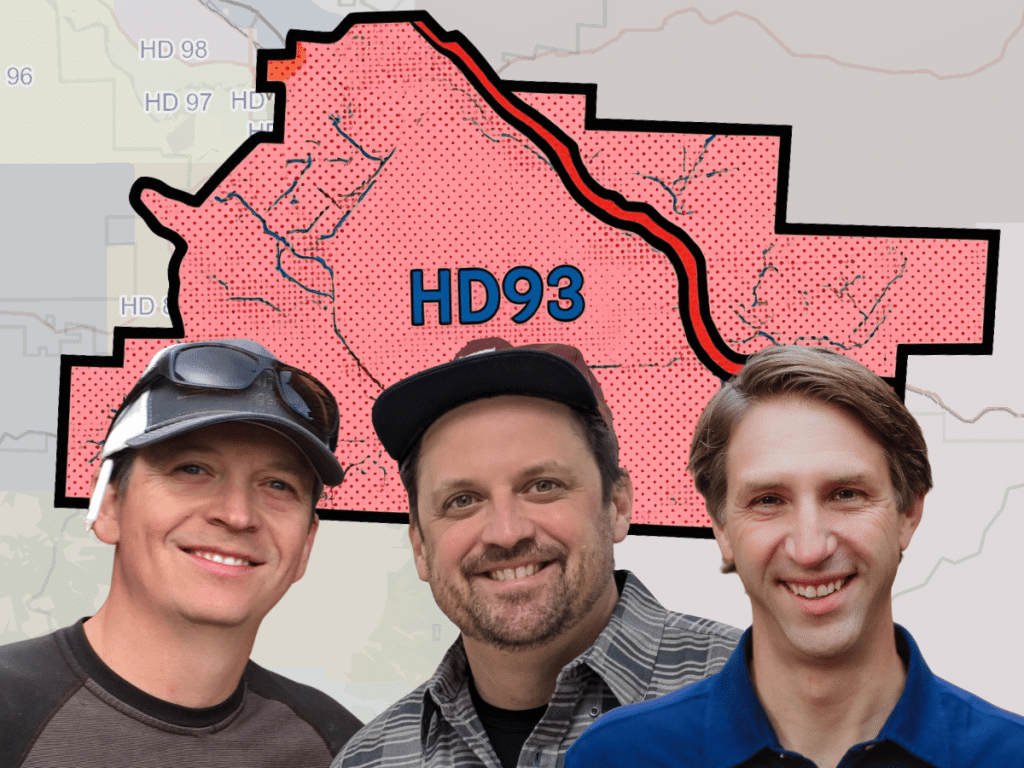
One is a builder who wants to bring Butte-style Democratic Politics to Missoula. The other, a former district attorney who runs a nonprofit that connects youth with professional mentors. The third, a Missoula local who sits on the board of the state Democratic Party.
They are Nick Kujawa, Ben Davis and Sam Kulla, and they’re challenging each other for the opportunity to represent Missoula in the state Legislature’s 93rd House District at a time when competitive Democratic legislative primaries are few and far between.
And while they have political differences, in the context of the wide partisan divide in Montana’s Legislature, those differences probably aren’t as important as who they are as people. Voters, in other words, will make some meaningful decisions in next week’s primary election on the policy front. But the real question is who they find trustworthy and experienced, who they feel represents who they are.
Do they want someone who’s been on the inside of the construction industry, someone who says he can deflate Republican criticism of Democratic ideas as anti-business? Do they want someone with a prosecutorial background and a record of nonprofit service? Do they want someone who has lived through layoffs and job hunts and is, by his own declaration, the only non-lawyer in the race?
Montana Democrats have worked hard in recent years to field more legislative candidates in more districts. And, as the Missoulian’s Carly Graf notes in a recent story, it’s largely worked: The party, long relegated to the minority in the Legislature, has fielded a candidate in 118 of 125 legislative races on ballots this election cycle. But one thing the party doesn’t have much of this year is competitive primaries.
HD93, which stretches from the Lewis and Clark Neighborhood to southeast of Clinton, is one of a few exceptions in Missoula County. House Minority Leader Katie Sullivan is termed out, and without an incumbent to protect, a competitive primary became more likely. And while the district includes some rural areas, it’s still solidly Democratic, so whoever wins in June is likely to win against Republican Roy Handley in November.
In interviews with The Pulp, the three candidates said the voters they speak to are largely concerned about similar issues: the cost of living, property taxes, access to healthcare and education. And some have broader, existential concerns.
“We’re talking about healthcare, education and the cost of living,” said Sam Kulla, who is running in House District 93. But he added that many voters, especially younger people, describe a “polycrisis” in their lives — a collision of high prices, low wages, a fraying social safety net, warming climate and geopolitical chaos.
“There’s this sense of an overwhelming need to solve everything at once,” he said. “But you have to take a hierarchical approach, and get people secure in their basic needs first.”
Sam Kulla
Kulla, the first to file for the seat, was born in Superior and grew up in Missoula.
He said he’s experienced these crises firsthand, navigating multiple jobs, layoffs, and a patchwork of social services.
“That range of experiences that I’ve had is why I’m running,” he said.
He once crewed oceanographic expeditions through the University of Washington and lost his job due to DOGE cuts. He was connected to a position at Submittable through the state job service but was laid off there. The financial disclosure he filed with the state shows that he owns no property and receives benefits through his partner’s job.
“I’m the only one of the three candidates in this primary who grew up in Missoula,” he said. “And I’m the only one who isn’t an attorney. I’ve had a very varied past. I’ve had professional jobs, blue collar jobs. I’ve worked in energy, the trades, education. I’ve lived in both urban and rural areas. I’ve seen the changes that our communities have undergone over the years.”
He says the first priority for the Legislature should be changing the property tax structure to protect people on fixed incomes or who otherwise can’t afford rising rates. And he wants to increase funding for the state health department and other agencies that provide some of the social services that he himself has relied on in the past.
“One of the least touted but most helpful social services that already exists is the Department of Labor and Industry’s Job Service. We need to lean into these existing systems.”
Kulla is no stranger to politics. In addition to his unsuccessful bid to oust Missoula City Council President Gwen Jones in 2023, he also serves on the executive boards of the state and county Democratic parties. But despite the soul searching that Democrats are doing in Montana and nationally after successive defeats and a collapse of traditional constituencies, Kulla said that, as a candidate, he’s not really thinking of the future of the party.
“You can put any letter you want after your name. If you zoom out, a lot of the problems that we’re facing right now with inaction are basically based on these team rivalries.”
”The most important thing is that we’re improving the lives of people in Montana,” he said. “Yeah, we want to elect Democrats. Yeah, we want to feel like our team will win. But you can put any letter you want after your name. If you zoom out, a lot of the problems that we’re facing right now with inaction are basically based on these team rivalries.”
Ben Davis
The second candidate to file was Ben Davis. He’s the executive director of Friends of the Children Montana, a nonprofit that connects youth with professional mentors. In a prior life, he was the chief research officer at Kharon, a global intelligence firm; a lecturer in the University of Colorado at Boulder’s international affairs program; a federal attaché in the Middle East tracking down financial backers of insurgent groups; an advisor for representatives in the U.S. Congress.
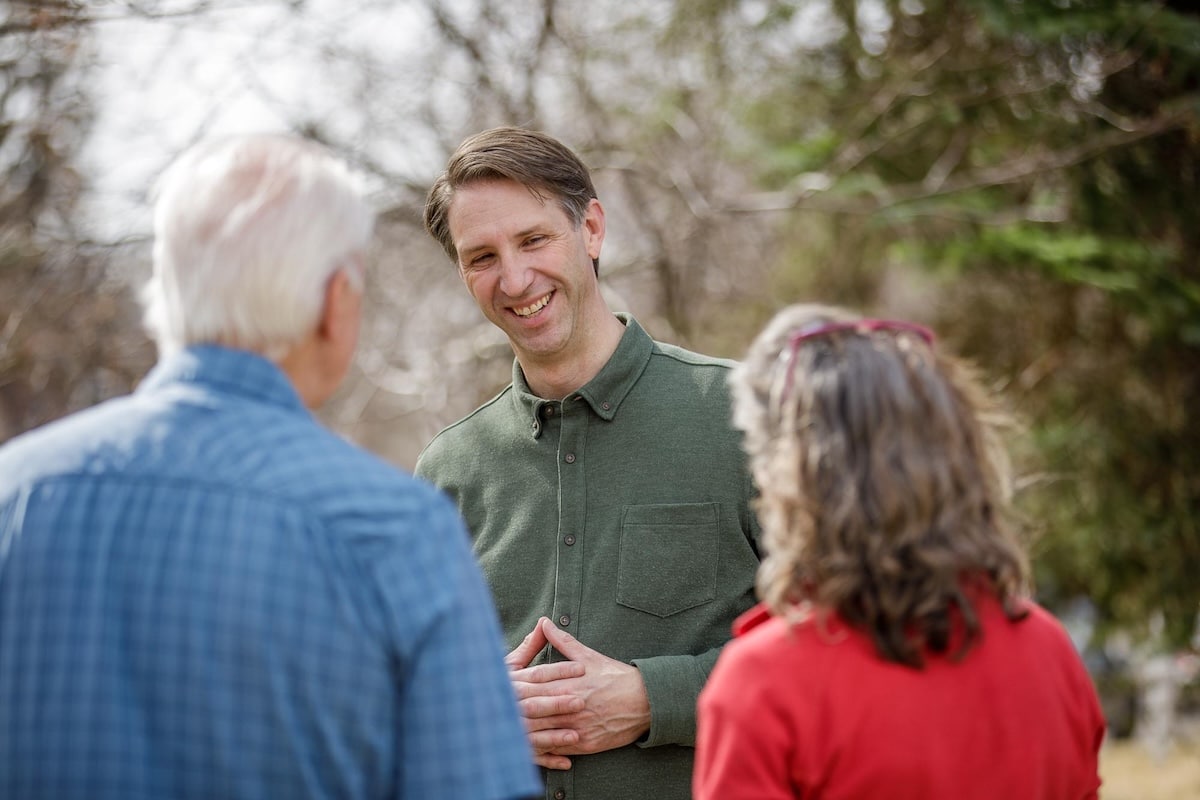
But despite his resume, his reasons for running aren’t all that different from Kulla’s.
“I lead a nonprofit that works to lift about 100 families out of generational poverty in the area,” he said, “and I just see so many families really struggling with the cost of living — too many people taking one step forward and two steps back. It’s not OK and I feel like we need to do something about it.”
He wants Montana to have a diverse, thriving economy, he said. But that can’t happen without tackling the housing crisis.
“If we are not figuring out the housing situation and developing more accessible housing options, regardless of community, and if we’re not investing in our schools and making sure that we have world-class education for our children, we’re going to be tying our hands behind our backs in terms of what the economic future of Montana looks like,” he said.
Davis moved to Montana about a decade ago after marrying a Montanan — fellow attorney Adrienne Tranel, the sister of Monica Tranel, a Democrat who previously ran for Congress in Montana and is now running for Legislature in House District 92.
“I married a native Montanan and we’re really proud to make this our home. I have four children who attend public schools, and this is just the place that we love. I think that the people are unique in their love of public lands and their individuality, their passion for community and love of place. I think there’s a lot to love that is unique about Montana.”
Like Kulla, Davis is also interested in a potential cap on property tax increases for people on fixed incomes. He also wants to see “targeted” taxes in the tourism sector to send some of the money that the millions of tourists who come to Montana each year spend to the state general fund. He also wants to see more investments in water, sewer and road infrastructure at the state level that can pave the way for new housing.
“If we are not figuring out the housing situation…we’re going to be tying our hands behind our backs in terms of what the economic future of Montana looks like.”
Davis stands out in the race for the amount of money he’s raised — more than $40,000, a huge sum for a Missoula legislative primary that dwarfs the amount raised by other candidates.
His campaign finance disclosures show mostly Montana donors and a handful from other chapters of Davis’ life — people from California, Colorado and elsewhere. He’s also lent his campaign $6,500 of his own money.
“I built this base of donors just from talking with thousands of people who are inspired by my campaign, my message and my ideas,” he said. “And I think it’s important to have a well-resourced campaign to deliver my message to all the voters in the district.”
Nick Kujawa
Kujawa was the third candidate to file. A former attorney — his bar status is no longer active, he noted in response to Kulla’s claim of being the only non-attorney in the race — he’s now a developer who focuses on brownfields and historic preservation, particularly in his hometown of Butte. Like any good Butte native, he wears his hometown on his sleeve.
“My great-great grandparents came from Ireland in the 1890s and went straight to the mines,” he said. “In the 1910s, my Polish great-grandparents came, and they were underground miners. And then my grandpa was in the operators union, and he helped dig the Berkeley Pit.”
This history is central to his campaign.

“Why have we lost so many union members to MAGA? Because we haven’t been talking about the issues of class,” he said. “Montana is turning back into the bad old days — the Copper Kings, the extractive economy, and people flying in on their private jets and buying ranches and closing off public access to land, and then, you know, running, a 40-head cow-calf operation and claiming that it’s agricultural land so they don’t pay property taxes.”
He said he tells people when he’s knocking on doors in Missoula’s HD 93 that he’s a Butte Democrat a la Pat Williams and Mike Mansfield. But he told The Pulp that the Butte message resonates in the district, his adopted home, as well.
“You go to Turah and Clinton and it’s trailers and chain link fences. That’s what I grew up in,” said Kujawa, who noted he was raised three-to-a-bedroom in a trailer in Butte. “And then, in this Lewis and Clark district, there are a lot of people who actually still are — I would call them, like a lot of people who are from Butte, Anaconda, and Deer Lodge — old-school Democrats.”
His main pitch, though, is that he’s a builder.
“What Democrats need is a builder in Helena.”
“That’s what I’ve done for the last 20 years — building housing for Montanans. And what Democrats need is a builder in Helena,” he said. “We’ve got 42 Democrats in [the Legislature], and when you go through all of them, we have amazing Democrats who are teachers, who are wildlife biologists. We have a river guide. We have firefighters and small business owners, and we have attorneys, and we have a ton of nonprofit leaders. But we have zero builders.”
Republicans, on the other hand, have quite a few developers and builders, Kujawa said, and when Democrats bring legislation to make housing more affordable, they’re often met with the argument that they don’t know how the industry works. “One of the difficult things is that we had nobody there to push back and say, ‘I’ve been on the inside, I understand how this works.’ And that’s complete bullshit.”
Like the other candidates, housing is his top priority. He wants to see, among other policies, a property tax “circuit breaker” — a type of tax credit for people who are burdened by property taxes. More broadly, he said the state needs to rejigger the tax code to at least partially decouple education funding from rising property taxes that people increasingly can’t afford.
Overall, Kulla said the primary campaign has been “wildly respectful.”
“We call each other. We talk to each other. This is a respectful, aboveboard primary,” he said. But in a race largely about personal identity and experience — especially economic experience — there are some tension points. Davis, for example, owns multiple rental units, according to his financial disclosure.
Kulla said this means Davis has a fundamentally different experience than much of the district’s constituency — people who are struggling to afford rent.
Kujawa, as a developer, has his own potential vulnerability on that front. But he said his professional history is more of an asset.
“People recognize that the system is broken,” he said. “If your heating system goes down, who are you gonna call? The HVAC guy? Or are you going to go call someone who’s unemployed. No, you want the expert to come in and fix your system. You don’t want to go get your neighbor who’s like, ‘Oh, mine’s broken too, I feel your pain.’”
And there’s also a question — as in all Montana elections — of Montanan-ness. Kulla probably wins top marks in that regard, but Kujawa has his deep roots as well. Davis notes that he’s the only person who actually lives and works in the district — Kujawa’s work is mostly in Silver Bow County, whereas Kulla technically lives in a different House district. That’s not against the rules, but it is something to note.
Kulla said he’s not interested in litigating the depth of people’s local connections, but especially in a race where the policy prescriptions are generally similar, these distinctions can be important.
“Just because you’ve been successful in business doesn’t mean you can represent a diverse constituency,” he said.