Missoula’s infamously stressful but largely unavoidable Reserve Street could be called a “stroad.” Bridgette Whiteman, a recent University of Montana graduate who’s been studying noise levels on Reserve, describes that as “the unholy combination of a street and a road.”
The term comes from civil engineer Charles Marohn, who ranks among the world’s all-time most influential urbanists (No. 15, to be exact—three spots ahead of Frank Lloyd Wright—according to Planetizen’s 2023 list). He founded the nonprofit Strong Towns, which advocates for a radical departure from the suburban experiment.
Marohn defines a street as a human-centric environment that’s meant for business and culture. Higgins Avenue is an example. A road is designed for vehicles to get from one place to another quickly.
Reserve somehow achieves neither while trying to be both. And in doing so, it’s inefficient and dangerous.
Between 2017 and 2021, more than 5,000 people were involved in crashes in the Reserve corridor between Brooks and Interstate 90, including 30 incidents with non-motorists, 64 suspected serious injuries and two fatalities, according to data from the Montana Department of Transportation.
Whiteman started scrutinizing these kinds of urban designs while working at a business on Reserve’s sister stroad in Great Falls: 10th Avenue South. She was commuting there regularly.
“It got me thinking about stroad developments and how pervasive they are in our society and how they dictate car dependency,” Whiteman said.
When she came to the geography program at the University of Montana, she and her lab partner, Kim Kresan, decided to collect data on Reserve Street. The pair focused on noise.
Whiteman and I recently parked matching Toyota Priuses on Reserve to talk about her work. From our table at Liquid Planet, she gestured up and down the corridor, describing the survey locations where she and Kresan measured noise levels and counted vehicles during different periods of the day over the course of three months.
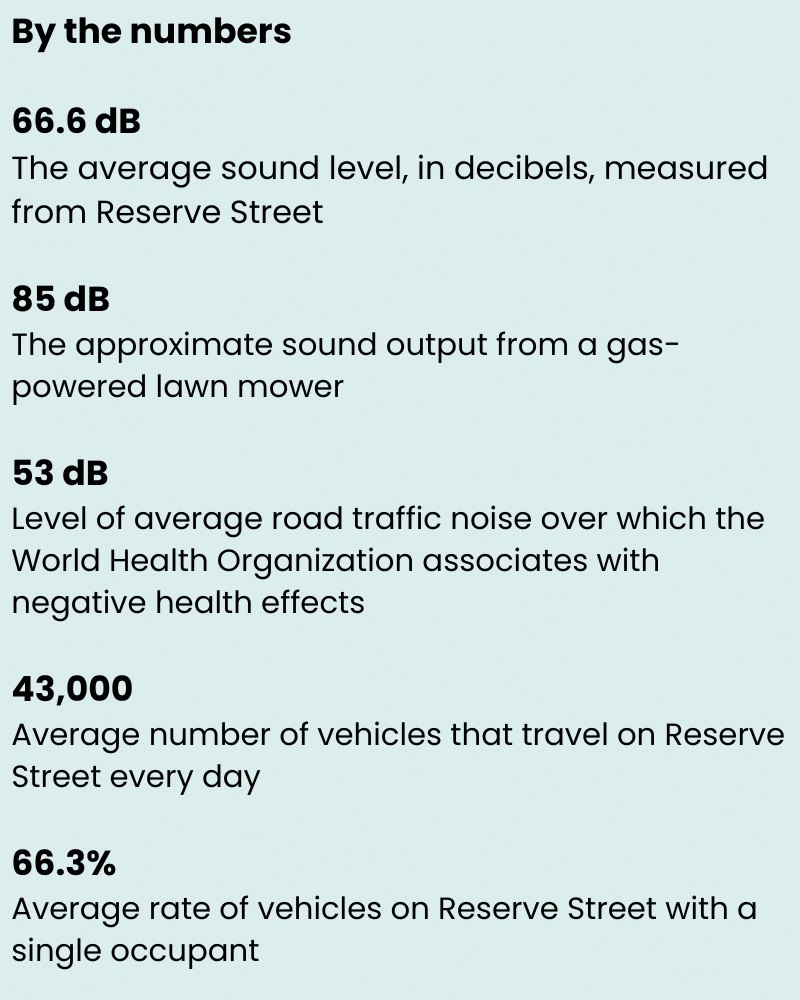
According to the team’s data, the average noise level coming from Reserve Street roughly during business hours is 66.6 dB. The World Health Organization says regular exposure to 53 dB of traffic noise can negatively impact health.
And the difference between those numbers is more, um, blaring than it sounds. That’s because the decibel scale is not linear, it’s logarithmic. Every increase of 10 dB about doubles the loudness as perceived by human ears.
Prolonged exposure to loud sounds is starting to gain attention as a serious health problem. Studies across the world have shown that chronic noise increases the risk of hypertension, stroke, heart disease and heart attack.
“A lot of people, when they think about noise pollution, they think about a big city, and it’s like, ‘Oh, well. We live in a small town. We don’t have to worry about noise pollution,’” Whiteman said. “[But] we kind of do, especially in [the] car-dependent infrastructure that we live in. Especially on Reserve Street.”
And Reserve’s design tends to encourage dependence on personal vehicles. Few brave its unprotected bike lanes and none of Mountain Line’s bus routes run along it, given how unpredictable the schedule would be.
The message sent to pedestrians and cyclists is, “Yeah, go get in your car, dumbass,” Whiteman joked dryly. “What are you doing here?”
Whiteman and Kresan also studied the relationship between noise levels and vegetation like bushes and trees. Vegetation helps dampen sound. But Reserve, of course, is mostly pavement and concrete.
This creates other problems, too, like the urban heat island effect and interference with rainwater filtration.
Issues with Reserve Street aren’t going overlooked by the city. Aaron Wilson is the planning manager for Missoula’s Public Works and Mobility department. His job boils down to planning the future of the city’s transportation system.
Wilson is also familiar with the concept of a “stroad.” In his opinion, Reserve is “an OK example of a stroad. But it’s not the worst example I’ve seen out there in the world,” Wilson said, with a nod to the East Coast.
On Reserve, Wilson said his department hasn’t put much thought into noise pollution. Its primary concerns are safety, accommodating growth and the question: “How does it operate and what are we trying to achieve?” as he put it. He, too, understands that Reserve isn’t achieving any single transportation goal well.
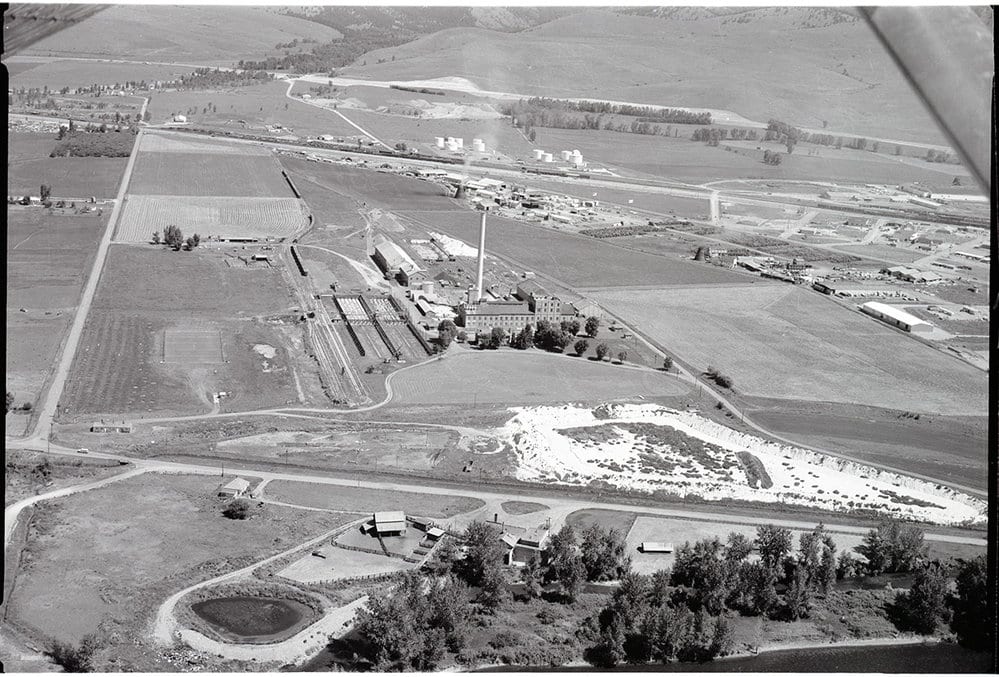
Wilson explained that Reserve Street was originally built as a way to connect the Bitterroot Valley to I-90 while avoiding downtown. In the early ’90s, the street was widened but remained somewhat rural. Then came a boom of big box stores and auto-oriented development, rendering the bypass function of Reserve as “almost superseded by local traffic,” Wilson said.
He added that it only took about a decade after widening the road for it to hit the levels of congestion we experience today. It was an “If you build it, they will come” scenario with “they” being national retail chains, fast food joints and the associated traffic.
In October, the federal Safe Streets for All Grant Program awarded Missoula $380,000 to study ways to make the thoroughfare safer. Wilson expects that work to start some time this summer and take about a year to complete.
The study, which will include ample opportunity for public input, is intended to help the city wrestle with the question, “Are we designing a safe highway corridor or a safe urban street?” Wilson said. “Those have really different solutions.” And different solutions might make sense at different points along the corridor.
When asked what solution Wilson would implement if he had a magic wand (i.e. without worrying about costs or displacing businesses), he said he would create spaces that are better separated for different users—pedestrians, cyclists and motorists driving through.
Wilson said building the South Reserve Bitterroot Trail Bridge, which opened in 2017, is a great example of an intersection where all users can cross without impeding one another. But the price tag for that bridge was over $4 million.
Another complication is jurisdiction. Reserve is part of U.S. Highway 93, a federal highway maintained by the Montana Department of Transportation, a state entity. The city, county and others get a say because they’re all part of the Metropolitan Planning Organization, an entity that ensures coordination across parties and is federally mandated for urban areas of a certain size.
“It’s a complicated decision-making environment,” Wilson said.
But all of that gets a little lost amid the road-rage-inducing experience of running errands on Reserve.

Back on the stroad in question, I asked Whiteman what changes she thinks could help make Reserve a safer and healthier area.
In the short term, Whiteman thinks the speed limit should be reduced. It’s currently 45 mph.
In her magic wand vision, Whiteman sees a tram, perhaps, that would run up and down the street, delivering humans and reducing traffic. She’s also an advocate for rail infrastructure that connects Montana in bigger ways—from Coeur d’Alene to Helena to Great Falls. And from I-90 to the Bitterroot, perhaps restoring Reserve’s original function.
Before parting ways, Whiteman and I walked toward a particularly infamous intersection (next to Costo, of course) and she recalled (in an increasingly louder voice to be heard over traffic) trying to cross the street on foot while taking noise measurements for her study. She remembered a turning car that never quite stopped, as if in denial there was a pedestrian there at all.
At the corner, I snapped a photo of Whiteman. Without my direction, she lifted her arms, rotated her wrists, and turned two thumbs down.