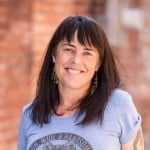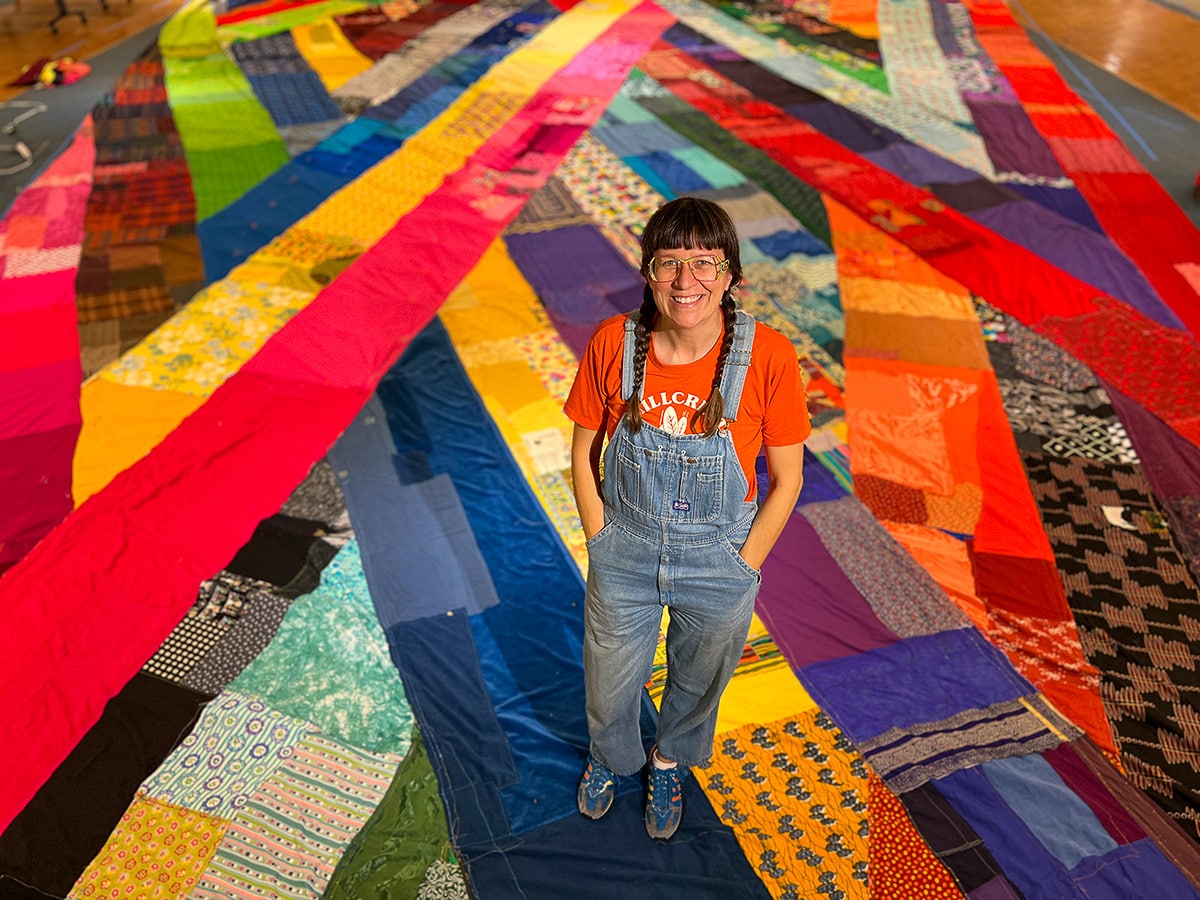
Amanda Browder, a Brooklyn-based textile artist who grew up in Missoula playing cello and haunting the counter at Carlos One Night Stand vintage clothing shop, has spent the better part of two decades turning donated fabric into monumental public installations. She has draped buildings and bridges from Tokyo to Belgium in swaths of eye-popping color and shown at White Columns in New York, the Triennale Brugge, Nuit Blanche in Toronto, and dozens of other spaces worldwide. Last year, she picked up the Iowa Governor’s Award for Arts in Service. You might have seen her work in January 2024, when she filled the Brunswick Gallery with an indoor installation called “Contour.”
This fall she’s back for a bigger, more extended project. UM’s School of Art and Game Design secured funding to bring in two artists for community-based projects, and Browder — whose whole practice runs on public collaboration — was an obvious fit. The result is “Soft Monuments,” a semester-long residency (and the name of the course she’s teaching) that engages students and community members in two large-scale textile works: one draped over the Music Building on campus, the other over the Brunswick Building downtown.
Making this happen means two months of public sewing days, fabric donation bins scattered across town, and a lot of math. We caught up with Browder — a friend since high school — by phone from Racine, Wisconsin, where she’s mid-installation on another project, to talk about how Soft Monuments comes together. Our conversation has been lightly edited for clarity.
The Pulp: To start, can you give a general overview of the class you’re teaching?
Amanda Browder: The class is really teaching the students how to deal with community-based artworks and going large scale. We’re breaking up into groups. Some are doing marketing, some are doing community outreach and storytelling.
We’re going to have two galleries we’re working with: the Knowles Gallery [on campus] and the Brunswick Gallery.
We’re going to be sewing a bunch on campus. That’s where we’re going to have a living wall where the students are going to do different projects on the walls related to the sewing [process]. It’s going to be a thing that builds over time. It’s kind of a Fluxus project.
The Brunswick is going to be a gallery show of the students’ work, and they get to decide what it is. There’s a lot of flexibility in this class because temporary public art is always — you have to go with the flow. So you’ll start one direction, then you’re like, “Oh, I’ve got to pivot over here.” The idea is that I’m setting up these spaces for art experiences.
Because this is temporary public art, you can be a little bit more garish and more intense, right? Knowing it’s not going to be there for that long. It actually leaves people wanting.
And then how does the class connect to the large community projects?
We’re going to be draping the brick wall of the music building at the university. Maybe not the whole wall, but it’s going to be a section of it near the entrance. What’s great is that everybody can drive past it — it’s accessible. You can actually just see it from the road.
And then on top of that, we’re going to go down to the Brunswick and cover the Brunswick building.
You have a long history with the Brunswick.
I love the Brunswick building because it’s an artist-run space, and I just really like championing those kinds of contemporary spaces in small towns. All the artist studios that are upstairs are lower cost. Leslie [Van Stavern Millar, the owner] really wants to make sure the artist studios are available to more people in the city. So I just want to celebrate that and put some light on it.
And you’ve installed work there before, right?
Last time, I encased the whole floor in the Brunswick building in fabric. That was two years ago. So, we did it on the inside then, and now we’re going to do it on the outside. It’s going to be on the north wall, and maybe on the west wall, with the idea that you could even see it from Waterworks Hill. I really like that about this scale.
So right now we have this huge calendar of public sewing days, and Jennifer and I have been working all summer to schedule these. We’re adding more and tweaking it as we go. But what’s great is it’s going to move people all over town and really incorporate different community groups. We’re going to be at the Senior Center on Sunday, and what’s cool is it might be people from there, it might be students, it might be — I don’t know. We’re gonna find out.
What should people know if they want to come to the public sewing days?
No experience necessary. Just come. You could organize fabric, pin fabric, sew. We will teach you how to sew if you want to learn. If you have a weird machine that’s not working in the back of your closet, bring it. I will try to fix it and show you how to thread it. It’s just a place to be creative.
I’m hiring Aaron Jennings [local musician, yodeler and owner of Listening Hat Records] next month to come to the space, and we’re going to make a recording of the public sewing day. The idea is to have an audio document of what’s happening there. We don’t know what’s going to happen in those times. Whatever it is, is what it is.
The hope is people pop in. Bring your instruments. You want to play some music for us for a little bit? Tell us a story? That would be great. It’s a really open forum for just being creative, and you can just hang out.
What about donating fabric?
We’re always looking for colorful fabric. So cotton, non-stretchy, saturated colors, and there’s bins all over the place where you can drop them off. It could be a small chunk. And it can be one foot square sizing. That’s fine.
If you want to support a local thrift store, go buy some fabric from them and bring it to the project. Or if you have fabrics you want to bring, bring them. If you put a story on it or give us a little information, we can make sure you find it [in the final installation]. Sometimes, people tell us stories about the fabric that they brought. It can be about their mother, someone in their family. There are these embedded stories that go into the donated fabrics. That’s a big part of the project.
These pieces work on a gut visual level, but there’s also a big conceptual side. How do you think about both of those layers?
The reason I work at large scale is to make people understand their human scale, because a lot of times we connect fabric to something home-related or smaller. Or something more private. And so if you make it that big, all of a sudden you have a reference of how big that building is.
And especially if you’ve worked on it during the public sewing day, you’ve worked on this table that’s pretty small, and you’re connecting with people and chatting with them. And then when you see it up on the building, there’s this level of vastness, and it just… I don’t want to say it makes you feel small. It actually makes you feel bigger. Like your heart gets bigger because fabric is so emotionally connected. Then on top of that, with the scale and the familiarity of the location, it becomes something much more connected.
Tell me about the temporary aspect of this work.
Because this is temporary public art, you can be a little bit more garish and more intense, right? Knowing it’s not going to be there for that long. It actually leaves people wanting. That’s the thing I’m trying to do, too. A lot of times in towns people make stereotypes around contemporary art as being inaccessible, or “I don’t understand it,” or “I don’t feel connected to it.” And so this is art you’re connected to and when the piece comes down, people are asking, “Wait, what’s the next piece? What’s going to happen next?”

And then that questioning becomes a way of support for the local arts community. So there’s this interaction of artist and viewer that’s hands-on and personal. There’s this civic collective creativity — that everybody is welcome to come to the project, even if they don’t make anything. It’s showing that the collective can mean something that large and awe-inspiring.
It’s kind of like… I talk about going from home to work. We lose track of our environment. You see these buildings, but they just blend together. And for this, the idea is to scale-shift it and kind of shock and awe you.
How do you actually design these installations and figure out how they’ll come together on the buildings?
Usually, I have a design already, but I’ve been too busy with this project. The design is based on how viewers are going to see the space. I’ll have a design in the next couple weeks that’s publishable to show people, and we’ll print it. Even right now, with the public sewing days, we’re just taking the fabric, organizing it by color, and essentially making new bolts of fabric — strips of fabric that are 40 to 50 feet long. Because I’ve already measured the building, and I can say, “Okay, so if we’re doing a diagonal, it has to be this length.”
There are a lot of dynamic lines. And in the urban landscape, we have a lot of rectangular aspects and browns and grays, and so this is going to break all of that up with more diagonals, maybe a curve. I don’t know. Let’s see if we can do it! So the design is how you’re going to see it when you walk past it, and how it’s going to affect the building. What’s behind it? How is the mountain getting involved?
I take a ton of photographs just to get a concept of how I am going to recreate this space.
It just occurred to me how perfect this kind of art is for you because I think of you as such a colorful person, but also as a math person. You’ve always loved math!
I know, yes. Oh my god, Pythagorean Theorem and I are best friends. I use it a lot. Yeah, and you should see this piece here in Racine. It’s bananas. Like I’m adding and subtracting every 20 minutes. It’s a lot of math.
As a nod to that: Every quilter that I’ve ever worked with uses boatloads of math as well.
Speaking of that, you’re clear on not calling these pieces “quilts.” Why is that distinction important to you?
The reason I make that distinction is not to diminish quilting. It’s more to support the quilters into that hierarchy of contemporary art. There’s this stereotype with quilters. I’ve had women come to me and they say, “Oh, I’m not creative but I made 15 quilts last year.” [Laughs] Because there’s this thing about calling yourself an artist versus doing something like quilting that supposedly is separate, and I disagree with it. And I think quilting is an extreme strength.
So these are contemporary art installations. They are large-scale textile installations. They’re patchwork-like, totally. But not quilts. The quilt thing becomes too diminutive, and it falls back into the stereotype of women as sewists. I don’t sew clothing. I’m horrible at it. I have no clue how to do it. I can cover buildings, I can’t cover bodies.