Every cook, in every kitchen, in every era, on every continent, knows that when you roast a bird, you stuff that thing. Otherwise it’s a wasted opportunity to impregnate that stuffing with rich, greasy flavor. I believe the first Thanksgiving, in 1621, was no exception.
At that first supper there was no pumpkin pie, as butter and flour were scarce. Nor marshmallowed sweet potatoes. But historians agree that wild fowl was likely on the menu, along with other wild meats like venison. Birds on the menu means there was probably some kind of stuffing.
Historians also believe that the first Thanksgiving menu featured seafood, in part because the regional diet around Plymouth was heavy on seafood like clams, scallops, seaweed, oysters, mussels, eels and fish. I imagine that the stuffing was composed of such delicacies.
“The skin of an extra-stuffed bird will have receded like the tide, leaving a bunch of mussels clinging to the bird like it’s a beach rock.”
Where I grew up in coastal Massachusetts, we would sometimes have clambakes, in which we would dig a hole in the beach and fill it with seaweed, corn, potatoes, lots of seafood and hot rocks. Along these lines, I figured, why not have a clambake inside a bird? Thus, my Thanksgiving seafood stuffing recipe was conceived. It may not dissolve the animosity at the table, especially if politics comes up. But it’s delicious enough to keep everyone’s mouths too stuffed to argue.
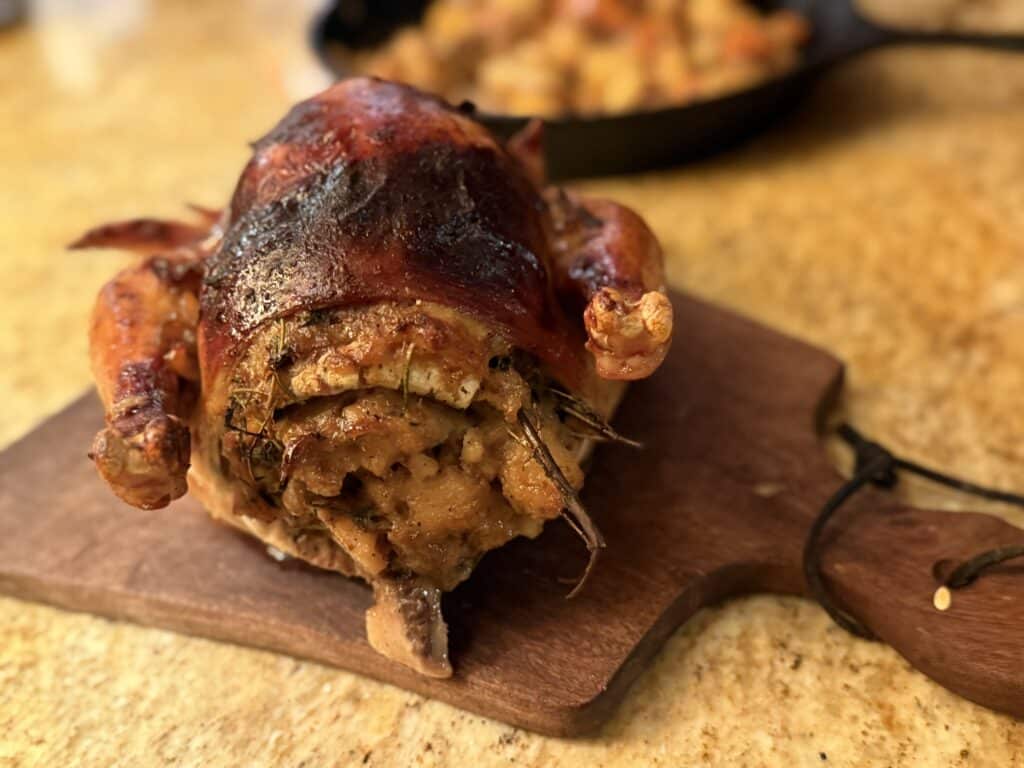
Roast bird with saltwater stuffing
This somewhat fanciful and totally delicious recipe for seafood-stuffed chicken can easily be scaled up to a turkey-sized bird. Feel free to add your favorite stuffing materials to make it your own.
It starts off with an overnight salt brine, which not only seasons the bird but also causes it to hold more water and thus stay juicier. Since we are going for a maritime feel, I add some salty clam juice to the brine. (Some clam juice is salty, some isn’t.)
I also use lemon in this recipe, as both chicken and seafood taste good with lemon.
The mix of seafood is flexible. I really like imitation crab meat because it soaks up flavor so well. And the last time I made this stuffing, I used frozen breaded scallops and calamari, and the breading fell apart into the stuffing wonderfully. I also like to use a piece of cod, a nod to the proximity of Plymouth to Cape Cod. Lobster meat is also a luxurious touch. When using shell-on seafood like clams or mussels, I steam them separately and then remove the shells, because the shells take up too much space.
Serves 6
- 1 4-pound bird
- 1 10-ounce bottle salted clam juice
- 6 teaspoons salt
- 2 tablespoons olive oil
- 2 cups minced onion
- 2 cloves garlic, minced
- 1 apple, red or green, chopped
- 1 teaspoon black pepper
- 3 tablespoons chopped fresh sage
- 2 sprigs fresh thyme
- 2 sprigs fresh rosemary
- 2 pounds seafood of your choice (clams, scallops, mussels, oysters, cod, imitation crab, lobster, fish sticks, etc.)
- ½ cup white wine
- 1 cup crouton-sized breadcrumbs (not necessary if using breaded seafood in the stuffing)
- 2 lemons, cut into quarters
- 1 cup chopped carrots
- 4 potatoes, cut into quarters, to surround the bird
Rinse the bird, remove any giblets stashed in the cavity and cover the bird with water in a pot or bowl. Add the clam juice and salt, and brine in the fridge for a minimum of 4 hours, preferably overnight.
Steam or boil the shellfish and remove the shells. Reserve what’s left of the shellfish water to add to the baking dish if it starts to dry out.
Pat the bird dry and put it in a roasting pan. Add the oil to a fry pan and sauté the onions, garlic and apple with the black pepper and herbs on medium heat. After 10 minutes, add the seafood, wine, lemon juice and a few of the lemon peels, and cook a few minutes longer. Add the breadcrumbs, stir it all together and stuff it into the bird. Place the potatoes, carrots and any stuffing that doesn’t fit into the bird along the bottom of a baking dish, and place the stuffed bird on top.
Cover with foil and place the whole business in the oven, preheated to 350 degrees. After 90 minutes, remove the foil. The skin of an extra-stuffed bird will have receded like the tide, leaving a bunch of mussels clinging to the bird like it’s a beach rock. The stuffing on top, including the seafood, will hold the baste like a sponge. Turn the oven down to 300 degrees. Baste every 15 minutes until the bird’s internal temp is at least 165 degrees. Rest, serve and stuff your face.