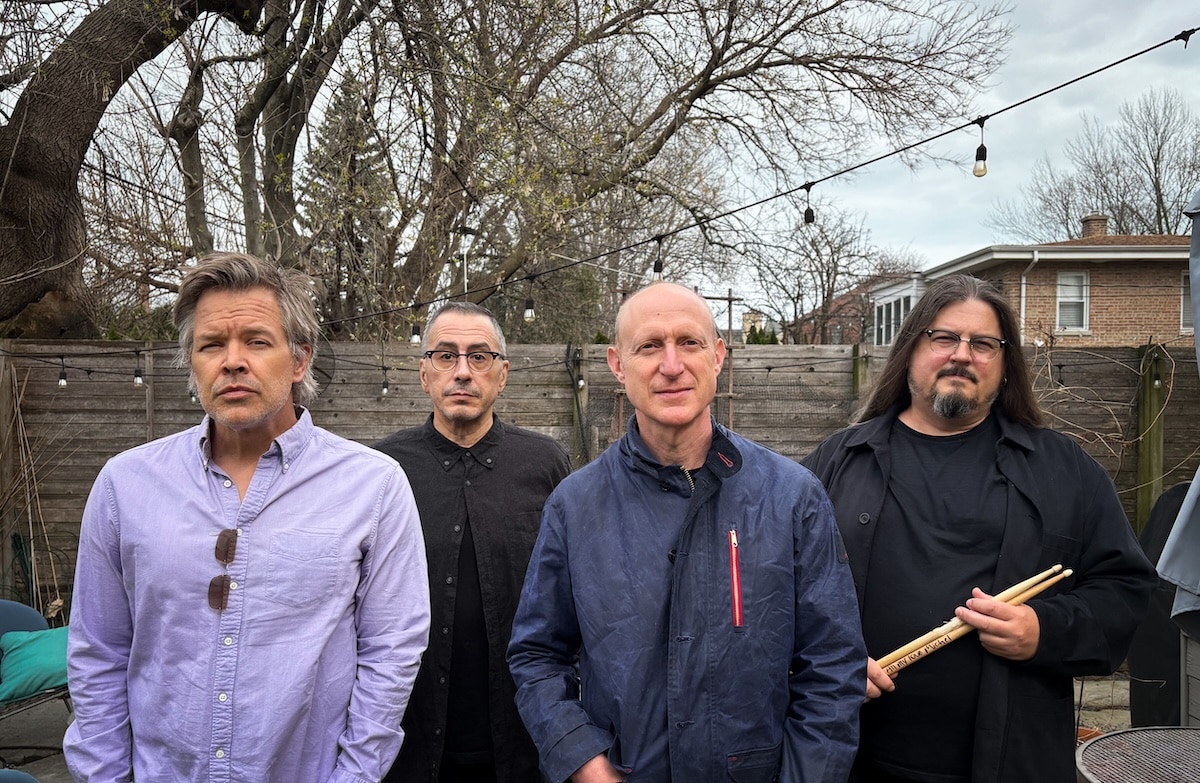
When Silkworm drummer Michael Dahlquist was killed in a car crash by a driver trying to take her own life in 2005, there was no replacing him. The remaining members, bassist Tim Midyett and guitarist Andy Cohen, felt it before they even had to say it. The band was laid to rest along with Dahlquist, 39, who was its great big heart both as a human and a player. Midyett and Cohen continued in a new group, Bottomless Pit (with a new rhythm section and Midyett playing baritone guitar) from 2005 to 2014.
And then, in 2024, another awful loss: Steve Albini, who grew up in Missoula and not only recorded all of Silkworm’s albums, but, along with his wife, Heather Whinna, had become like family (Whinna even had producer credit on two Silkworm records, which was both a legitimate reflection of her input and an affectionate joke about her husband’s eschewal of being called “producer”). Albini had just finished working on the latest record by Midyett’s newest band, Mint Mile, when he died of a heart attack on May 7, 2024.
With Midyett, Cohen, and Silkworm founding member Joel RL Phelps (who’d left the band in 1994) all planning to attend Albini’s memorial in Chicago that July, it was also felt as much as said: Silkworm would be part of it, with Mint Mile’s Jeff Panall on drums. (Panall was also in Songs: Ohia with the late Jason Molina — another Albini project.) And that experience was good enough — both emotionally and musically — that it felt right for the band to play more shows, the first of which were in the fall of 2025, in Chicago and at Gonerfest in Memphis.
Silkworm were a Chicago band. And before that, a Seattle band. But it all started in Missoula, where high school students Phelps (Sentinel) and Midyett and Cohen (Hellgate) first played in Ein Heit. And now, on what is basically the fourth leg of an intermittent tour, they’re home at last, playing the Showroom at the Zootown Arts Community Center (ZACC) on Aug. 25.
The Pulp spoke to Midyett about how it happened, the band’s early days, and what may — or may not — be next.
The Pulp: You tell a couple of stories about meeting Steve Albini in the Silkworm documentary Couldn’t You Wait. But what did he mean to you before that, in Missoula?
Tim Midyett: His reputation preceded him. We knew all about his various kind of cretinish exploits (laughter) in high school. And the review of Just Ducky playing a prom in Hot Springs. He was a lunatic, kind of, but also well-liked by other lunatics.
And we heard those records. We thought [Big Black’s] Lungs was really funny. It didn’t seem like… bitchin’ to us. We just thought, “Oh, this is funny. The guitar sounds cool, but what’s up with these songs? They’re hilarious.”
And then the other records came out, and you were like, “Oh, we love this band.” We went to see them in Seattle in ’86.
We had a bunch of meet-cutes over the years, and then we recorded with him at his house in ’92, and that’s when we started to become friends. I’d say by the time we made Firewater, in ’95, we were good friends. And then super-close for 30 years after that.
“The very first time we recorded with [Steve Albini], everything sounded great except the bass … he actually was kind of not that great at recording bass. By the time he recorded In Utero, he was great at it. I like to think I had something to do with him getting better.”
One of your early meetings was at Rockin Rudy’s. What do you remember about working there? Any particular record you got people into?
I got good at recommending stuff to people. I remember selling a lot of New Order records to, like, aerobics instructors. You’d play it for them and they’d be like, “Oh yeah, I can work with that.” It was a very free-wheeling place back in the day. It’s more like a department store now. Justifiably so, ’cause it’s so huge. You couldn’t run it the way it was run back then, that’s for sure.
I started working there when I was maybe not quite 14, and it was the best possible job I could have had in my late teens and early 20s. I mean, it was perfect. And the guys who ran it, Bruce Micklus and Tim Bierman — who runs Pearl Jam’s fan club now — [made it] just an awesome place to work. I got so many good records out of it. Spent a lot of the money I made on records!
So do you feel like Missoula still claims Silkworm as much as Chicago or Seattle, or no?
It’s hard to say that, because the band only existed there for a few years, and only in varying forms, right? ’87 to ’89, because we moved [to Seattle] in January of ’90 [Editor’s Note: which is when and where Dahlquist joined].
But that’s where we learned how to play. From Joel, and the other guys in Ein Heit — John Kappes and Tom Kipp. That’s where we learned how to be in a band. The whole aesthetic came out of doing that. So, the fact that we cut our teeth there, and the attitude we had about doing stuff, and have had ever since — that makes it super-important.
What made Albini such a good producer for Silkworm?
Well, that he didn’t produce anything. The very first time we recorded with him, everything sounded great except the bass. And I was like, “What’s up with the bass?” And he’s like, “That’s what it sounds like.” And looking back on it, he actually was kind of not that great at recording bass. By the time he recorded In Utero, he was great at it. I like to think I had something to do with him getting better, because I nitpicked later.
But we had one day to do that whole EP, and he was right that it did kind of sound the way it sounds. Every other record we’d ever made, they’d do all this stuff to [the bass] to compress it. So, hearing what it actually sounded like was huge. And it was really gratifying to hear the drums and the guitars. We were like, “man, that’s it.”
So tell me about working with Steve on the most recent Mint Mile record, andwhichstray, which came out late last year.
Yeah. It was crazy that it happened, given that he died just a couple days after we got back. We had to do some stuff to finish it later, and it got mixed later. But we ended up going to France to do this thing. It was part of a [recording] seminar. McLusky was going to do it, and they canceled, so Steve asked if we wanted to do it. I did the math, and I’m like, “Well, it’s actually the same price or cheaper than recording with Steve at Electrical Audio. We’ll be under the gun. We’ll have to get something done.” We piddle around a lot, that band, at my house.
And it was awesome. I hadn’t made a whole record with him since the last Bottomless Pit record. It just instantly sounded great, and we had a great time. Got to hang out a lot, ate great food. It was just such a uniformly pleasant experience… and such a huge contrast to like, a week later, when we were grappling with what happened when he died.
And it’s odd: you would think that the second one would ruin the first one, but that’s not the way it was. The fact that the first one happened, somehow, for me, made it easier, mildly. It was just illustrative of the way life is, I guess. Sometimes things are great, and sometimes they’re horrible. To get two sides of the same coin, one after another, doesn’t feel like whiplash to me anymore. It might have 20 years ago.
And then it also leads to Silkworm reuniting.
Yeah. With Steve’s memorial, Andy and I were like, “Should we play some Silkworm songs with Jeff?” And then we found out Joel was going to be there. And we were like, “Well, this is pretty low stakes. The fact that we’re even there trying will matter.” It’ll matter to Heather, and it’ll matter to some other people there. So even if it’s not that great, it’ll still be worth doing.
So, we did it, and it was shocking how good it was. I mean, it just sounded great. Playing with Jeff, that was the big thing. Can he do anything like what Michael used to do? And it turned out he totally could. It’s not the same, but it’s very good, and drives the whole thing.
And Andy and Joel, we hadn’t played together … Joel started the band in ’87, and he left the band in ’94, after we’d moved to Seattle and sort of worn him out by touring too much. And then we kept touring too much for 11 years after that. So, seven with Joel, 11 without him. But then there’s the Ein Heit stuff. So it feels like half my life, I’ve been playing with Joel.
So when we did that stuff for the memorial, it was really heavy, and it was fine. And we started talking. “Do we want to do more of this stuff?” “Let’s see what happens.” And I was like, “How about if I ask this festival in Memphis, Gonerfest, if they’d have us come play?” And they did, and that just started the whole thing back up again.
I assume it was still more of a longer conversation…
It was a big lift. We had to be like, “Well, what are we going to be able to do, and what do we not want to do?” And also, “What’s it going to be like for Joel, to have to come in on all this stuff?” We’re not just going to play the first two records.
And we have to suit Jeff’s style. He didn’t grow up playing this, he didn’t make this stuff up. He’s had the most trouble with the earliest stuff, when Michael didn’t really have his shit together, ’cause he would play these bizarre things.
So we got into Gonerfest, and then we committed to what Joel referred to as boot camp. Three days at my house, and we would practice nine hours a day. Never done that before in my life. I thought I’d give myself arthritis at a certain point. But I think we all felt like, we need to do this to see if we’re good enough. Or can get good enough. And also see if we can put up with it.
It’s crazy when I think back on it, but we just did it. And after, we were like, “Oh, we’re good!” That, number one, it’s going to kick ass. And number two, we can do whatever we want to do.
Early on, we were playing one of Andy’s songs, probably “I Hope You Don’t Survive.” And that only ever had one guitar on it, right? And so we’re playing it, and Joel had absolutely gone to school on all this stuff. Andy got this look on his face while he was singing and playing, and I was like, “Oh, he’s not into it.” But we got done, and he’s like, “It’s so fucking rocking!” He looked over at Joel, and was like, “What are you even doing?!”
It was kind of like, there’s this video online of [the Rolling Stones’] “Start Me Up,” and it shows Keith playing, and then it shows the Ron Wood part, which doesn’t alone sound like it should work. But then you play the two of them together, and it’s this 100-foot-wide guitar. And that’s what Joel does.
“It’s really heavy, because we’ve been through a lot. Even before Michael died, we as a band had been through a lot. There’s a lot of peaks and valleys in there, and it’s nice to be back on one of the peaks.”
And who decided that Joel might sing some songs from later records?
That was me. I gave him “Swings,” off of Firewater, which is sort of about him, and I think he knows that. It’s not directly written about him, but it’s some of the emotion around him leaving the band. I also thought he could sing it better than me, which is true.
And he sings about half of “The Bones,” which is definitely about Joel and my wife both, sort of mixed. It’s actually hard to get through it for me sometimes. We played it in Boston at the end of the tour and I totally blew out, which I’ve never done on stage before. But I think people took it as a good thing.
It’s heavy. It’s really heavy, because we’ve been through a lot. Even before Michael died, we as a band had been through a lot. There’s a lot of peaks and valleys in there, and it’s nice to be back on one of the peaks. I’m not sure we’ve ever played any of this stuff better than we’re playing it right now. It feels really vital. It doesn’t feel like a retro thing to us — even though some of the songs were written literally 40 years ago, which is kind of insane. It feels like a living thing.
It seems like each time that the band announces shows, the default position is, “We’re just doing this run. Don’t expect another.”
And that’s still true. We’ve joked with Joel a bunch that this West Coast tour is going to make him quit the band again. It’s two weeks, and it’s a lot of driving. But his appetite for it is pretty strong. And he’s in a much different place than he was when we played together last. So are we, for that matter. But it is totally a feel thing. We have nothing booked after our show in Denver, at a festival [Ghost Canyon] that served as a linchpin for the whole tour.
I know you also weren’t sure if you could make Missoula work, in terms of time and routing.
Yeah, it seemed pretty tenuous. And then when we sketched stuff out and decided to start in L.A., that helped a lot, ’cause then we can just loop up [north], and take a day to get to Missoula from Vancouver. I was glad we were able to make it happen.
I have no idea what it’ll be like. I’m not under the illusion it’s going to be anything like it was playing at the Moose Lodge or Elks Lodge, or (laughs) Crickets, or the old Top Hat. But that’s fine. I don’t need to relive the past. But it’ll be fun to see our relatives there, to the extent they want to show up. Some of my old high school classmates still live there, so it should be a good time.
As we know from the documentary, you and Steve both had the same beloved Hellgate German teacher, Rosalind Hudgens. Is she going to make the show?
I hope so. That would be great to see her. I don’t know. It might be a little bit, y’know, blaring. When Steve put out Lungs, he sent copies of it to certain people in Missoula that he liked. Or maybe wanted to annoy. But in her case, it was because she was by far the coolest teacher at Hellgate, always.
And her husband at the time, Paul, was a good guitar player and a guitar repairman. I remember [Big Black] coming up and he was just like, “What even is that? Like, I guess it’s music, but I just don’t understand. How did it get put together like that?”
And I’m like, “Y’know, Steve would take that as a compliment.”
And he’s like, “Yeah. That’s what I hear.”
That was very funny. So, I hope she shows up.
Silkworm plays the ZACC Tue., Aug. 25, with openers cul.de.sac. Doors at 7 p.m., show at 8 p.m. $25 plus fees.