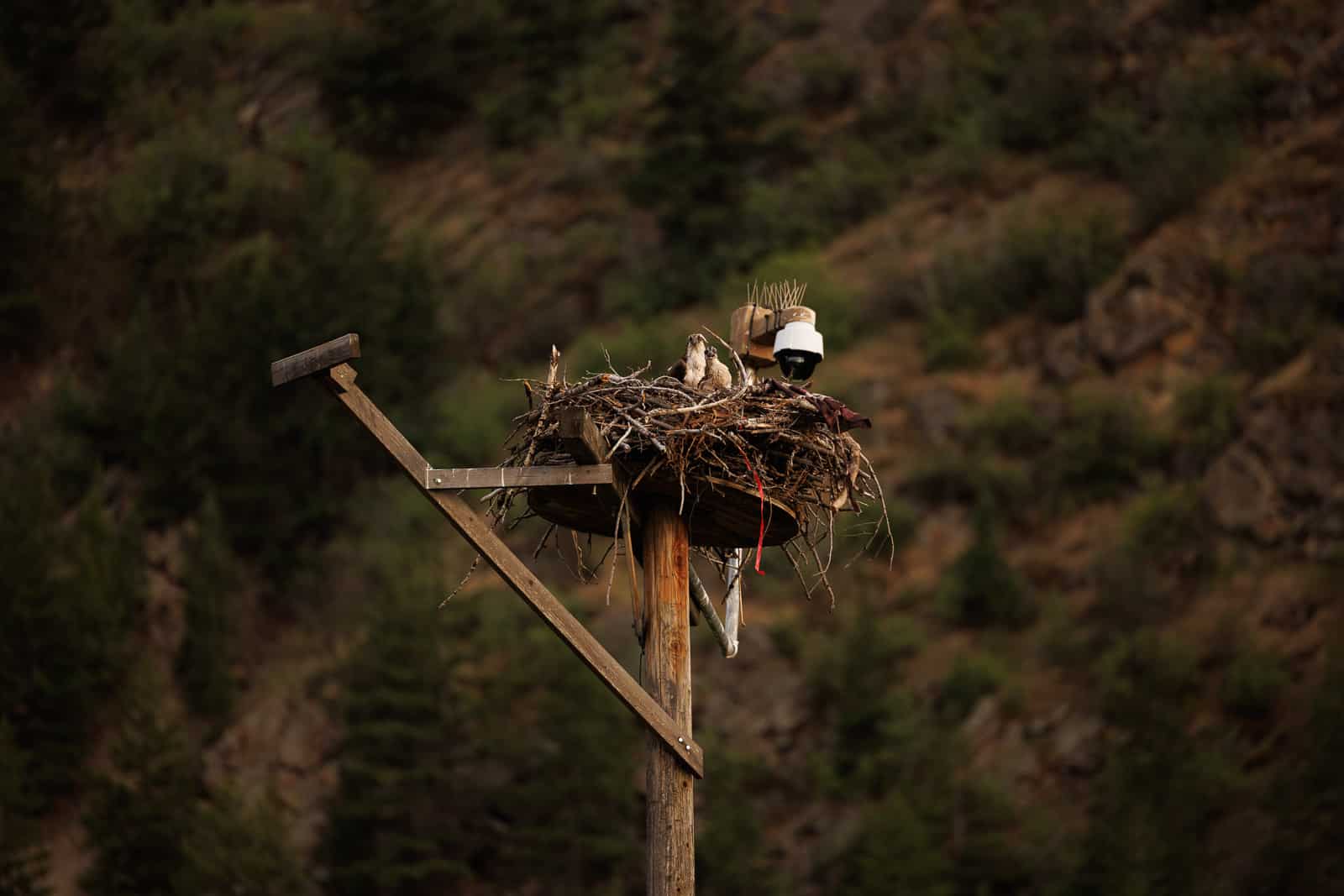
On the morning of June 11, one of three speckled eggs in a nest high above Missoula’s Riverside Health and Rehabilitation parking lot began to crack. At exactly 10:29 a.m., a brand-new, bobbleheaded chick with wisps of white down made its debut, watched over by its mother, Iris, the oldest known osprey in the world. The chick is the newest of more than 20 offspring Iris has raised so far. Estimated to be at least 30 years old, Iris has earned her reputation as a legendary matriarch nicknamed the “Queen of Hellgate Canyon.”
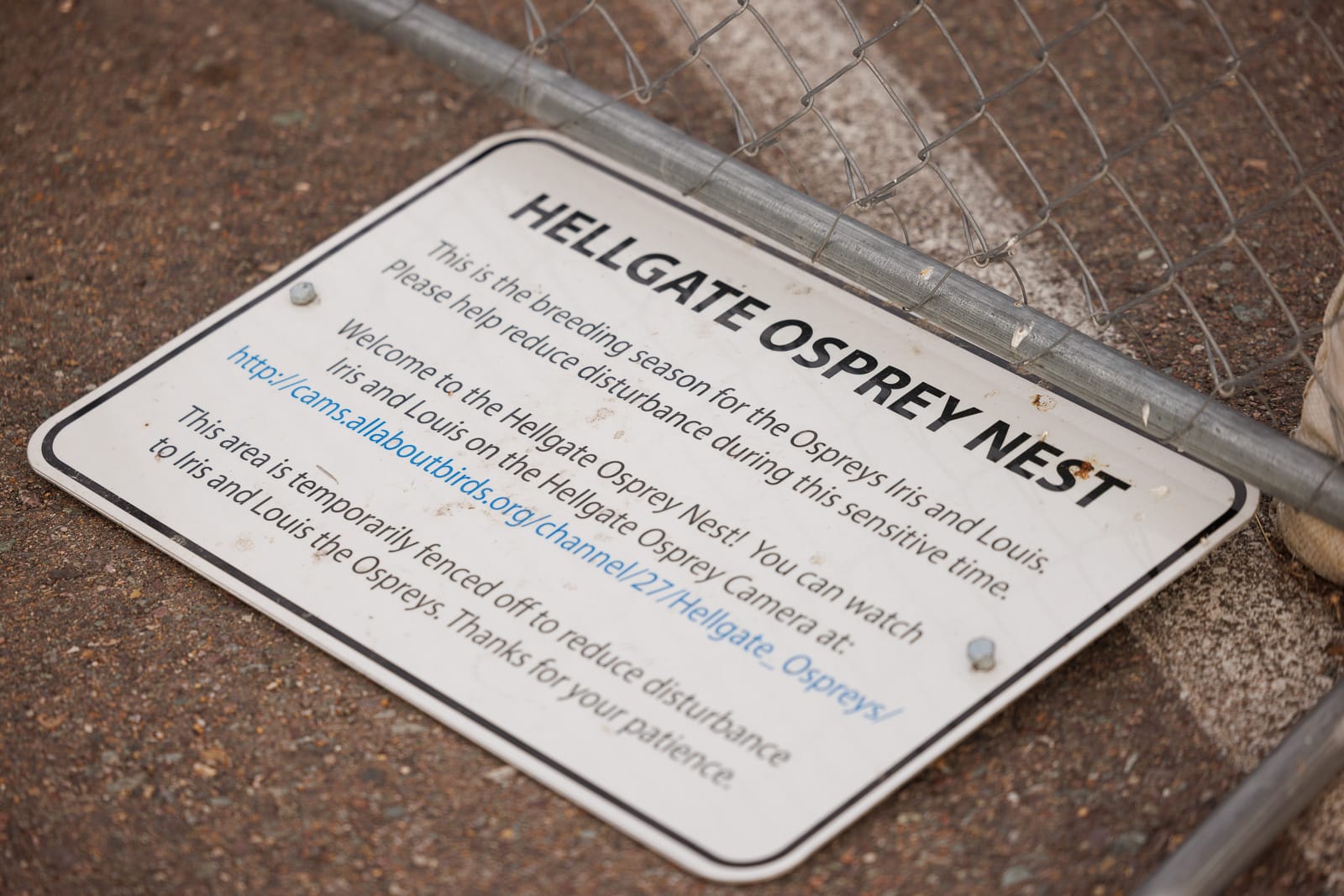
If Missoula had a wildlife celebrity, Iris would be it. Since 2010, when University of Montana scientists first installed the Hellgate Osprey Cam on the nesting platform, anyone online has been able to watch Iris’s nest 24 hours a day. The up-close access has captivated viewers worldwide and turned her spring homecoming — typically right around April 7 — into an event. Even local businesses catch osprey fever. Recently, Montgomery Distillery projected the live camera feed on its wall for weeks, and KPAX gave Iris a shoutout on the evening news. The comments sections on highlight reels and Facebook posts about the cam are as entertaining as the livestream itself.
But Queen Iris’s contributions are bigger than her and her nest. Two decades ago, Iris’s offspring were part of a study that kicked off the Montana Osprey Project, an ecological and educational effort. Between 2006 and 2009, a team of scientists from UM and Missoula-based nonprofit Raptor View Research Institute, or RVRI, sampled the blood and feathers of more than 100 osprey chicks nesting along the Clark Fork River and tested them for heavy metals. The goal was to better understand the impact of historic mining pollution with ospreys as the barometer.
Results from that original study, published in 2012, gave researchers a snapshot of the impact — and RVRI has continued to collect data. Every summer since, the team has returned to the same stretch of river, adding to that data set year after year. Now, that work is finally nearing a milestone: RVRI is currently reviewing sampling results from 2009 to 2024 and expects to produce an updated analysis by mid-2027. It will offer a read on the river’s recovery — and, hopefully, new insight into ospreys themselves.
If an osprey is feeling the effects of pollution, it’s safe to say the surrounding ecosystem is also out of balance.
The Clark Fork’s upper 120 miles, stretching from its headwaters near Butte and Anaconda to Milltown in east Missoula, encompass one of the nation’s largest Superfund complexes due to a legacy of mining, milling, and smelting. And because ospreys feed almost exclusively on fish from nearby rivers, measuring the amount of heavy metals in their offspring gives scientists a way to zero in on where contamination is and how it is moving up the aquatic food chain.
Ospreys, as with other top predators, act as indicator species. The fish ospreys feed on eat smaller bugs, which eat even smaller algae — each level potentially accumulating toxins. In that sense, if an osprey is feeling the effects of pollution, it’s safe to say the surrounding ecosystem is also out of balance.
“When you key in on certain species that are atop food pyramids, they really are acting as a metric for the overall system,” said Adam Shreading, senior research biologist at RVRI. “We can study these individual critters, but that critter is telling a much larger story.”
Results from the initial study showed that cadmium, copper, zinc, arsenic and lead concentrations — priority contaminants also known as the “Clark Fork Five” — were either low or variable in osprey chicks. But there was something else that showed up. Mercury levels were extremely high depending on the nest’s location, and between Drummond and Missoula, osprey nestlings showed a spike in the amount of mercury in their blood, with the source later traced to a contaminated tributary home to a former gold and silver mill.
This new study may tell researchers something the original study couldn’t: just how much mercury is still moving through the system — and what that means for birds like Iris.
The Montana Osprey Project first got off the ground thanks to the help of a local bucket truck.
Rob Domenech, who founded RVRI in 2004 to research raptor ecology, saw an opportunity in 2006 when his uncle’s roofing business purchased a truck with a hydraulic lift.
“When I looked at it, immediately I thought — we can get into osprey nests with this,” Domenech said. Today, the organization partners with utility companies and a local arborist to access nest platforms.
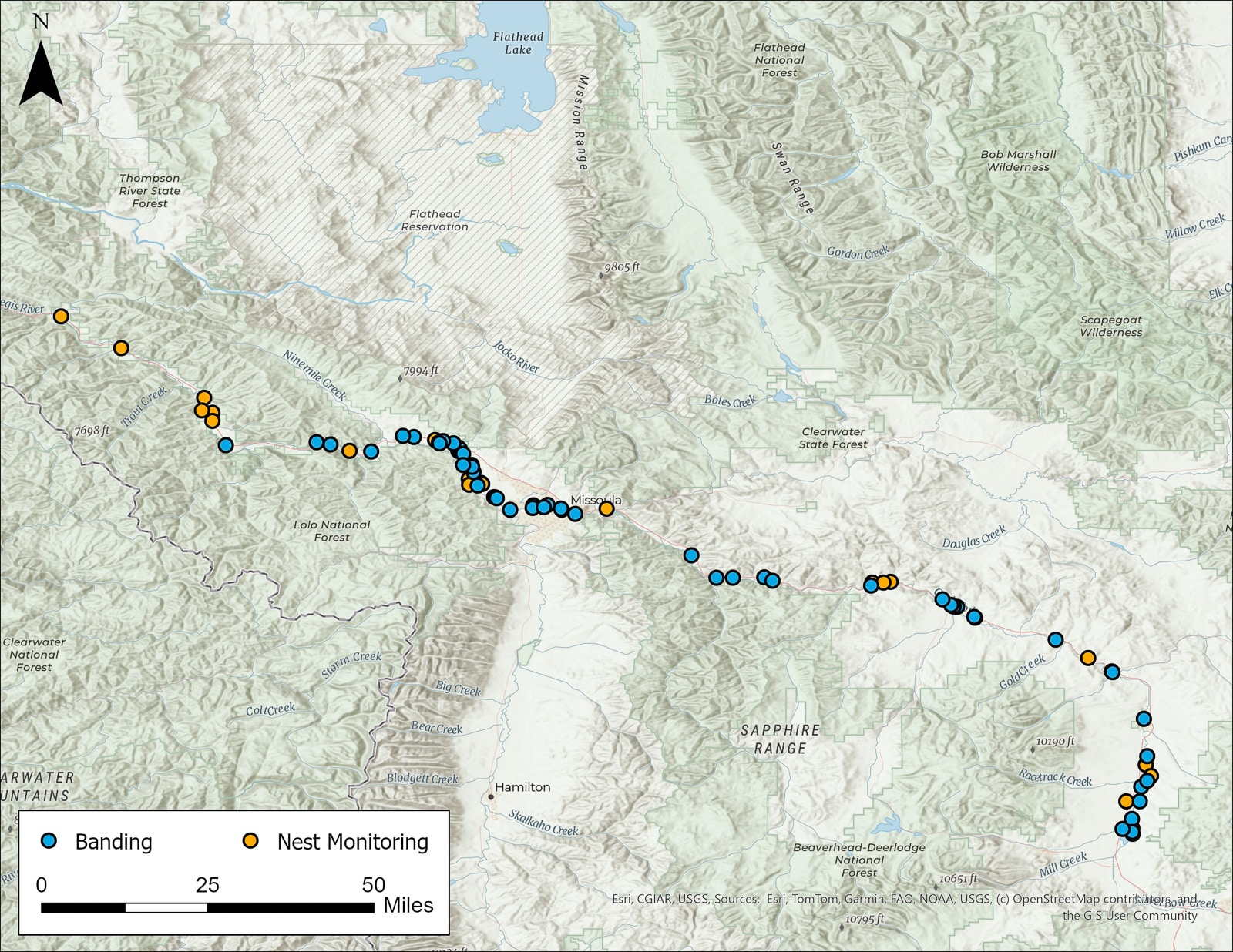
Since the project’s inception, RVRI has sampled 80 nest sites and banded over 600 osprey across a 160-mile stretch of the Clark Fork. Beginning in July, once young birds are hardy enough, the team visits about 20 osprey nests per summer to collect blood and feather samples and attach bird bands to each chick.
UM’s environmental biogeochemistry lab processes each sample to determine what heavy metals are present, then returns that data to RVRI. That data set — now complete for 2009 through 2024 — gives Domenech and his team the chance to draw new conclusions over a longer timeframe. Once analyzed, the data will help gauge the effectiveness of the ongoing Clark Fork cleanup and bring more clarity to the long-term impacts of mercury exposure.
“What we generally find is the more we learn, the less we know.”
Based on the 2012 study results, the cleanup seems to be working: osprey chicks did not seem particularly affected by the “Clark Fork Five.” But mercury isn’t part of the cleanup plan. Technically, the Clark Fork’s Superfund remediation efforts can only address heavy metal contamination from mines formerly owned and operated by Atlantic Richfield Company, or ARCO, the mining conglomerate responsible for funding the cleanup. Because mercury seems to be coming from smaller abandoned mines, there is no funding mechanism to address the problem.
While heavy metal studies of osprey exist in other parts of the U.S., RVRI’s ecotoxicology work is particularly valuable because it contains nearly 20 consecutive years of data.
“Sometimes we go into these things and we don’t know what we’re going to discover and what conservation impact it may have. It comes back to these long-term data sets, because what we generally find is the more we learn, the less we know,” Domenech said.
In addition to studying heavy metals in the Clark Fork watershed, RVRI is also collecting movement data. Citizen scientists who spot a banded bird can report it on RVRI’s website. The organization is also tracking ospreys in the Bitterroot Valley using satellite telemetry. RVRI fits the birds with a Teflon harness and transmitter similar to a backpack that can send up to 100 location points per day. Combined, the wealth of information is significant, providing insight into osprey migration, habitat use, and preferred locations for hunting, breeding, and wintering. Domenech credits technology as a big help.
“If we had done this 30 years ago, we wouldn’t have been able to amass this data set,” he said. “We’re basically able to watch the birds 24/7.”
To help make sense of all its data, RVRI hired Kylie Denny in May 2025 as science director and the organization’s research biologist. Denny, a quantitative ecologist, has yet to analyze osprey-specific information, but plans to start with unpacking the results of the heavy metal study.
“I’m really excited to dig into this heavy metal contaminant dataset,” Denny said. “It’s something unique to Montana and it’s unique to our osprey population compared to other regions in the world.”
New this year, RVRI has also started a nest-monitoring program to track chick survival rates — yet another layer that can be applied to osprey locations to better understand contamination impacts.
Iris’s nest, for example, only had one successful hatch out of three eggs this spring — an outcome that could be attributed to her old age, genetic or developmental problems, poor fertilization, or possibly mercury exposure.
Osprey can “offload” mercury — a potent neurotoxin — by passing it into eggs and growing feathers, according to Megan Fylling, research director and avian ecologist with the UM Bird Ecology lab. This can be problematic for developing embryos in highly contaminated sites and result in a low hatching rate, Fylling said in an email.
But, Denny says, a high mercury concentration doesn’t necessarily mean it’s going to be detrimental to the birds. Evidence suggests that mercury exposure can impact reproductive success and chick development in other species, but they need more data to fully understand how it affects osprey.
Inspired by the Montana Osprey Project, Fylling currently leads multiple projects exploring whether heavy metals are accruing in songbirds along the Clark Fork.
Because songbirds are also part of the ecosystem’s food web, Fylling hypothesized that they could be exposed to heavy metals just like ospreys.
“Essentially birds are eating the same thing that trout are eating, so we knew there was this potential mechanism for songbirds to get exposed to heavy metals,” Fylling said.
Similar to the Montana Osprey Project’s study design, Fylling and her crew of graduate students are collecting eggs, taking blood samples, banding birds and tracking nest occupancy. Fylling says they are even able to analyze songbird telomeres – protective DNA caps – to see if birds are more or less stressed in certain locations. And when it comes to understanding where heavy metals are coming from, Fylling can look at diet and stable isotopes to tell whether birds are being contaminated by eating terrestrial bugs or aquatic ones, work led by PhD student Bridger Creel.
“None of this could have happened if we [didn’t have] long-term monitoring programs on the ground that really provided this basis for the work that we’re doing,” she said.
There’s an irony in Iris’s role in all this. Her chicks were part of the very first sampling that launched the Montana Osprey Project back in 2006, but they haven’t been tested since. After that first study came out, webcam viewers, protective of a bird they’d come to love, pushed back on the idea of researchers handling her chicks. RVRI stopped sampling her nest. Iris was too famous to touch.
But the data her offspring helped generate is still part of the picture — folded into the same long-term data set that may, one day, help explain what mercury is doing to nests like hers.
“It’s the ripple effect,” Fylling said. “We always talk about the ripple effect because we work in watersheds, but it really is what it is.”