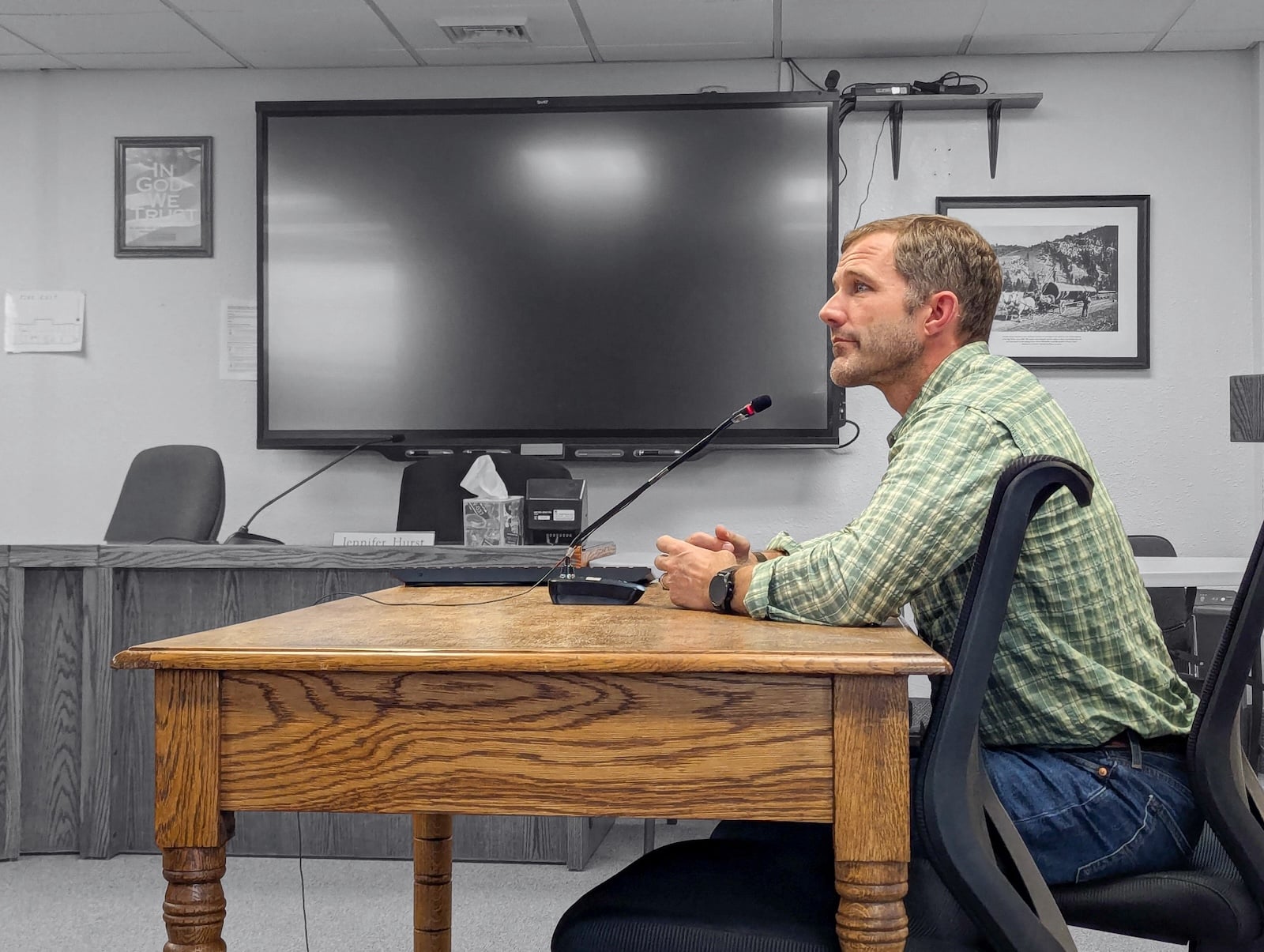
With his shirt sleeves rolled up and his stubbled face split by the same broad grin that characterized his eight-year stint as University of Montana president, Seth Bodnar walked straight into the jaws of one of Montana’s most renowned conservative strongholds last week, bent on selling himself as the state’s next U.S. senator.
The meeting, billed by Bodnar’s campaign as a public confab with Ravalli County’s three-member board of commissioners, offered a glimpse into how his ambitious bid as a political independent in 2026 is landing in staunch Republican circles. Bodnar spent roughly an hour fielding questions about mining permits, health care funding, and the national debt, taking alternating swipes at both the Trump administration and at national Democrats. And while he appeared to find firm nonpartisan ground on a variety of deeply local issues, it became clear that the Bitterroot Valley’s right-leaning voter base remains on high alert for any trace of a hidden liberal agenda ahead of the Nov. 3 ballot.
“The partisan warriors are going to try to push and talk about issues that raise emotions,” Bodnar told The Pulp moments after concluding the Aug. 27 meeting. “I want to talk about issues that people are struggling with at the kitchen table, and that’s what I’m focused on with Montanans.”
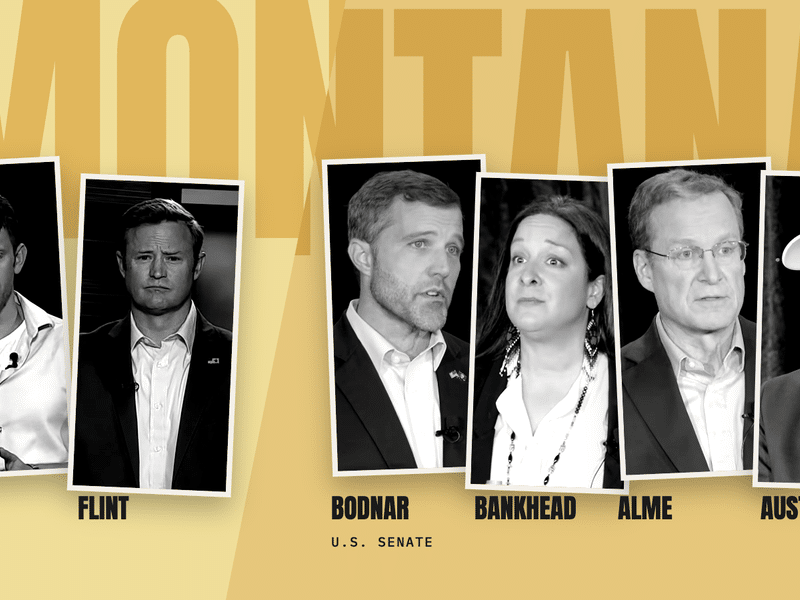
Montana’s U.S. Senate race has been replete with surprises since January, when rumors first surfaced that former Sen. Jon Tester planned to back an independent Bodnar run against incumbent Republican Steve Daines rather than support a Democratic challenger. Daines threw another curveball in March when he withdrew his reelection bid just minutes before the candidate filing deadline, clearing a last-minute path for his preferred successor, federal prosecutor Kurt Alme. The next twist came in June with the decisive Democratic primary victory of Alani Bankhead, whose scant fundraising was offset by millions in spending by outside groups, elevating her candidacy over that of primary opponent Reilly Neill. Calls mounted last month for either Bankhead or Bodnar to bow out of the running before ballots were finalized, with Alme opponents fearful the two would split left-leaning voters and ensure a Republican win.
Now, with Bankhead and Alme all but guaranteed a particular slice of the electoral pie, Bodnar’s betting that a message of nonpartisan compromise will prove more alluring than party affinity. He’d amassed a $3.2 million war chest as of the last mandated reporting period in June — not quite double Alme’s $1.9 million in campaign fundraising and well ahead of the $59,000 Bankhead had accumulated. Outside groups are pouring millions more into digital advertising supporting Alme or opposing Bodnar, the latter primarily from the same political committee that spent big for Bankhead earlier this year. Third-party messaging about Bankhead has meanwhile fallen silent.
“To me, this is an absolute moral failure, to see our politicians in D.C. spending like drunken sailors — spending on gilded ballrooms for the White House, arches, reflecting pools, billions of dollars on a war without a plan.”
It’s against this backdrop that Bodnar strode into the third floor of the Ravalli County Administration Building in Hamilton, 10 minutes late and apologetic about being delayed by a chip-seal project outside Florence.
“Construction, right?” he quipped to commissioners Greg Chilcott and Dan Huls. Commissioner Jeff Burrows was absent due to a conflicting meeting of the Ravalli County Board of Health.
Huls promptly teased an array of concerns he said weigh heavily on the county including the loss of the local timber industry, the reliability of federal revenues tied to public lands, and the Trump administration’s fast-tracking of the proposed Sheep Creek Mine near the headwaters of the Bitterroot River’s West Fork. Chilcott seconded the concern about payment in lieu of taxes — a system through which the U.S. government compensates municipalities, often rural ones, for the loss of property tax revenue generation on federal lands — and added a few of his own. He argued for decisive action on a string of nearby Wilderness Study Areas that have hung in regulatory limbo for decades, and asked for help in moving protected wilderness boundaries in the Bitterroot Mountains to facilitate maintenance of an aging high-alpine dam system.
“We have 17 dams that were constructed there on the west side of Bitterroot Valley, by man, that feed our ag community and our valley, and they’re critical to our survival. Yet we can’t maintain them,” Chilcott said. “It literally took an act of Congress to do maintenance on the Tin Cup Dam 20 years ago. I don’t know how we’re going to get that done, but somebody needs to be a champion for that.”
Bodnar threw out nods to the importance of safeguarding public lands, of supporting Montana’s ag sector, of “revitalizing our wood products industry.” He affirmed that payments in lieu of taxes are essential to the financial stability of local budgets, and agreed federal laws should not be weaponized to slow down responsible forest management. He also hammered a familiar point about the rising cost of living and the resultant struggles Montanans have making ends meet. It’s a point the commissioners were in sound agreement on, and one Bodnar’s opponents continue to emphasize as well.
“Groceries, gas, housing and health care come up in nearly every conversation [with voters],” Bankhead’s campaign spokesperson, Jeri Bucy, told The Pulp via email. “Montanans are tired of being told the economy is great when their own budgets say otherwise.”
Similar to Bodnar, Bankhead has adopted a “kitchen-table first” approach to voter outreach, Bucy wrote, employing a mix of town halls, one-on-one conversations, and local podcast appearances to get her message out. That message includes drawing a hard line on opposing data centers and calling attention to the outside money being spent on Bodnar’s behalf.
Alme, too, is endeavoring to sell himself as a down-home candidate running a grassroots campaign on issues that matter most to Montanans: creating jobs, fighting crime, making life more affordable. In an email to The Pulp from his campaign, Alme also took swipes at Democratic border policies and “woke DEI” and said there’s “no substitute for shoe leather” in a race like this. As for Bodnar, Alme accused the independent of being “a far-left Democrat in Disguise,” a defender of open borders, higher taxes, and “boys in girls’ sports.”
In Ravalli County, perhaps the strongest point of agreement Bodnar struck with Republican commissioners came on the subject of the national debt, which they all agreed has swelled beyond reason and will doubtless spell disaster for future generations if left unaddressed. However, Bodnar’s response also directed a good deal of blame at President Donald Trump, still an influential figure among conservatives despite his low approval rating.
“To me, this is an absolute moral failure, to see our politicians in D.C. spending like drunken sailors — spending on gilded ballrooms for the White House, arches, reflecting pools, billions of dollars on a war without a plan,” Bodnar said. “We were told last election, ‘I’m going to bring the national debt down.’ Well, we’ve seen it go up $4 trillion just since January 2025.”
There was nothing veiled in Bodnar’s critiques of the Trump administration. He tied concerns over federal Medicaid reimbursements and the impacts on local mental health services to cuts implemented via the so-called “Big Beautiful Bill.” He called for responsible enforcement of immigration laws and a clear path for foreigners to U.S. citizenship. And he denounced the recent renaming of Lake Ontario to Lake America as an “offensive” allocation of government time when so many American workers, farmers, and public school students are struggling to get by.
“Government has no place in our bedrooms, government has no place in our gun cabinets, and government has no place in our doctor’s offices.”
The message was clear: Not only does Bodnar see the federal government as a corrupt and broken system, he counts Trump as heavily complicit in the breaking. It was an interesting line to take in a county Trump won handily in 2024 with 69 percent of the vote, and where his name still adorns flags and signs through the valley. Chilcott and Huls seemed content to let those criticisms slide past, the air heavy with deep sighs and silent disagreement. Instead, the most pointed probe into Bodnar’s ideological alignment came from one of the eight citizens in attendance, a man eager for a more direct answer on one of Trump’s chief cultural complaints: transgender women in school sports.
“I heard a lot of roundabout talking in what you were just saying,” Skip Gibbons of Stevensville said to Bodnar, “but I was wondering if you could actually provide what you think is a definition of a woman.”
Bodnar had already informed the commissioners that he believes in fairness in women’s sports, a response Gibbons was clearly unsatisfied with. Bodnar repeated the question back, pausing to think before mentioning that people “have chromosomes.” But it quickly became clear that the independent did not consider the topic among the most pressing priorities for Montana voters.
“Montanans can’t afford to put a roof over their head. Montanans can’t afford health care. Our farmers are in crisis. We have a war in Iran without a plan or a strategy. We’re losing lives every single day,” he said. “I don’t think, as the United States Senator from Montana, the most important thing that I will be focused on or should be focused on is coming up with a definition of a woman.”
Gibbons expressed disappointment over what he saw as an equivocation, and the two had a brief, impassioned exchange during which Bodnar challenged Gibbons on whether any transgender athletes were currently participating in school sports in Montana. Why are we “picking on kids,” Bodnar asked, when they already have it hard enough today? Parents and children should be able to make their own decisions without elected officials telling them how to live.
“It’s not my business, and I don’t think it’s any of ours,” Bodnar said. “We have a state that believes pretty strongly that government has no place in our bedrooms, government has no place in our gun cabinets, [and] government has no place in our doctor’s offices. And I don’t think it’s my place, and my faith doesn’t tell me that I have any right to judge and get into somebody else’s business.”
The back-and-forth provided a deeper glimpse into how some Republicans are viewing this race. Bodnar spoke fluently regarding beef labeling requirements, health services for veterans, and using federal infrastructure investment to help spur residential development, all of which struck a deep chord with those gathered in the Ravalli County boardroom. But for right-leaning voters in 2026, social issues often have a prominent place at the kitchen table alongside the national debt and the cost of living, and the backing Bodnar’s received from groups on the left may come as an ideological red flag. Just last month, the executive director of the Montana Democratic Party, Emily Marburger, told Montana Free Press that while she’s supporting Bankhead, she’s “not going to hate on” anyone who opts for Bodnar.
Even in a world checkered with ideological landmines, major party candidates can largely count on established institutions and a loyal base to embrace their message. Alme, for example, has endorsements from Daines and Gov. Greg Gianforte, two officials still popular among a large swath of Republicans. For an independent trying to build appeal across the political spectrum, though, the pressure’s on to give individual voters a compelling reason to look past such trusted stamps of approval, set aside their own partisan grievances, and decide, in one race at least, to try something new.