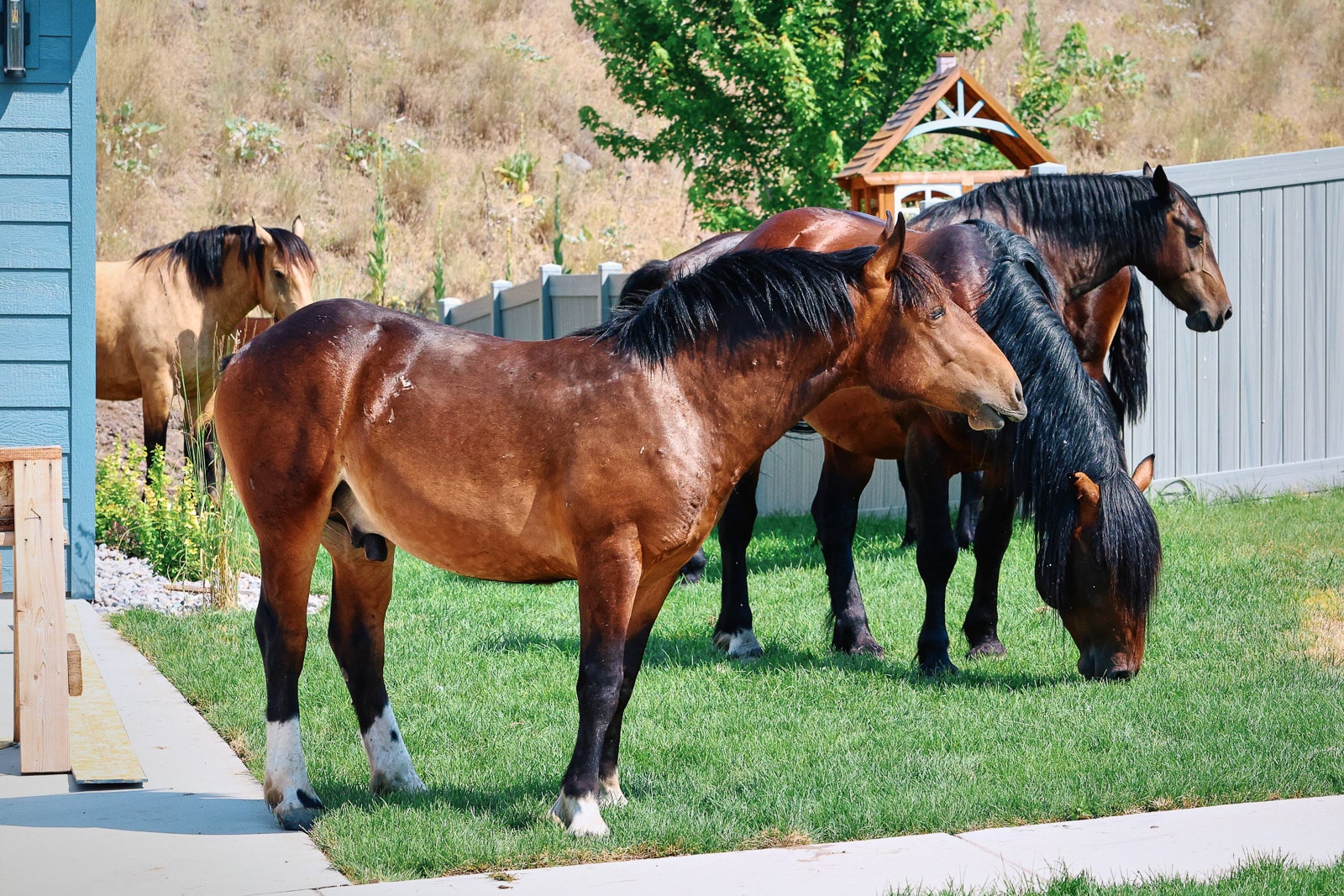
The hollow clop of hooves rang off the pavement along Shaver Drive last Saturday, followed by the crunch and grind of teeth as nearly a dozen horses gradually grazed their way from one bright green lawn to the next. One mare seemed particularly spirited as she nickered, chased and thudded other members of the group away from her small tobiano foal. Several cars slowed to a crawl on their climb toward Miller Creek Road, children gawking through backseat windows, and two neighbors in slippers stood photographing the herd from the safety of their front stoop.
The Miller Creek horses have become an increasingly popular sight in Missoula’s southernmost suburban stretches over the years. They are unowned, free-ranging, and they’ve attracted a strong and fiercely protective following among some residents who discourage human interference in favor of letting the horses continue to thrive undisturbed. Yet growing concern at the county level — spurred in part by a vehicle collision in fall 2025 that resulted in one horse’s euthanization — has drawn the herd into a policy debate over how best to manage public safety, animal health and potential conflict.
“We have some horses that are presenting themselves in public spaces in a way that potentially creates conflict with the traveling public and just the public in general,” Missoula County Chief Administrative Officer Chris Lounsbury told The Pulp. “What we’re looking at is is there anything we can do to try and mitigate that on the front end, so we don’t end up in a situation where the state or another entity has to act in a way that would not be good for the community or for the horses.”
Missoula County commissioners initially proposed a landowner-focused strategy last month outlining a process for capture and “disposition” of individual horses on private property — transferring horses to a nonprofit, a private owner, or back to the state for possible sale, or letting the landowner keep the animal. But according to Lounsbury, the county has since shifted its emphasis toward education and government management, potentially including signage and population control in coordination with the Department of Livestock. Commissioners will consider its draft resolution at a public hearing at 2 p.m. Thursday, Aug. 6.
“The horses are not encroaching on the community. The community is encroaching on the horses.”
The public feedback driving that shift has been intense and impassioned over the past nine months, running more than 200 comments at last count plus a MoveOn petition that’s collected more than 2,000 signatures. Though some have voiced caution about the risks inherent in mixing residential life with large, unpredictable animals — and both officials and members of the public alike have stressed that people should never approach or feed the horses — an overwhelming majority want the horses left alone. Read enough of the comments (here and here) and two arguments repeat like a chorus: the insistence that humans, not horses, are the real intruders here, and the reflexive comparison to Missoula’s unfettered urban deer.
“The horses are not encroaching on the community,” wrote Lower Miller Creek landowner Evan Tipton. “The community is encroaching on the horses.”
Wrote Julie Umbro: “I really don’t find them to be any more of a nuisance than the overabundance of urban deer … I feel that might be a more urgent issue to solve than the lovely wild horses. Having them up here makes our neighborhood unique and provides much conversation, opportunities to observe and learn about these amazing giants. I say, ‘Let them stay!’”
Underneath the debate sits a point of linguistic confusion central to the discussion’s complexity. Because while this band of Miller Creek horses is far removed from its domestic roots, state and federal law make it damned tricky to pin down a firm legal status.
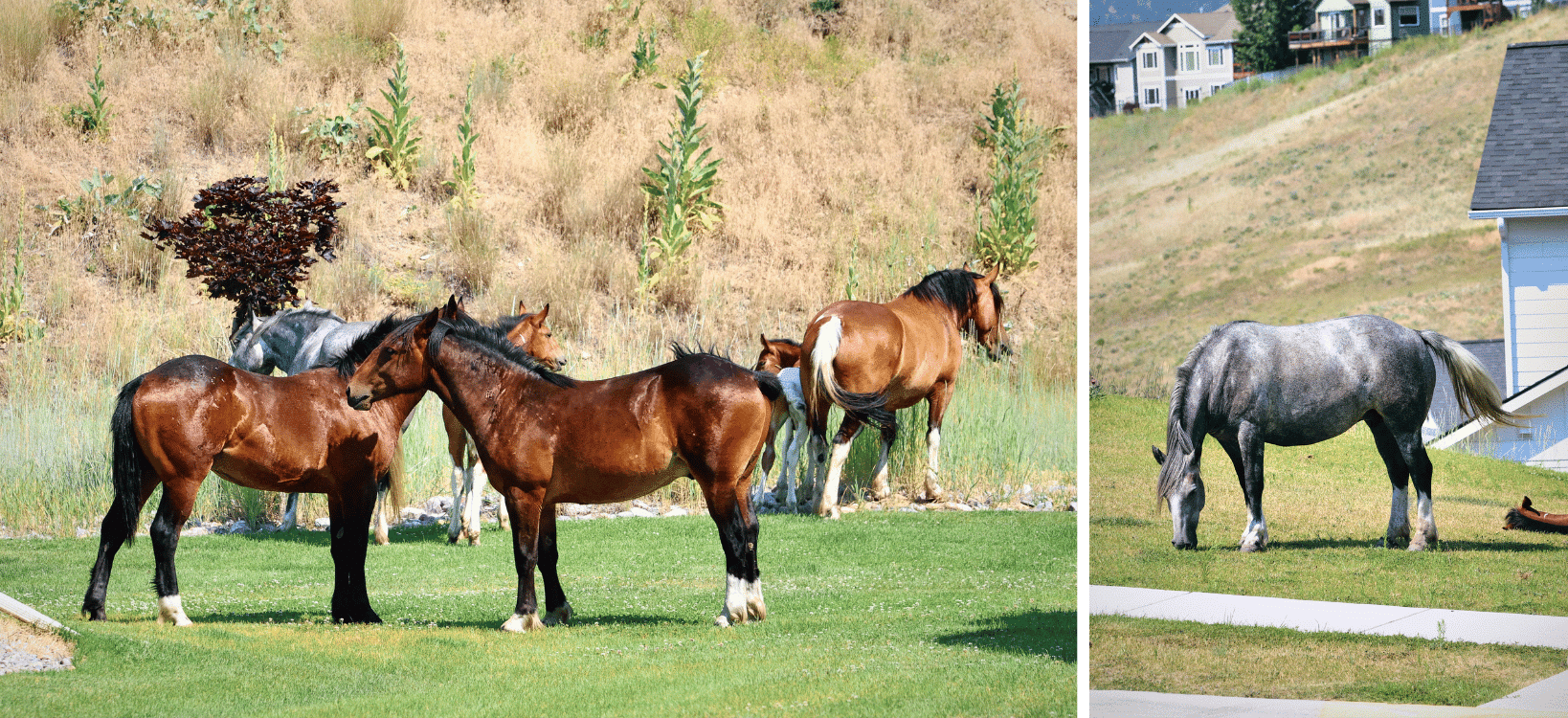
According to Jay Bodner, brands administrator for the Montana Department of Livestock, the 10 or so horses now active in the Miller Creek area are an offshoot of a larger herd ranging the northeastern fringes of the Bitterroot Valley. Bodner estimates the total herd size between 70 and 100 horses, all of them likely descended from former rodeo stock turned loose and abandoned up Miller Creek half a century ago. They’ve since established a strong presence on the landscape, crossing through a mix of state and private land between Missoula and Florence, unbranded and largely left to their devices.
Even 50 years isn’t enough to qualify the herd as “wild,” though, at least not by any official definition. That word carries a very specific meaning under the Wild Horse and Burro Act of 1971, which extended federal protections to identified wild horse herds in the western United States and placed their management in the hands of the Bureau of Land Management. Wild horses reside on specially designated herd management areas, where the BLM conducts routine monitoring and fertility control efforts as well as round-ups designed to remove excess animals for public sale or adoption. The BLM’s controversial handling of herds during those round-ups often triggers similar emotions to the debate over Miller Creek’s horses, but the agency is quick to underscore the uniqueness of the “wild” designation.
“Wild horses are not simply horses living on open landscapes,” the BLM said in an emailed statement, adding that the only wild horses in Montana belong to the Pryor Mountain wild horse herd south of Billings.
“They’re kind of in a gray area. The classification we feel they fit best under is this kind of abandoned livestock, abandoned horses.”
Montana Fish, Wildlife and Parks confirmed it too has no role in or jurisdiction over management of the Miller Creek horses as the state does not consider them wildlife. FWP does, however, manage a herd of horses on Flathead Lake’s Wild Horse Island State Park. FWP regional spokesperson Malia Freeman told The Pulp her agency has endeavored to maintain the island’s small resident horse population through multiple relocations since 1978, primarily to preserve the integrity of its historic name. Freeman added FWP manages the horses with the same largely hands-off approach it takes to other wild animals, though state laws and regulations pertaining to wildlife are mum on the subject of horses.
Missoula County’s branding of the Miller Creek debate in agendas and on its public engagement website has instead centered on the word “feral.” This term cuts closer to the mark, as it’s often been used elsewhere in the state or country in reference to free-roaming animals descended from livestock. Feral hogs are perhaps the most familiar example, and they have plagued numerous states from Canada to the Mexico border. Just last year, Montana’s Department of Livestock intervened on the Hi Line to contain a loose swine herd that was beginning to exhibit feral behavior, ultimately sending the animals to be slaughtered and distributed to community food banks. Lounsbury acknowledges “feral” is also an imperfect fit for the Miller Creek horses, and a reading of Montana code confirms the term is rarely applied to animals other than pigs.
According to Bodner, state law really only leaves two more options to consider: estray and abandoned. An estray is defined as livestock whose owner can’t be identified due to an unrecorded brand or lack of brand, while abandoned applies to branded or unbranded horses ranging at-large on open state lands. Missoula County has opted to formally embrace the latter in drafts of its proposed Miller Creek resolution, mirroring the Department of Livestock’s own assessment of the situation.
“They’re kind of in a gray area,” Bodner said. “We know they’re not an astray because nobody owns them. The classification we feel they fit best under is this kind of abandoned livestock, abandoned horses.”
The idiomatic quandary highlights just how unusual the situation up Miller Creek is. Regardless of what label locals saddle the horses with, this small band has decided there’s good living to be had in an increasingly dense and developed part of town. Their presence adds a dash of character and Western charm to the neighborhood many residents seek to preserve. It also ratchets up the odds of conflict — the type that could impact the health of humans or horses or privately owned livestock, and the type experts feel can’t be ignored.
“There’s a lot of passion with these horses, and we certainly recognize that,” Bodner said. “There are some landowners — ranchers in that area, too — who do have to face some of the realities of dealing with these horses and the challenges with them, so we want to make sure that their rights are protected. It is a delicate balance.”