This is one of several transportation stories from the first issue of The Pulp’s new quarterly print edition. Read the rest of the package:
Everyone in Missoula has roundabouts figured out. Everyone else, not so much.
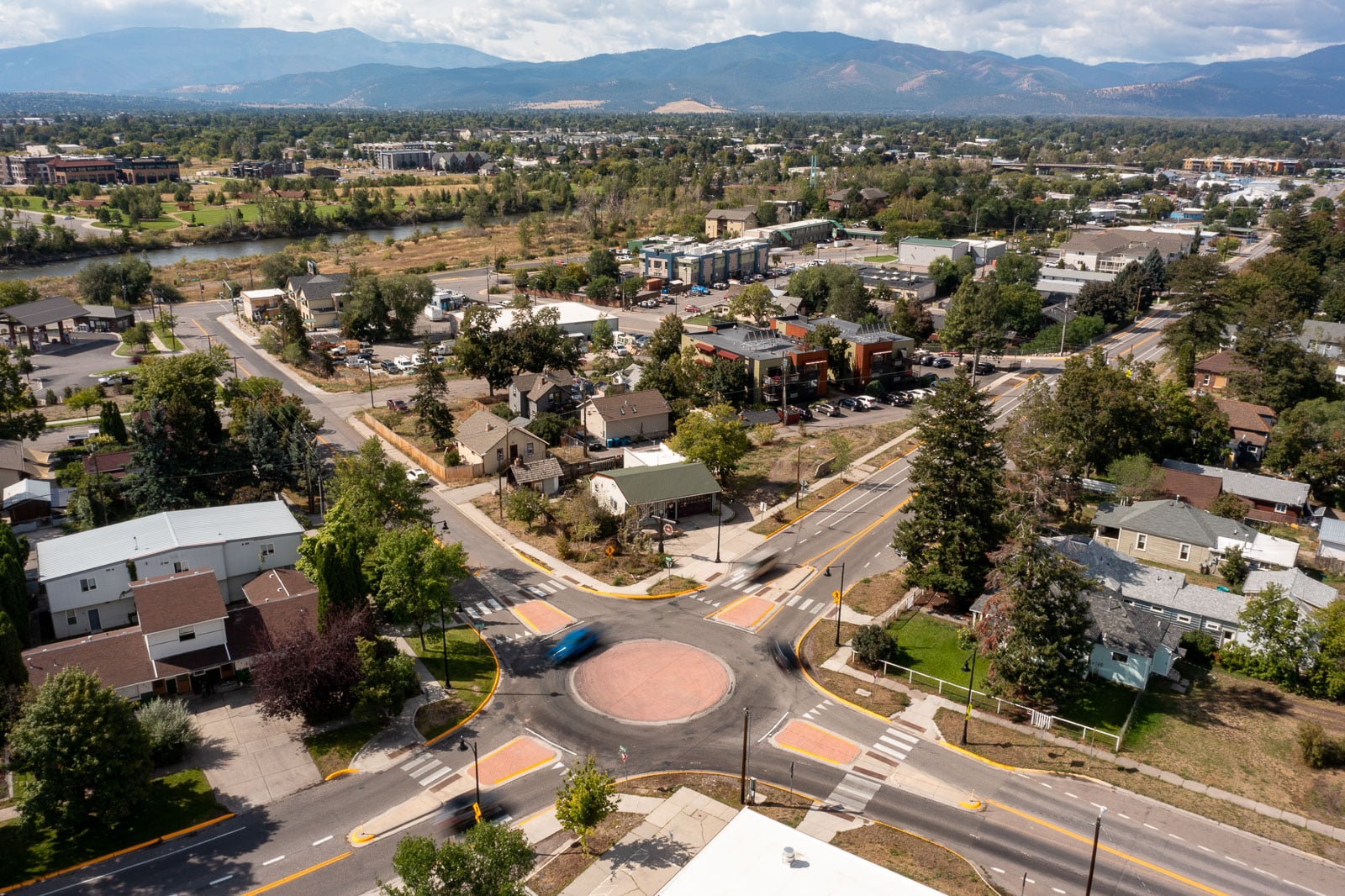
That’s the paradox Aaron Wilson keeps running into. As the city’s transportation planning manager, he’s watched roundabouts multiply across town — Higgins and Beckwith, the two on Van Buren, Lower and Upper Miller Creek, a few on Mullan, with more coming at Broadway and Toole, and South and Clements. And almost nobody, he’s noticed, thinks they’re the one gumming up the works.
“It’s very rare that you talk to someone who says, ‘I just don’t know how to use them,’” he says. “It’s more often people don’t like roundabouts because they don’t think everyone else knows how to use them.”
Imagine you’re creeping toward the Van Buren roundabout on a hot afternoon, watching cars circle around like planets in orbit. You inch forward, hesitate, and check again. What does this make you feel? A sense of calm? Anxiety? Annoyance? Are you glad it’s there because you remember how much the traffic backed up without it?
One thing is, you know the rules — or at least you think you do. Yield to traffic already inside, wait for a safe gap, never stop mid-circle. (I’m not sure I’ve seen most people use their turn signal to exit, but you’re supposed to.)
For Wilson, that cautious tension isn’t a failure of design. In some ways, it’s the point.
“So much of what we do in transportation is balancing what we know technically with how people actually behave,” he tells me. “Speed and predictability are the two really important things. If you can’t have predictability, you should have slower speeds.”
“In some communities, people are just used to heavy traffic and tend to be more assertive. In other places, it’s more like that ‘Portlandia’ skit where two cars arrive and both are saying, ‘You go.’ ‘No, you go.’”
Wilson spends a lot of his time thinking about intersections. Inside the world of traffic engineering, those spots where roads cross get a report card called “level of service,” or LOS. And as with a report card, each intersection gets a letter grade from A to F.
“At a high level, it’s one way to evaluate intersections,” he says. “There are really two pieces. One is the math — how much delay there is, how many vehicles can move through at any given time. The other is driver perception and behavior at those intersections. Level of service A is the best — it’s just free-flowing traffic. There’s no delay.”
For signalized intersections, LOS F usually kicks in at more than 80 seconds of delay per vehicle. That’s the point where the system is considered to be failing. But roundabouts play by slightly different rules.
“For roundabouts, level of service F is over 50 seconds per vehicle,” Wilson says. “You could have the exact same 60 seconds of delay at a roundabout as at an intersection with a signal — that’s considered failing for a roundabout but not failing for a signal.”
Why the double standard? It comes down to how those 60 seconds feel.
At a signal, the experience is structured. “If you’re sitting at a light, you know at some point your lane is going to get a green,” Wilson says. “That predictability makes longer delay more tolerable.”
In a roundabout, there’s no red or green, just a circulating flow of vehicles and a set of rules about who yields to whom. Instead of waiting for your turn, you’re waiting for a gap.
“That lack of predictability lowers people’s tolerance for how much delay feels acceptable,” he says.
Where the psychology aspect really gets interesting isn’t at the big roundabouts. It’s at the small, unglamorous neighborhood islands that look temporary or like someone DIY-ed a cement circle and plopped some metal stakes with signs around it. Those are the traffic circles. And they have different rules.
“You yield the same way you would at any normal uncontrolled intersection, which is yielding to the right,” Wilson explains. “People assume those should operate the same as a roundabout, but they don’t.”
The actual wording is: The driver on the left must yield to vehicles approaching from the right that are ”close enough to constitute an immediate hazard.”
And of course, what constitutes an “immediate hazard” is where interpretation comes in. It’s the personality test. How close is too close? Do you creep forward and claim the space with cautious dominance, or wave the other driver through with the particular Missoula flourish of someone performing an act of patience? Do you trust the person in the pickup to slow down, or do you hang back like a cloaked figure in the shadows waiting for the coast to be clear?
“In some communities, people are just used to heavy traffic and tend to be more assertive,” Wilson says. “In other places, it’s more like that “Portlandia” skit where two cars arrive and both are saying, ‘You go.’ ‘No, you go.’”
Missoula, in his view, has long leaned toward the “Portlandia” end of the spectrum.
Whatever you feel about roundabouts, the data, for what it’s worth, backs them up. Roundabouts slow cars down and cut the number of ways two vehicles can actually collide. If there’s a crash, it’s usually going to be the kind you walk away from rather than the kind that sends you to the emergency room.
“You sometimes get close calls — like somebody may cut in front, you know, when there’s not enough of a gap — but again, speeds are really low,” Wilson says. “You have very few conflict points that you have to pay attention to, and so your ability to react to that is generally much greater. And so we just see fewer severe crashes that are really injuring people or killing people.”
As Missoula grows and more drivers encounter these roundabouts, Wilson will be watching how people interact with them. The same mix of design, perception, and habit that shapes our feelings about roundabouts also shows up in other parts of the system — from how we think about parking to how we navigate everyday intersections.
And Wilson, for all his exposure to Missoula drivers, isn’t cynical.
“Compared to a lot of other communities,” he says, “even in the state, Missoulians — I think because there are so many people walking, or we just have that culture built in still — the drivers tend to be pretty respectful, more so than a lot of other places that I’ve been. Missoula is still one of the nicest driving publics of places I’ve been and lived.”
Respectful, maybe, but some of us will argue that Missoula drivers need a refresher on parallel parking and turn signals. Well, everyone except us.