This is one of several transportation stories from the first issue of The Pulp’s new quarterly print edition. Read the rest of the package:

Missoula has made a lot of progress in building bike lanes and promoting bicycle safety, earning its reputation over the years as a bike-friendly community — with room to improve. That reputation took a long time to build, and most people would trace it back to the 1970s, when the University of Montana offered a class called Bikeology for students to study bicycles as sustainable transportation. Two years later, African American Studies students rode from Missoula to St. Louis, reenacting the 1897 journey of Fort Missoula’s 25th Infantry Bicycle Corps. And by 1976, the cross-country cycling event Bikecentennial had made Missoula its headquarters (later becoming Adventure Cycling). It was during this decade that UM students and local residents began pushing for bike lanes.
But unlike the path bike lanes take through downtown Missoula from North Higgins and across the river to the Hip Strip, the history of bike lanes hasn’t been a straight line from dark ages to enlightenment.
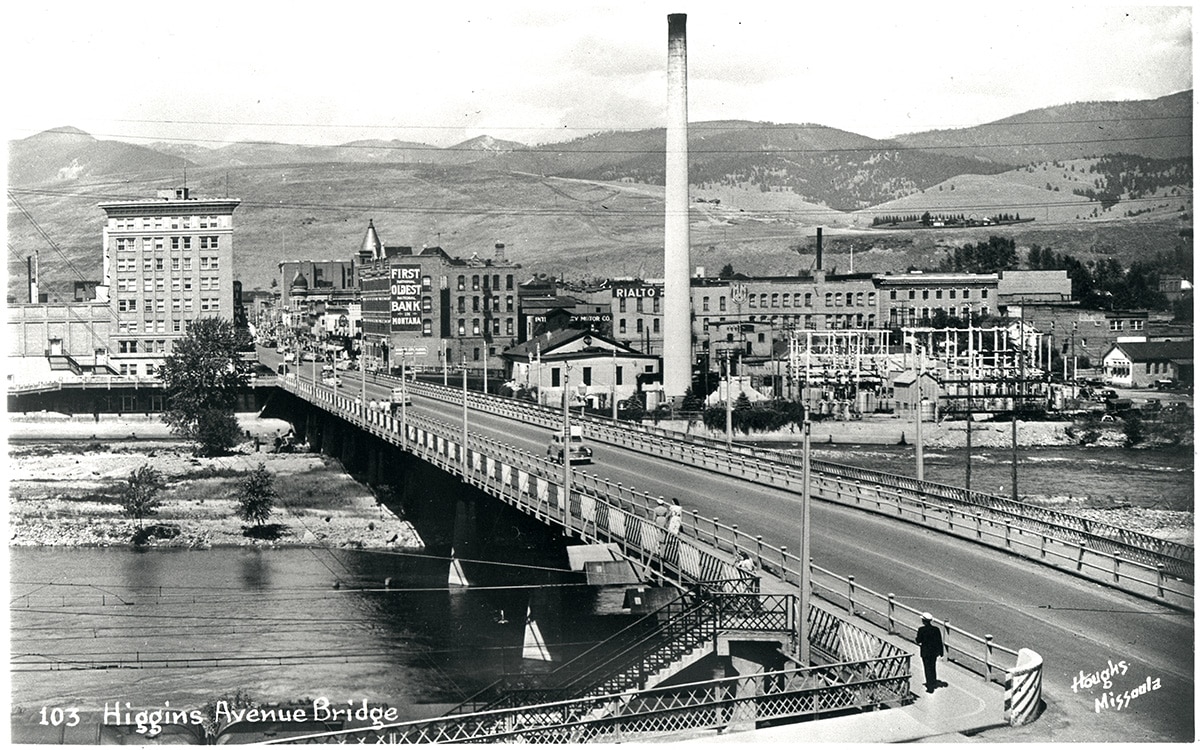
In fact, Missoula had explicit bike lanes on the Beartracks Bridge — known for years before that as Higgins Avenue Bridge — as early as 1936. But they wouldn’t last.
The bridge itself had already been through one rebuild by then. The original bridge was destroyed in the devastating flood of 1908, and the city replaced it in 1909 with a structure meant to serve every mode of transportation crossing the river. It had an 8-foot-wide path on each side, protected by a guardrail, to accommodate pedestrians. The other transportation methods — horse carriages, electric streetcars, automobiles, and bicycles — shared the two-lane road in the center.
But in 1936, concerned about bicyclist safety and traffic congestion, the city council changed the traffic rules. It banned bicycles from the center road and required them to ride on the pedestrian path, ordering bikes to keep to the inside of the path and pedestrians to the outside. To make this clearer, it painted a bright yellow line down the middle of the pedestrian path, creating what it explicitly called “bicycle lanes.” The painted line is visible in the photo from 1948.
If progress for bike lanes hasn’t been a straight line, it hasn’t quite been cyclical, either.
Unsurprisingly, pedestrians complained of speeding bicyclists, and bicyclists complained of pedestrians wandering into the bike lane. While the system didn’t create perfect harmony between transportation modes, for several decades it did carve out explicit spaces on the street for each, and the barrier protected bicyclists from automobiles.
By the 1950s, the bridge was showing its age. Automobile traffic and congestion had increased dramatically, and many Missoulians pushed for an upgrade. In 1956, Missoula County residents voted to replace the old bridge with a new, four-lane one. While Missoula County would foot some of the bill for the new bridge, much of the financing would come from state and national road agencies, which had a lot of say in the final design.
Their focus was improving automobile traffic flow. Missoulians did advocate for maintaining a protected pedestrian and bike pathway, although they only suggested a 6-foot-wide path. But even that was too much for the U.S. Bureau of Public Roads engineers, who wanted a 3-foot path and no guardrails — which they deemed unnecessary and not modern enough — between the path and the road. The compromise was a 5-foot path with no inside guardrail.
The new Higgins Bridge opened in November 1962. It was 10 feet wider than before and accommodated four lanes of automobiles. But the space for pedestrians and bicyclists had shrunk and become more dangerous.
But then — one adjustment soon after the bridge officially opened. The Women’s Club of Missoula had been campaigning for that inside guardrail, and while the U.S. Bureau of Public Roads did not object, it refused to help pay for it. The chairman of the Montana Highway Commission asked the women if they really wanted the guardrail, knowing it would be “the only modern one in the U.S. with such railings.” They answered yes, and so local taxpayers funded what was, according to the Missoulian, the first inside railing on any bridge built in the United States since 1950.
But with the inside guardrails installed, the sidewalk space was only about 4 feet — much too narrow for a separate bike lane. This inevitably put pedestrians and bicyclists in more conflict on the protected path. Missoula had already outlawed bicycles from riding on the sidewalk well before the 1960s, but it had made an exception for the Higgins Bridge. After the new bridge was built in 1962, complaints about bicyclists on the pedestrian pathway increased. Eventually a sign went up: “No bicycles on sidewalk.” Bicyclists could ignore the rules, walk their bikes on the sidewalk, or, as most did, take their chances riding in traffic. Later, in the late 1990s, the city painted bike lanes on the bridge, but they lacked the protective barrier of the earlier bike lanes. Only when the new Beartracks Bridge replaced Higgins Bridge in 2023 did Missoula get dedicated, protected bike lanes again.
If progress for bike lanes hasn’t been a straight line, it hasn’t quite been cyclical, either. Maybe it’s something in between. Missoula has never fully settled the bike lane question, because there have always been too many people riding, and too many opinions about where they belong, to let the argument rest. Even when the protected bike lanes disappeared for 60 years, the fight for them never did.