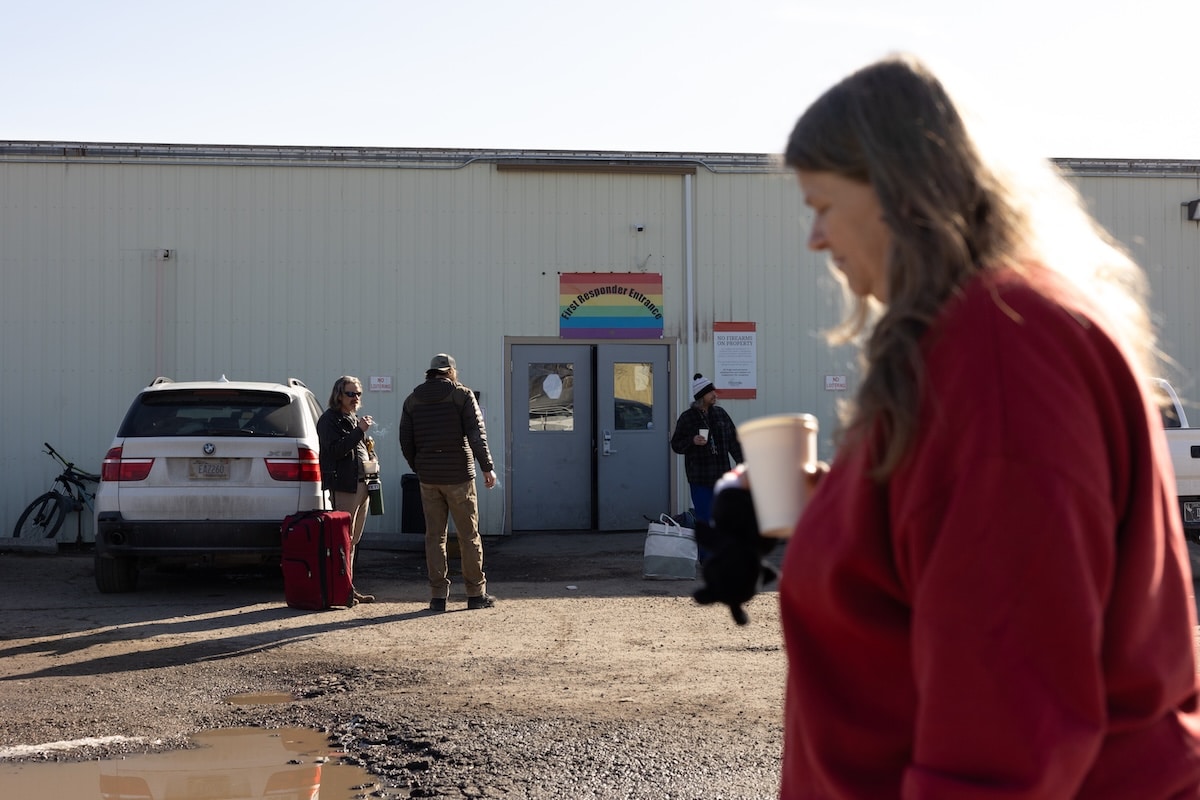
The ambitious city initiative to connect residents of the Johnson Street Shelter with housing before its planned closure in August has housed 17 people, according to a presentation to the Missoula City Council this week.
That still leaves about 70 people sleeping in the shelter each night, according to the city. The shelter hit a peak of more than 200 residents last winter, and was averaging between 150 and 160 occupants a night when the city announced in March its intent to close the shelter.
Still, the relatively modest number of people housed through the city’s so-called housing sprint since it began in the spring belies the initiative’s total reach: About $36,000 has generated at least some kind of help for 63 people, city houseless programs manager Emily Armstrong told the city council Wednesday. The sprint — effectively a fundraising drive in partnership with the United Way of Missoula — has raised a little less than half its $400,000 goal.
There are a number of steps required to put someone in permanent housing, Armstrong said. (Although, this reporter notes, it seems to be comparatively easy to kick someone out of a shelter). While money from the housing sprint can be used to help someone pay a deposit on an apartment, for example, it may also be used to obtain legal documentation or pay outstanding bills or other debts, among other case management services. Many of the people in the sprint’s orbit are in this stage but may soon find permanent housing, Armstrong said.
Citing funding constraints, the city announced the closure of the shelter and establishment of the donation fund to help connect its residents with permanent housing in March. Even then, city officials like Mayor Andrea Davis acknowledged Missoula would not be able to find housing for everyone staying there. The shelter has already gradually reduced its capacity since the announcement, dropping from 165 to about 110, and will further restrict bedspace to 70 in July. Those who must leave will be decided by a lottery system.
“There are a lot of people who have income between $800 and $1,100 that is reliable, but that is not a rental in our community that they can sustain at that rate.”
Of the 17 who have found housing, nine have stayed in Missoula, three have found a place elsewhere, four have moved in with family and one has moved into a skilled nursing facility. The program has some fundamental limitations, Armstrong acknowledged. Namely, even with the funds and services offered through the housing sprint, Missoula is still an increasingly expensive city with a constrained housing inventory.
“There are a lot of people who have income, they have income between $800 and $1,100 that is reliable, but that is not a rental in our community that they can sustain at that rate,” Armstrong said.
Homeless Missoulians face a number of structural and individual barriers to housing, especially for those who have been incarcerated and Indigenous people, according to a new report released by Missoula County and Homeward, a local housing non-profit.
“Justice system involvement and housing instability are mutually reinforcing,” the report, prepared by the University of Montana’s Rural Institute for Inclusive Communities, reads. “Many people experiencing homelessness are justice-involved and vice versa.”
About one in five people who were booked in Missoula County in 2023 were unhoused or had no fixed address, according to the report, which analyzed official criminal justice data as well as anecdotal data from interviews. About one in 10 people entering the city’s coordinated entry system had recently been released from some kind of carceral facility.
People without homes obviously have less privacy. This means more scrutiny from other members of the community and, for this and a number of other reasons, more criminal justice interactions, the report says. The existing racial disparity in the population of homeless Missoulians — about 15 percent are Native American though they make up roughly 6 percent of Montana’s population — is amplified in jail or prison. Indigenous people make up about 25 percent of jail bookings among homeless Missoulians, according to the report.
“Interview participants described a ‘revolving door’ in which people are released from incarceration into homelessness, only to be re-arrested for minor infractions often related to being unhoused, such as trespassing, public intoxication, or failure to appear in court,” the report says. “These dynamics point to the urgent need for housing and reentry strategies that interrupt this cycle.”
More blowback over maternity center closure
The union and professional organization representing nurses in Montana released a statement this week decrying Providence St. Patrick Hospital’s recent decision to close its maternity center.
“The decision to shut down the Family Maternity Center without meaningful stakeholder input, transparency, or transition planning is not only harmful to the healthcare workers impacted but puts the health and safety of families and newborns in jeopardy,” Montana Nurses Association President Vicky Byrd said in a statement shared with the press Wednesday.
The statement calls on the hospital to reverse its “abrupt” decision and find a way to keep the center open.
The hospital said in a statement earlier this month that it would close the center in October, citing declining birth rates and workforce challenges.
“We are working closely with Western Montana Clinic and Community Medical Center to ensure a seamless transition of care for expectant mothers,” a statement from the hospital at the time said. “Community Medical Center’s labor and delivery program, including advanced NICU capability, can meet current and future market needs, ensuring no decline in access to quality services.”
The decision met immediate blowback. In an open letter, doctors from the hospital’s obstetrics and gynecology department called the hospital’s statements that the decision was made following consultation from clinical and community leaders “categorically false.”
“None of the physicians or clinical staff from the FMC, nor leadership of the Western Montana Clinic, were included in any decision-making process. We learned of our unit’s closure on the morning of June 3 — mere hours before the public announcement — through a meeting to which only one of our five Ob/Gyns was invited, and for the rest of us, via a hospital-wide memo,” the letter reads.
Now the nurses at the hospital have added to the chorus of criticism.
“We call on Providence to return to the table and work collaboratively to find a path forward — one that ensures the continuation of this essential service while honoring the vital contributions of the healthcare professionals who make it possible,” the MNA statement says.