Wow.
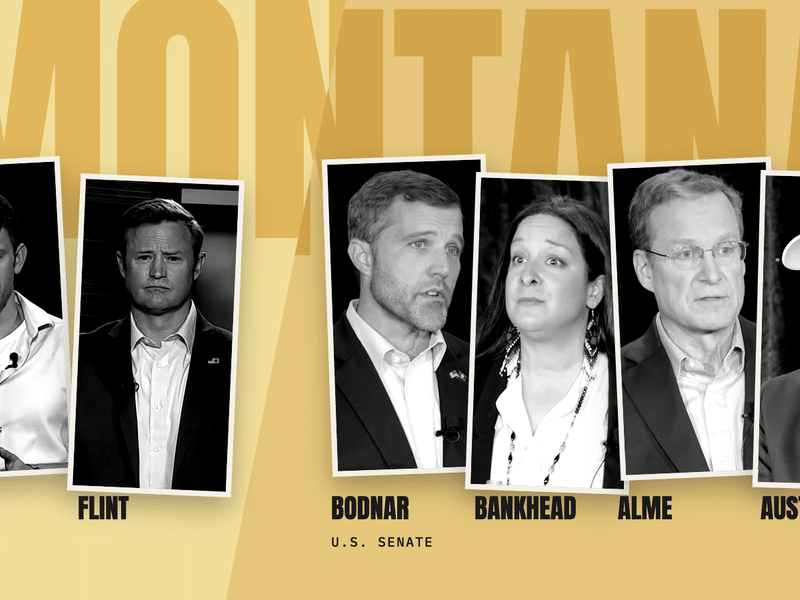
That probably best sums up the general reaction most people had to this week’s election results. Democrats secured control of the U.S. Senate, seized their strongest majority in the U.S. House in decades, even claimed every single statewide office on the ticket in Texas. Montana didn’t feel the full force of that “blue wave,” but the western district caught a little spray: Sam Forstag defeated Aaron Flint to become the first Democrat Montana has sent to the U.S. House since Pat Williams’ final reelection in 1994 — the year Forstag was born.
The win would seem to suggest that Democrats once again have a competitive edge this side of the Continental Divide, or perhaps simply that voters here had wearied of the brash, showy stage performance Flint brought to his strongly Trump-aligned campaign. Speaking Wednesday outside the Missoula County Courthouse, Forstag said he’d heard from voters who told him this was “the first time they’ve felt hopeful about our politics in a long time, if not ever.” Flint, for his part, acknowledged Forstag’s victory and offered his help if and when the Democrat ever needs it.
In the U.S. Senate race, the story was somewhat more familiar. Republican Kurt Alme claimed roughly 48 percent of the vote in a four-way contest that October polling indicated was very much his to lose, with Democrat Alani Bankhead and Independent Seth Bodnar splitting the minority vote as predicted. Montanans from both camps were quick to vent on social media, claiming Bankhead’s refusal to duck out of the race cost Bodnar the win — and vice versa.

In truth, though, the math is more complicated than that. As veteran political reporter Tom Lutey at Montana Free Press pointed out this week, the absence of one or the other from the race would not necessarily have spelled Alme’s doom. Would moderate Republicans who backed Bodnar really have voted for a Democrat without an independent option? Would loyal Democrats have turned out without their party’s candidate on the ballot, or would some have simply stayed home?
Recent history shows a modern Montana Senate race is rarely a sure bet for anyone outside the GOP. Jon Tester learned that the hard way in 2024 when he lost his third reelection bid to Republican Tim Sheehy by a staggering 7 points. Tester’s wins had never been comfortable. Starting with his narrow 2006 defeat of Conrad Burns, the popular Democrat typically bested his challengers by fewer than four points. Outgoing Republican Sen. Steve Daines, by comparison, beat Steve Bullock by 10 points in 2020 and Amanda Curtis by 17 in 2014. As a two-term governor and former state attorney general, Bullock in particular was a household name across the state — something that can’t really be said for Bodnar or Bankhead.
Democrats also eked out legislative gains Tuesday night, flipping two state Senate districts and further chipping away at the 102-seat supermajority Republicans briefly held across both chambers a couple of sessions ago. Republicans will hold the Senate 30-20, a split last seen in 2019, while the House will likely see its strongest Democratic minority in nearly two decades. That puts the parties on more even footing heading into a 2027 session when public education funding, health care access and property tax relief will again take center stage.
A national blue wave was never going to translate into a seismic shift in the partisan makeup of the Montana Legislature. We’re just too big and red and rural a state for that. But as is so often the case, the next chapter in Montana’s post-election political story will largely be written by those nearer the middle — the ones who don’t always bring a partisan jersey to work, who see lawmaking as a responsibility rather than a rivalry, and who measure their success not by whether their party wins but by whether the government they’re elected to does its job.
Elsewhere on the ticket…
Montana’s three citizen initiatives all passed handily, each with at least 65 percent of the vote, a rebuke of some Republican leaders’ positions on dark money, judicial partisanship and government interference in the initiative process. Montana will now add two provisions to its constitution and move to implement a ban on corporate influence in elections that directly challenges the U.S. Supreme Court’s ruling in Citizens United.
The two constitutional amendments maintain both the timeliness of Montana’s ballot initiative process itself and the longstanding nonpartisan nature of judicial elections. Neither pitch came out of nowhere. During the 2024 election cycle, Attorney General Austin Knudsen tried unsuccessfully to delay the certification process for an initiative to enshrine the right to an abortion in the Montana Constitution, while the Legislature’s Republican leadership has launched several attempts in recent years to force judicial candidates to declare a party affiliation. CI-132 and CI-133 came in answer to these politically charged efforts, giving voters a collective voice in resolving two hot-button partisan issues.
I-194 was a slightly different beast — an answer to a problem that continues to plague our nation’s electoral process. Despite widespread voter disgust over what amounts to corporate sponsorship of political candidates, money still talks in election cycles, often with a damn megaphone. Much of it these days is virtually untraceable, having passed through a sprawling network of super PACs and so-called “issue advocacy” nonprofits, the original donor’s identity concealed by financial shell games and IRS protections. Candidates may not even know who is backing or attacking them, and coordination with these networks is strictly prohibited (at least on paper).
This is dark money, funded by the only people rich enough to bankroll such endeavors but executed in a way to shield their influence from sunlight. And it’s driven Jeff Mangan nuts since his six-year stint as Montana’s political practices commissioner, the primary investigator and enforcer of state campaign laws. The national nonprofit Center for American Progress this week praised Mangan’s work turning opposition to corporate money in Montana elections into a movement and shepherding I-194 onto the 2026 ballot. With “The Montana Plan” now approved by 302,141 Montana voters, state lawmakers will be tasked with prohibiting “artificial persons” from spending money to sway political races.
“We were up against some of the biggest special interests in Montana,” Mangan said in a press release about the election results, “and today, the people of Montana have won.”
I-194’s backers are still up against them. Before Election Day was even over, the Montana Republican Party and four advocacy groups sued in federal court to block the measure.