This story appears in The Pulp’s fall print edition, available now at local businesses all around Missoula, including Rockin Rudy’s. Want copies at your business? Text us at 406-540-PULP.

The writer Gale Wilhelm, who wrote a seminal book in the 1930s about a woman who, like her, was gay, didn’t have someone like Leonard Woolf pouring cement into her legacy the way he did for his famous wife, Virginia, right there in the middle of London’s literary elite.
But now Wilhelm has Brad Bigelow of Missoula, Montana.
It’s Bigelow, bespectacled and 68 and not necessarily a feminist, who found and secured the rights to reissue “We Too Are Drifting,” Wilhelm’s debut novel about, among other themes, a lesbian love triangle.
It’s a sparse and beautifully written book that was the first mainstream novel to treat women loving women as normal — or normal in the ways that Jay Gatsby throwing a party because he wants to get under Daisy Buchanan’s dress is normal. But Jan Morale, the protagonist of “We Too Are Drifting,” is less annoying than maybe all of the Fitzgerald characters today’s high-schoolers are still required to know.
If you search in a specific way, you’ll find Wilhelm’s book included in a list of important queer fiction of the 1930s (Woolf’s “Orlando” came out in 1928). But if you wanted to find an actual copy, good luck.
Now it’s part of Recovered Books, a fascinating series Bigelow oversees for the U.K. publishing house Boiler House Press. And you can easily buy a lovely, slim paperback version at a warehouse-turned-mall with the best creaky floors off Alder Street, where Vespiary Books relocated and recently relaunched “We Too Are Drifting.”
The event in September also included the author of the new edition’s afterword, Talie Wilkinson, a University of Montana senior studying creative writing. She’s the one who went to Berkeley to dig into Wilhelm’s archives after Bigelow reached out to UM and asked for a promising student to help do the research. At the event, Wilkinson described Wilhelm’s archives as “five slim binders,” emphasizing slim.
“I’m more than happy to help balance the historical literary tables.” —Brad Bigelow, Recovered Books
Wilhelm wrote six books from 1934 to 1945. In addition to “We Too Are Drifting,” her “Torchlight to Valhalla” from 1938 included lesbian main characters. Her others fell into more typical hetero slots. A few of her novels, especially “We Too Are Drifting,” sold relatively well and were reviewed favorably by critics. Then Wilhelm disappeared from a literary map she was never fully on. She quit writing or, at least, publishing, and the availability of her works dwindled. She moved with a partner to the Bay Area; they bought a house and lived their lives, weathering what Bigelow points to as the “Lavender Scare” of the 1950s. Wilhelm died in 1991. Her partner’s niece inherited Wilhelm’s manuscripts, eventually gifting them to the library at the University of California, Berkeley, which held the rights and granted permission for the new edition to Bigelow and Boiler House. Now Bigelow hopes to also include “Torchlight to Valhalla” in his series, which he calls a true labor of love.
Unearthing neglected authors is not how he made his career, nor how he ended up in Montana, but it is how he spends his so-called retirement instead of playing golf, which he admits he doesn’t get.
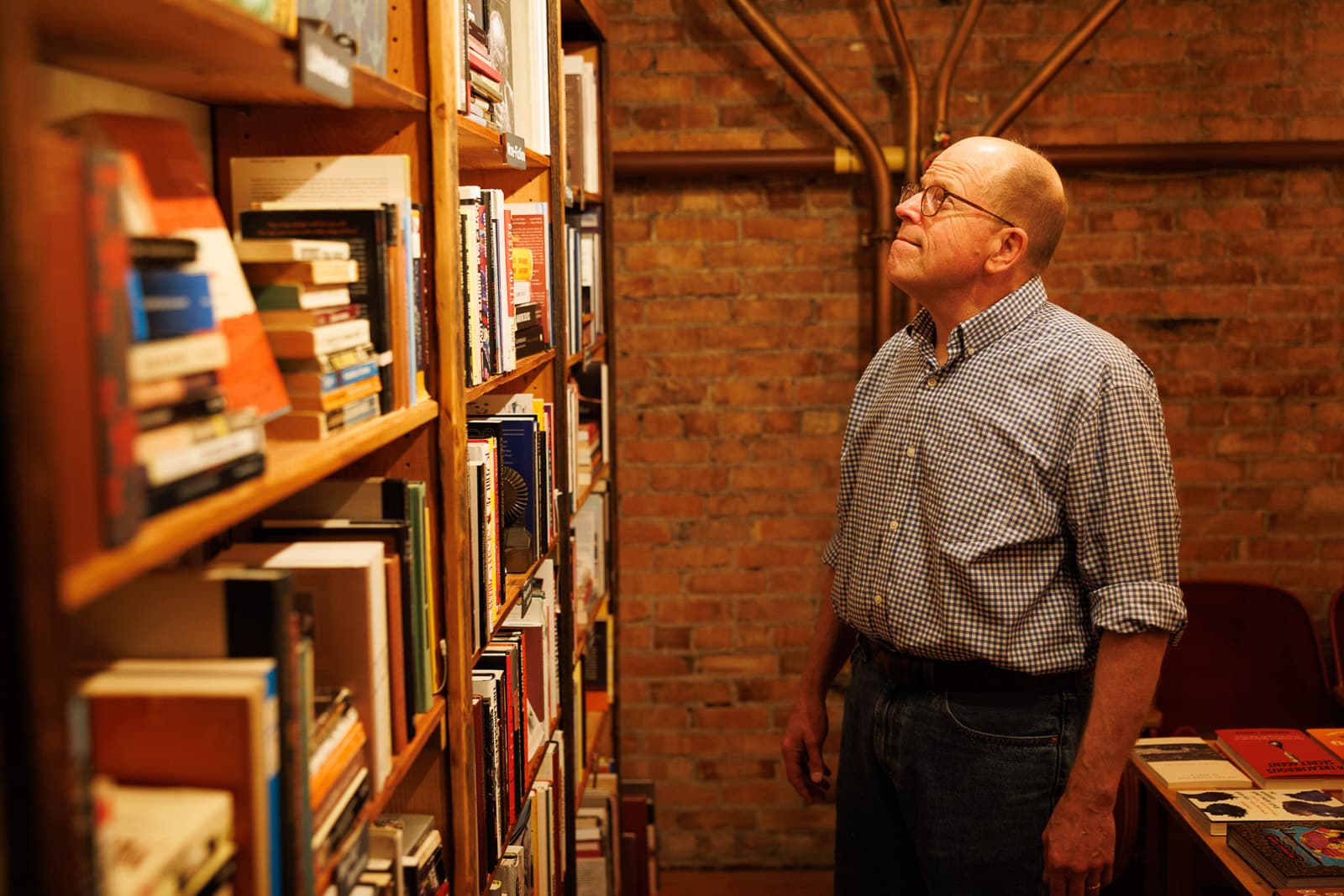
Bigelow grew up a self-identifying Air Force brat, living in various places in the U.S. and Italy. He studied English alongside math at the University of Washington, where he often wandered the library’s stacks looking for old, forgotten books even then. An Air Force scholarship paid his tuition in exchange for service; he ended up staying for 25 years and then taking a job as a technical adviser with NATO, living in Belgium. His wife, Susan Andrews, had family in Missoula. A sister, Mea Andrews, wrote for the Missoulian, and her husband, Dave Guffey, was the sports information director for the Griz. Brad and Susan visited a few times, liked it, and when it came time to pick an official “home” for required leave from work, they chose Missoula.
But they didn’t stay put. In 2019, he and Susan lived in Norwich, England, so Bigelow could take advantage of the GI Bill and a graduate program that specialized in his big interest — biography writing — at the University of East Anglia. After the virus locked down the world in 2020, he had a conversation with a publisher associated with the university that led to the Recovered Books series. It started with a very on-brand novel about isolation, “Gentleman Overboard” by Herbert Clyde Lewis. Initially published in 1937, it’s about a banker lost at sea, treading water and waiting to die after falling off a ship. Bigelow calls it “riveting.” Because of that reissue, it’s been translated into 13 languages and there’s a YouTube vid where an Italian actress will read it to you in its entirety.
Many — but not all — of the authors Bigelow and Boiler House Press bring back to bookstores and, ultimately, to literary regard are women. It makes sense. While women authors certainly sold in Wilhelm’s time and after, they’re labeled that way: as women authors. “Men didn’t read women,” Bigelow said in an interview after the book launch. And, he admits, that’s still too often true.
A few years ago, he was part of a conversation among academics where one (a woman) asked another (a man) the last time he’d read a female author. Her colleague stumbled around and couldn’t get specific. Bigelow realized he could recall the last time he did, but he hadn’t sought them out. Then he did. For 2015, he committed to only reading women. He dug it so much, he continued the trend the next year. That helped him tap into a place where he could make a difference — and also, eventually, sell books.
“I’m more than happy to help balance the historical literary tables,” he said, but he does it as frugally as he can.
For example, the photos on the cover of the new “We Too Are Drifting,” a collage of nine black-and-whites of smiling women from the ’30s — two to a frame and one in the center of a couple kissing — came to him on the cheap from eBay auctions of photo-booth pics. Additional photos of ’30s women for the inside covers, called endpapers in the publishing biz, came from damaged acetate negatives developed in 1934 by Arnold Genthe. They’re part of the public domain through the Library of Congress and, therefore, free. He paid around $50 for the rights to a portrait of Wilhelm, a softly lit photo of a serious-looking, buttoned-down woman.
Because of Bigelow, “We Too Are Drifting” is now totally findable locally and elsewhere for around 20 bucks. It’s a small fee to spend time in the circle of Jan, the no-bullshit wood-carving artist at its center. In her voice, Wilhelm writes that Jan “was carrying the excitement in her jacket pocket now, locked tightly in her hand.” It’s a good line, one among many Wilhelm wrote in the ’30s, long before anyone knew it could also describe what it’s like to hold her first book in 2026.