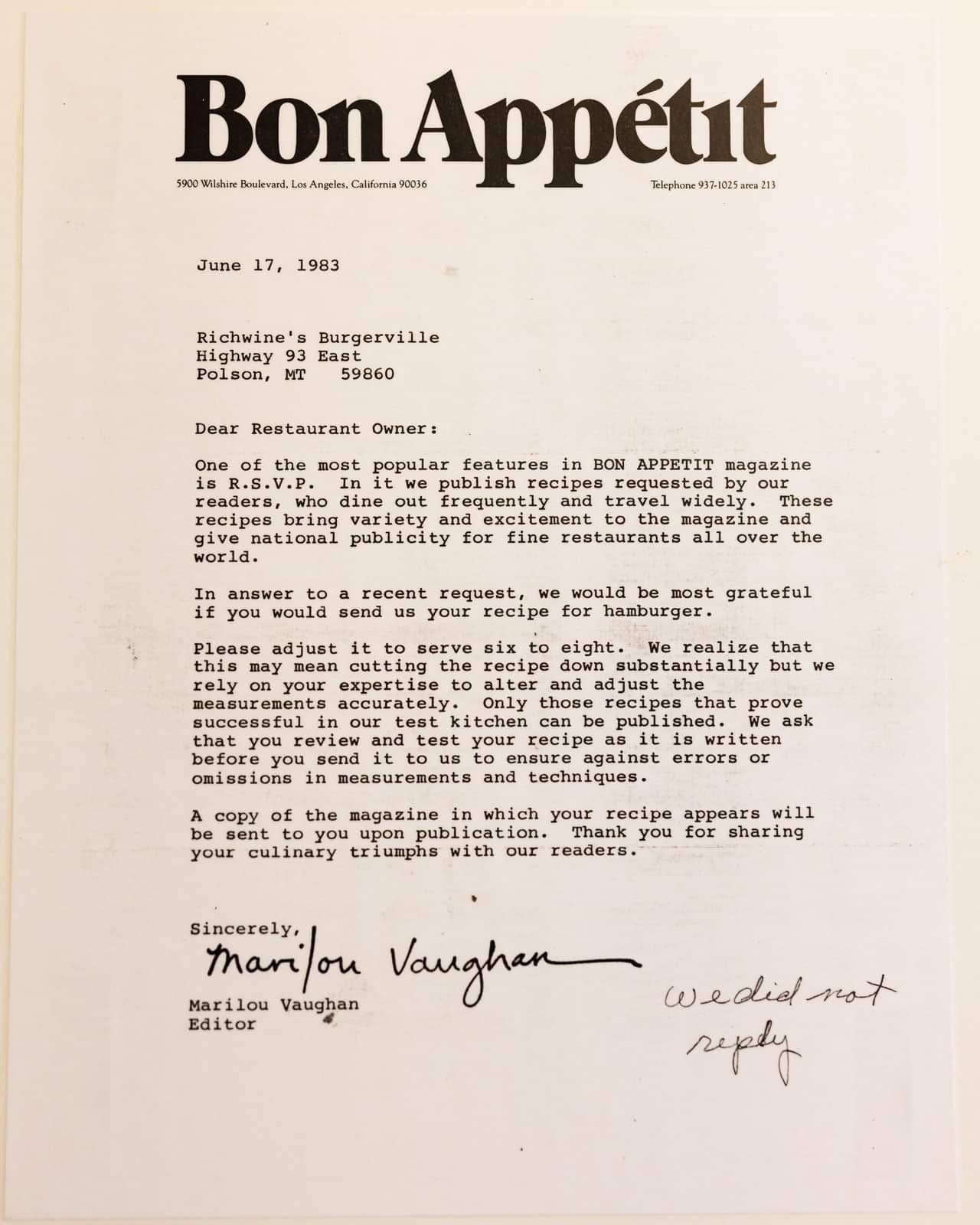
In 1983, Bon Appétit editor Marilou Vaughan wrote to Richwine’s Burgerville, a family-run drive-in just off U.S. Highway 93 in Polson, on the southern shore of Flathead Lake.
Her magazine’s popular R.S.V.P. section published recipes requested by readers who “dine out frequently and travel widely.”
“In answer to a recent request,” Vaughan wrote, “we would be most grateful if you would send us your recipe for hamburger.”
The Richwine family, who had run the drive-in for more than 20 years, did not write back.
That a Los Angeles food magazine came calling on a town of around 3,000 tells you something about the burgers at Richwine’s, which sold this summer to new owners.
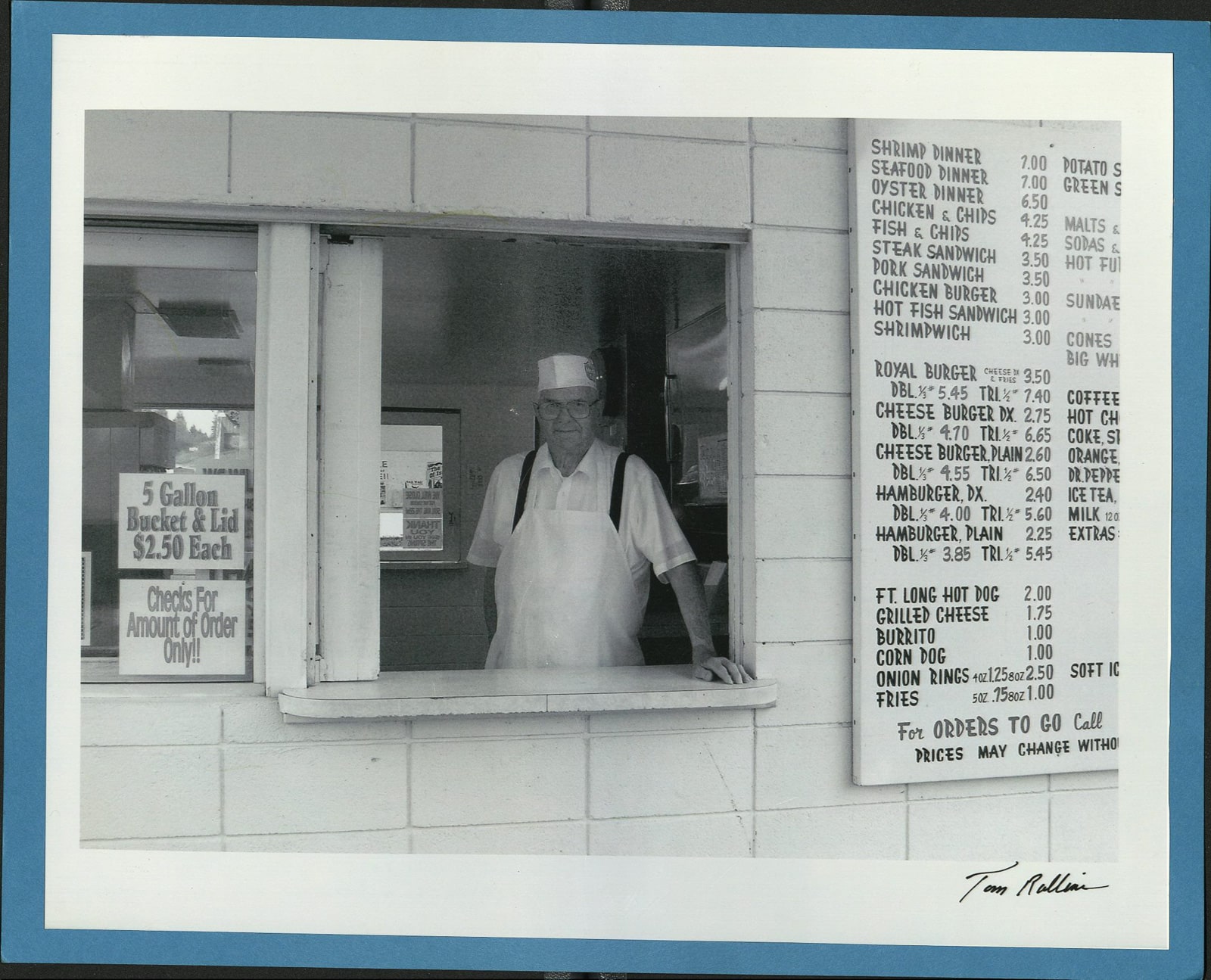
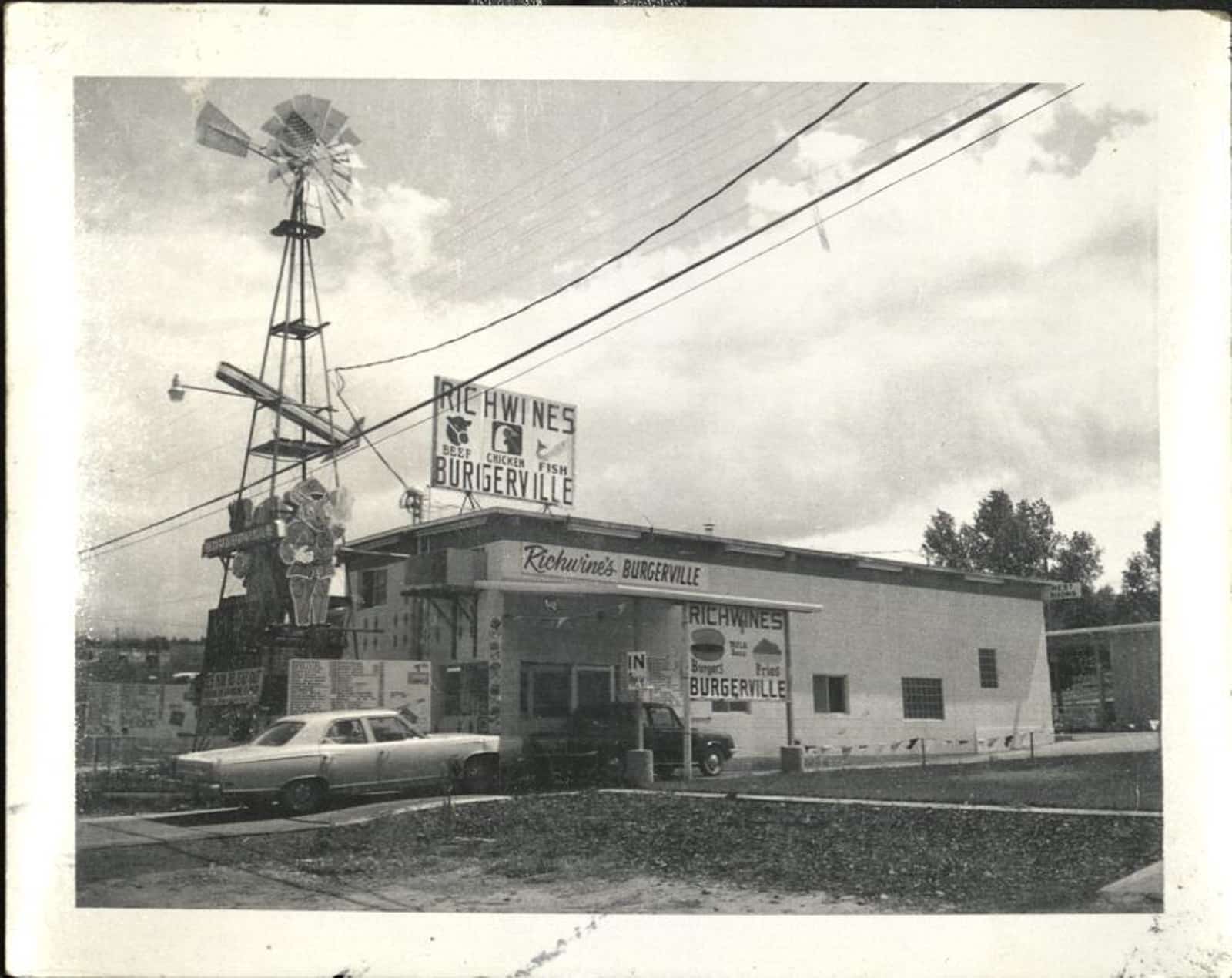
Enoch Richwine and his wife, Lucy, took over the business — then a small, movable burger stand — in 1962. The couple leased the drive-in for about a year before purchasing the stand and its equipment, then bought the land Burgerville sits on in 1965 and, in 1969, erected the brick building that exists today. In the early 1970s, Enoch started grinding and mixing his own hamburger. He exclusively used bull meat — a leaner option than cow — sourced from Montana ranchers, adding about 10 percent fat and seasoning it with salt and pepper.
The task of grinding hamburger typically started in February, while they were closed for the season, and the meat was then hand-pressed into patties every day before service. The Richwines did all of this on-site, and began the process again in May to re-up their supply for the rest of the summer.
“If somebody was new to Burgerville, I would say don’t order anything less than a double.”
Richwine’s burgers have long been heralded as some of the best in the West. I first visited the drive-in at 9 years old and have returned almost every summer for the past 30 years. Going to Richwine’s could feel like entering a portal to a simpler time — not only due to the 1970s-era cartoons of burgers and fries on the drive-thru walls, but also because the business prioritized doing things by hand, giving its hospitality a more personal, human quality.
Every burger bag was stapled with a napkin and all cheeseburgers deluxe came topped with a garnish called a “do-hinkey” — a hand-cut, bite-sized piece of celery, carrot and radish stuck on a toothpick. Staff, in blue polo shirts with matching baseball caps, took down each order with a pad and pencil.
In late July, after more than 64 years in business, Richwine’s sold to Idaho-based restaurant group Lake City Restaurants, which owns and operates the north Idaho chain Roger’s Ice Cream and Burgers and in April 2025 acquired the Cougar Country Drive-In in Pullman, Washington.
A couple of weeks after the sale, I stopped by for lunch and gave my order — always a Royal Burger Cheese Deluxe (named for former Burgerville owner Royal Morrison) — to an employee inside the walk-up window who looked down at a tablet. When my food arrived, there was no stapled bag, no do-hinkey.
To the untrained eye, these missing touches would not register — just another burger place off the highway. But to those of us who know Richwine’s, they stood out.
You could say it was the end of an era, but maybe more so a reminder of how the Richwine family chose to do things differently, and the impact their small-town drive-in leaves behind.
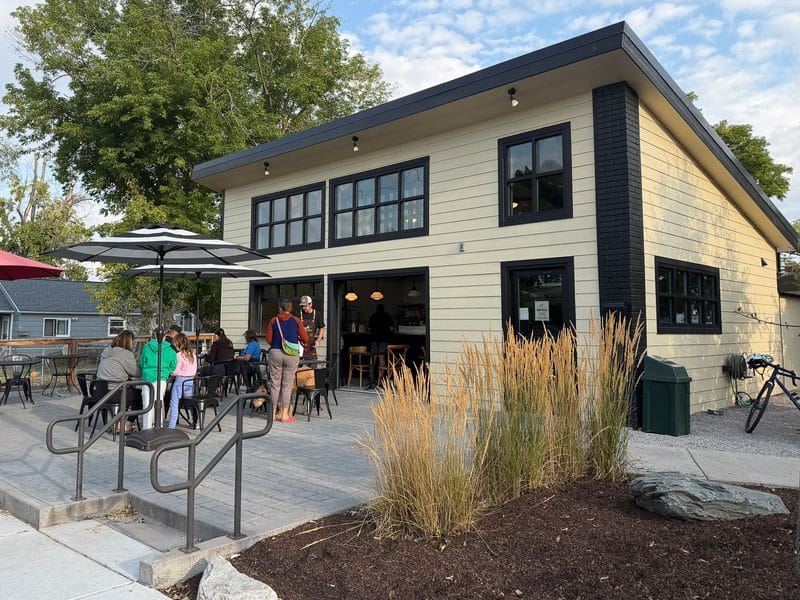
In mid-August, I met up with Marcia Richwine Moen in the back corner of Break Espresso in Missoula.
Moen, 65, is the youngest of Enoch and Lucy’s four children and the last family member to oversee operations at Burgerville. She had managed the drive-in full time for the past 17 years, living eight months of most of those years in an RV trailer parked behind the restaurant.
Family-owned drive-ins like Richwine’s are a dying breed. Around the time Moen’s parents took over, there were an estimated 40,000 drive-in restaurants across the United States — now that number is closer to a couple hundred.
Across from me, Moen’s eyes welled up as she talked about the decision to sell. “It’s just the hardest thing I ever did,” she said.

Moen’s older brother Shane managed Richwine’s for almost 20 years after their parents retired. In March 2009, as Shane began to lose his battle with skin cancer, Moen came back to help run the drive-in. To keep Richwine’s in the family, she volunteered to take over, and after Shane died that June, she formally took the helm in 2010.
“As long as my mom was alive, I wanted her to be able to put a key in the door,” Moen said. Their father, Enoch, had died in 2006 at age 81, on his way — Moen says — to go press burger patties.
Moen kept up her parents’ traditions, grinding and mixing bull meat on-site with her brothers, Corey and Mason, and other family members, and hand-pressing every patty.
Each season, which lasted from March through September, she would train from 12 to 23 staff members to take orders in pencil on a “guest check” pad and to count change back. Employees learned how to make “do-hinkies” and were coached on how to greet and interact with customers. Moen says she made a point of teaching employees how to do every job except cook, which required them to be 16 or older, so that everyone was capable of pitching in where needed.
In 2019, local film producer and longtime customer David King released Burgers, Fries & Family Ties, an award-winning documentary he called a “love letter to Richwine’s Burgerville.” Shot behind the scenes over 18 months, the film traces the family’s history and captures Moen’s dedication to the drive-in and its impact on the community. In it, employee Jacob Ascensio describes how Moen coached him through his first interview with her, giving him tips he later used when applying for other jobs.
“As soon as I met her, she acted as a teacher for me,” Ascensio said in the film.
Moen ran every aspect of the business, from bookkeeping to working the grill, and before long she learned what her customers ordered and how they liked their burgers.
“My customers became my family. And when they’d pull up to the speaker, I know what those people order,” Moen said. One couple, she recalled, always got a hamburger and cheeseburger deluxe, no “goop” (ketchup, mustard and relish), with fries and rings and two small Cokes, and sometimes a footlong with a little bit of mustard.
I asked Moen what her order was, and she didn’t hesitate: a double cheeseburger with ketchup, mayonnaise, pickles, relish and onion, plus fries and rings. “If somebody was new to Burgerville, I would say don’t order anything less than a double,” she said.
Ironically, Moen’s sense of taste has all but disappeared. She suspects she got COVID after rotator cuff surgery three years ago. “I can barely taste the chai in this tea,” she said, holding up her cup. “Now a hamburger tastes like cardboard.”
That surgery was one of several. The physical toll of running Richwine’s, where, she said, 16-hour days were routine, has also included a hip replacement, carpal tunnel surgery, knee surgery and a stress fracture on her sacroiliac joint, and it has aggravated her rheumatoid arthritis.
After Lucy Richwine died in 2015, Moen began to consider putting the restaurant up for sale. In 2017, the family received interest from a potential buyer but held off. Then, in 2023, they officially put the business on the market, listing it at more than $1.6 million. After a sale fell through — Moen says the prospective buyer failed to show up to sign — she continued to lower the price. In May, they got a bite.
Moen’s 25-year-old daughter, Cassidy, felt pulled to help her mom run the restaurant and moved back to Montana from Nashville in April. A few months later, the two sat together at the title company in Polson as Moen signed the final paperwork. (The family declined to share the sale price.)
Cassidy Moen was only 9 when her mom moved to Polson to take over the drive-in. “My first memory [of Burgerville] is that my mom was home a lot less,” she said.
Working alongside her mom during their last season and then watching her sell the business, she said, prompted a wider perspective. “My whole appreciation for what she has done … just all came together. I really got the full understanding of what she sacrificed and what it takes every day.”
Since the new owners took over, both Moens say it’s been hard to watch their traditions change. Handwritten orders have been replaced with a point-of-sale system, and the business plans to operate year-round. Most of all, no one is grinding hamburger on-site. Marcia Moen and her brother Corey kept the meat grinder, and the family’s two metal patty-pressers went to Cassidy Moen and her older brother, Casey.
“I have to keep telling myself it’s OK,” Marcia Moen said. “It’s never gonna be the same. All I can hope is that everyone knows what I did.”
With no other family members interested in taking over, Moen says she chose to sell out of concern for her health and to spend more time with her family. Still, she admits it’s not easy to let Burgerville go.
“It was a blessing that I was able to put my key in that door and walk through it every morning and honor my mother and father,” Moen said. “I didn’t have to. I didn’t have to run that restaurant. I got to.”
Lake City Restaurants, owned by husband-and-wife team Mark and Nicole Randolph, did not respond to multiple requests for comment via email this fall, or to messages left in person with staff at Richwine’s over the summer. In an online description of the business, the Randolphs wrote that they “love preserving the history and tradition within local communities” and are “committed to serving the highest quality, freshest ingredients starting with our hamburgers.”
Asked what she hopes for moving forward, Cassidy Moen shared what she valued about the customer experience at Richwine’s.
“We did handwritten orders for so long because we teach kids how to write. We teach kids how to manually add. We teach kids how to count change back because you catch your mistakes by doing that. These are not only customer experiences [that are] like, ‘Whoa, this is old-fashioned, this is cool,’ but also we’re teaching valuable human lessons,” she said.
“The people who’ve worked and the people we’ve gotten to serve, we’ve changed their lives in some way and I hope that that lives on forever and those stories are told.”
The next time I saw Marcia Moen was on a sunny morning later that week, outside her home near the Wye.
She led me through the living room, past a table with a sewing machine, project patterns and stacks of fabrics — a crafting wonderland.
Before showing me to the kitchen table, where she had laid out decades of Richwine’s archives and memorabilia, Moen held up a fox-themed baby blanket she’d recently finished for her grandson, Archie, due near the end of August.
We combed through newspaper articles from the 1980s, when Richwine’s first received national attention. After a 1980 review from United Press International put Richwine’s on the map, others followed. A 1987 story for The San Diego Union began, “If there’s anything a fisherman appreciates, besides a hungry trout, it’s a delicious sandwich. I found one of the better ones, maybe the best one, at this small town on the south shore of Flathead Lake.”
Moen shared old photographs, including one of the first Burgerville locations (back then, it was a three-business franchise) and her dad’s hand-drawn blueprint for the current location, complete with space for a playground and shaded outdoor seating. From a crate of file folders, Moen produced a stack of original paper menus from the mid-1970s. From another box, she pulled a couple of bumper stickers that read, “Shake your Hinkey Maker” next to a photo of a do-hinkey.
Our final stop was the garage. Moen unfurled a long plastic banner headlined “Good Times at Richwine’s” onto the floor, next to a white SUV with a “BSTBRGR” vanity plate and a pile of blue Burgerville polo shirts. The banner, which used to hang inside the drive-thru, reminded me of a giant yearbook page, with photos of community members, Burgerville staff and the Richwine family spanning decades. It didn’t just highlight milestones for the business, but for the people who supported it: customers celebrated their birthdays, anniversaries and even weddings at Richwine’s. The drive-in’s history also reflected years of giving back, like annual Mother’s Day blood drives in honor of Lucy Richwine, or donating a portion of the proceeds of every “Bernie Burger” — Shane’s nickname — to the American Cancer Society or a local family battling cancer.
A month later, I spoke to Moen on the phone. She’d had one of two surgeries to help relieve tendon pain in her fingers — a side effect of repetitive motion, like flipping burgers. She also reported that her new grandson had been born, and she was going to visit her brother Corey.
With winter approaching, Moen had ordered bull meat for herself and her family. Together, she said, they planned to grind hamburger.