Two years ago, a bike trailer full of compost became the subject of a Missoula Reddit investigation.
A work-from-home poster near Free Cycles described weeks of surveillance from behind their curtains, including one investigative expedition with their cat. They noticed that every Thursday, a Missoula Compost garbage truck pulled up to Soil Cycle’s location and hauled away roughly 10 carts of what the bikes had collected, straight to the city’s composting facility.
What the amateur investigator wondered was whether funneling some of that compost into a gas-powered garbage truck operated by a for-profit hauler was a little misleading to Soil Cycle members, who assumed everything moved by bike — especially since Soil Cycle’s $33-a-month bucket service cost about the same as Missoula Compost’s $33.92-a-month full-size bin, which took far more material.
Both companies showed up in the Reddit comments. An employee at Soil Cycle explained that the human-powered model can’t process everything, so the partnership with Missoula Compost exists for the overflow, adding that it was all public information in their annual reports. Missoula Compost just thanked the poster for the fun read.
Still, the post came at a fragile moment for Soil Cycle, and some members canceled their service over it. Board President Elyse Caiazzo remembers it as the disappointing tail end of three hard years — neighbor complaints about smell, a forced retreat from the composting method the organization was built on, and now an internet mystery with her organization cast as the villain.
Soil Cycle survived the controversy, and this year, the organization finally secured a second location — Tower Gardens, a small farm in Orchard Homes — letting it return to nearly all-human-powered composting for the first time.
Soil Cycle started in 2017, when University of Montana graduate student Caitlyn Lewis began offering composting services via bicycle. The pitch was simple: Reduce the environmental impact of food waste by picking up scraps by bike, composting them into soil, and redistributing the soil back to members for free. The idea was to replicate a natural cycle for soil, so the name Soil Cycle made sense.
Soil Cycle had a choice: stay nearly all human-powered and take less, or lean on a local partner to keep every member’s scraps out of the landfill.
Those early grassroots efforts evolved into a nonprofit that now offers both food scrap pickup and drop-off services for more than 250 members of the Missoula community. Until 2023, they compiled all the waste at their location on First Street and used multiple composting methods — thermophilic hand-turning, vermiculture, and an Earth Tub — to break it down into soil for their members.
Executive Director Mikela Nolin estimates that Soil Cycle handles about 60,000 pounds of food scraps per year from individuals and restaurants around Missoula. According to their calculations, that comes to around 150,000 pounds of carbon dioxide diverted annually, while also lowering emissions as much as possible with the bicycle program. Or at least, that’s the goal.
All this means a lot of work for a small nonprofit that relies on human energy for almost all their processes. They can’t break down everything that a larger composter can, such as meat, dairy, bones, and compostable bioplastics like those found in some to-go containers. So in addition to the hauling, Nolin’s team must sort the scraps they receive by hand — about 450 gallons of food waste each week.
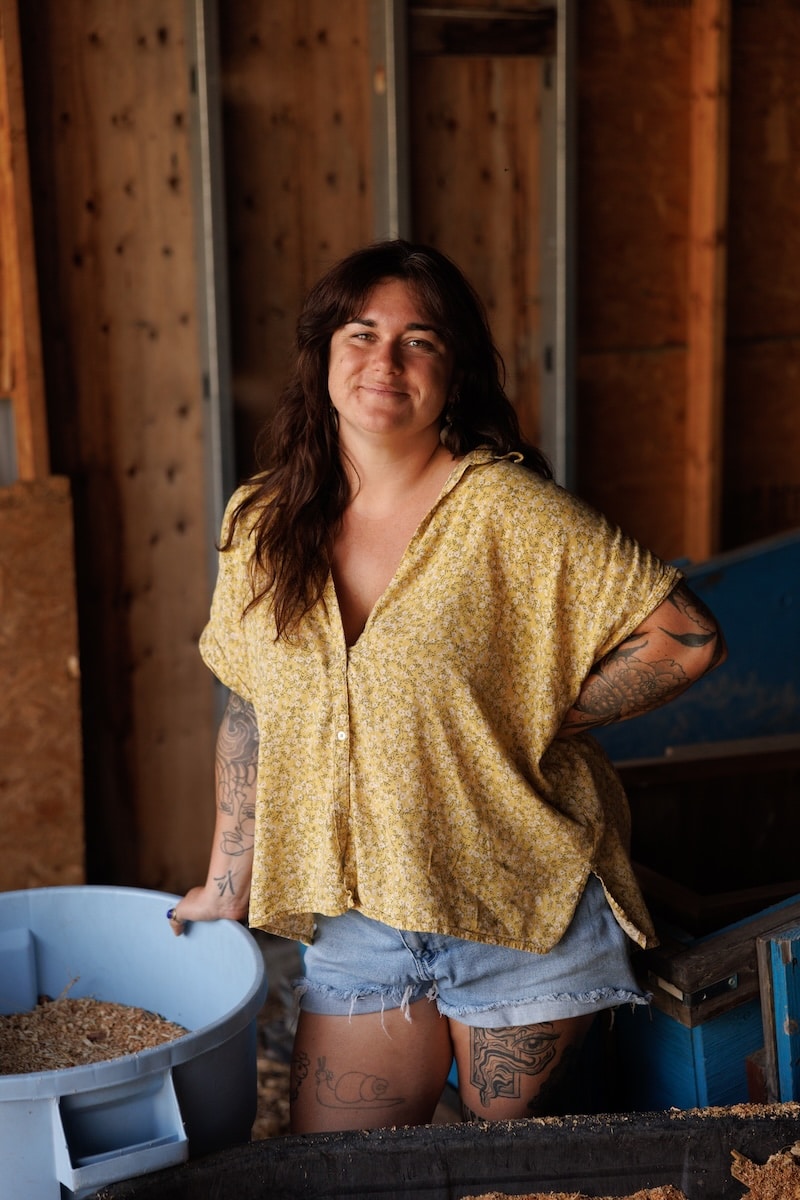
“We literally go through shovelful by shovelful,” she says. “We pick out every single item that would not break down in our pile, whether it is those compostable bioplastics, or some folks will accidentally throw in metal cans, and we’re always seeing metal spoons for some reason, too. Produce stickers are the bane of my existence. A lot of it is just picking off produce stickers.”
Offloading what they can’t process has always been part of Soil Cycle’s model. What changed in 2023 was pressure from neighboring residents and businesses over the smell from the open hot piles of the thermophilic process. Unable to find a second location at the time, the organization made the call to abandon thermophilic hand-turning at First Street. To maintain capacity, they arranged for Missoula Compost to pick up the excess scraps their vermiculture and Earth Tub systems couldn’t handle, and deposit them into the city’s large composting facility, Garden City Compost.
That’s the arrangement the Redditor stumbled onto two years later. Faced with losing thermophilic composting at First Street, Soil Cycle had a choice: stay nearly all human-powered and reduce the amount they could accept, or lean on Missoula Compost’s capacity to keep every member’s scraps out of the landfill while they hunted for a new location. They chose the latter.
That search ended this year, when Soil Cycle finalized a lease with Tower Gardens, allowing them to restart thermophilic composting and return the vast majority of their process to human power. It was one of Nolin’s top priorities since taking over as executive director.

“Yeah, we can’t process every single little thing that we get, but we can probably process 99 percent of it and only have to use [outside processes] for that small bit,” she says. “We are so grateful for our collaboration with [Missoula Compost], but our missions are just a bit different. It was important to me that we take back our own means of production.”
Missoula Compost and facilities like Garden City Compost matter, she adds, but Soil Cycle provides something different.
“There is also a reason that we exist, and that’s to complement those systems with another option that is more similar to a natural cycle of food and waste.”
Now at its new location, Soil Cycle is focused on fundraising to repair or replace their small fleet of two e-bikes, increasing the frequency of soil give-backs to members, and expanding school programming. The goal of doing it with as much human-powered energy as possible continues.
As for the produce stickers? Well, a solution for that may take more time.